Roy Louis Christian Walsted, the son of Jens and Kathrine (Christensen) Walsted, was just six years old in 1917 when a wave of infantile paralysis, or polio, swept his hometown of Sioux City, Iowa. He became seriously ill; although the details of his experience are not known, polio can cause flu-like symptoms and, in serious cases, muscle weakness and paralysis that can lead to death. Indeed, several deaths had been reported locally—and many more across the state—by the time the Sioux City Journal printed news of Roy’s anticipated recovery:
SICK AND INJURED | Roy Walstead, 6-year-old son of Mr. and Mrs. James Walstead, 406 South Helen avenue, Morningside, is expected to recover completely from an attack of infantile paralysis, according to the attending physician. The boy is able to walk alone now and in six months he is expected to have recovered entirely. If recovery is complete it will constitute one of the few cases on record, according to the physician.
Sioux City Journal, 14 September 1917
Roy did recover from his bout of polio, although not completely. His left leg was left shorter than his right, resulting in a lifelong limp, and it has been said that his younger brother—who was born just two months after Roy’s illness was reported in the newspaper—was his defender when he faced bullies. While his impaired gait may have discouraged him from athletic pursuits, local news clippings point to other activities that occupied Roy’s leisure time. In 1925, as he entered his teen years, he was a member of Boy Scouts, and he must also have been devoted to his studies as he made the honor roll at East Junior High School in Sioux City that same year. The following year, when Roy was fourteen, he moved with his family to the Logan Square neighborhood of Chicago where his paternal uncle lived. Roy was confirmed at the Gethsemane Danish Evangelical Lutheran Church, located at 2624 Fairfield Avenue, in June of 1926, when he was fifteen, and he most likely completed his second year of high school the following year before entering the workforce.
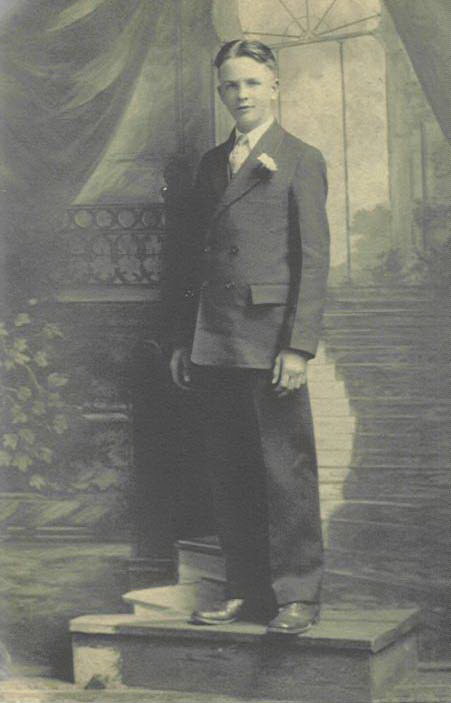
Roy Louis Christian Walsted, confirmation, Chicago, Cook, Illinois, 1926; digital image ca. 2010, privately held by Melanie Frick.
By the time he was eighteen, Roy had returned to his native Sioux City while his parents and younger brother remained in Chicago. He at first boarded with relatives and within a few years worked his way up from being an office boy at a hardware store to a clerk at the Sioux City Gas & Electric Company. In his spare time, he was active in the Young People’s Society of Our Savior’s Lutheran Church, which conducted its services in Danish, and a 1930 newspaper account reported that he hosted his fellow young congregants at his home at 900 Morningside Avenue. In 1932, as a member of the Sioux City Youth Council, he acted in a biblical drama entitled The Prodigal Son. This was not his only performance that year: he also sang the solo “I Love You Truly” at the twenty-fifth wedding anniversary of his maternal aunt and uncle in Storm Lake, Iowa.
The only sport that Roy was known to have dabbled in as a young man was golf, his name appearing as a participant in a few casual tournaments involving employees of the Sioux City Gas & Electric Company throughout the 1930s. When the time came for him to register for the draft in 1940, the draft card reported that Roy, who was slight of build at five feet eight inches and one hundred twenty-five pounds, had the identifying characteristic of “left leg shorter than right due to Infantile Paralysis.”
Roy married Frances Marie Noehl on 17 January 1934, and their first of seven children was born in Sioux City the following year. Polio outbreaks continued to recur, with nearly one thousand cases reported in Iowa in 1940 and a dramatic peak in 1952 when Iowa saw 3,500 cases, a quarter of which were in Sioux City. Roy and Frances had just welcomed their youngest child in February of that year and they must have been terribly afraid that one or more of their children would be taken ill. Doctors, nurses, and iron lungs were flown to Sioux City in the midst of the outbreak, one of the worst in the nation, and 16,500 children there were part of a gamma globulin vaccine trial that ultimately offered only short-term protection against polio.
However, hope was on the horizon. In 1954, the Salk vaccine trial took place and was deemed a success, and in 1955 the vaccine was made available to the public. The Walsted children were vaccinated at a clinic held at St. Boniface Catholic Church, and fears were finally alleviated.
Jordan Stilley was a southern Illinois settler of the early nineteenth century who had a family of twelve children. His name appears on only a smattering of records, and at a time and place where efforts to keep vital records were scant if not entirely nonexistent, developing a picture of his life is not unlike attempting to assemble a jigsaw puzzle with only a few of the pieces available.
Born in either 1797 or 1799 in Hyde County, North Carolina, Jordan Stilley was one of nine known children of Hezekiah Stilley and Sarah Davis. No record exists of Jordan’s birth, and no record has been located that documents the marriage of his parents; this information has been pieced together thanks to transcriptions of a faded nineteenth-century family Bible by the late genealogist Peggy (Stilley) Morgan, the 1802 will of Jordan’s maternal grandfather, and early census records.
Jordan likely made his first appearance in federal records as a tick mark in the 1800 United States census. Hezekiah Stilley was recorded as the head of a household of eight individuals in Hyde County, North Carolina that included a male and a female between the ages of 26-44, two males between the ages of 10-15, three males under the age of 10 (one, presumably, being Jordan), and one female under the age of 10.
Before Jordan was ten years old, he had trekked eight hundred miles west with his parents and siblings as well as members of his extended family. Their destination was the Illinois Territory, and it was there that his father’s name appeared on a petition for three hundred and twenty acres of land in what is now Cave-in-Rock Township, Hardin County, Illinois. This petition indicated that Hezekiah, among others, had been squatting there prior to a legislative act which took place on 03 March 1807.
Cave-in-Rock, located on the Ohio River, would have been a rough place for a child to grow up, as it was known at the time as a hotbed of river pirates, outlaws, and highwaymen. In the winter of 1811-1812, when Jordan was twelve years old, he would have felt the rumblings of the New Madrid earthquakes, the epicenter one hundred-some miles away. Did his family’s frontier home survive, or was destruction such that they were forced to rebuild or relocate?
“The Great Earthquake at New Madrid,” ca. 1877, woodcut, artist unknown; Wikimedia Commons.
In December of 1812, Jordan’s eldest brothers—Davis, John, and Stephen, all of whom were over the age of twenty-one—are believed to have signed a petition put forth by residents of the Big Creek Settlement in Illinois Territory. Jordan’s father’s name was not included on this petition; if he were still living, which he may not have been, he would have been around fifty years of age at this time.
Jordan Stilley made his first appearance in the United States census by name in 1820 as “Jourdan Stilly,” head of a household in the area of Frankfort, Franklin County, Illinois that included one male and one female between the ages of 16-25 and one female under the age of 10. The age of the adults and presence of only one young child suggests that Jordan was relatively recently married, and it is notable that he was enumerated next to the household of his brother Davis Stilley. Also notable is the presence of both a William Farris and a John Farris in Franklin County. Although the county’s marriage records are incomplete, it is believed that Jordan Stilley married Phoebe Farris here circa 1818.
According to recent research, Phoebe Farris, whose name is known only from the obituary and cemetery records of her youngest daughter, appears to have been the daughter of Virginia-native William Farris and his presumed wife Mary “Polly” Bunnell. Genealogist George J. Farris has indicated that all of the children of brothers William Farris and John Farris have been identified with the notable exception of one daughter of William, who was acknowledged via tick mark in the 1810 United States census in Green County, Kentucky. This daughter would have been born between 1797-1800—and it now seems likely that this daughter was Phoebe, as she lived in the right place at the right time to have become the wife of Jordan Stilley. DNA connections between Farris/Bunnell and Stilley/Farris descendants tentatively support this relationship.
Jordan relocated with his family at least once again between 1820 and 1830, at which time he was enumerated in the United States census in Washington County, Illinois. His household now included one male and one female 30-39, two males under 5, one male 5-9, one female under 5, one female 5-9, and one female 10-14—a total of two adults and six children. His brothers Davis and Hezekiah resided nearby. Little is known about Jordan’s life in the next decade save for the fact that in January of 1838, there is record of his purchase of one bay mare, one yoke of oxen, one wagon, one sorrel mare, and one colt from his brother Davis Stilley, who operated a mill.
In 1840, Jordan remained in Washington County where he was enumerated in the United States census with a household that included one male and one female 40-49, one male under 5, one male 5-9, two males 10-14, one male 15-19, one female under 5, one female 5-9, one female 10-14, and one female 20-29. This equates to nine children at home; his two eldest daughters were known to have married before 1840 and were no longer living at home. The household of Mary Stilley, who was the widow of his brother Hezekiah, was recorded next on the census, and, according to The History of Washington County, Illinois, both Jordan and Mary were constituent members of the Concord Baptist Church at the time of its founding in 1841. The Baptist tradition was strong in the Stilley family; Jordan’s paternal uncle was Elder Stephen Stilley, who was a missionary and founder of the Big Creek Baptist Church, not far from Cave-in-Rock, in 1806.
Tragedy befell Jordan’s family when his son, also named Hezekiah, enlisted to serve in the Mexican-American War and died in Buena Vista, Mexico, in the spring of 1847. The following year, Jordan was involved in a bounty land transaction for one hundred and sixty acres of land in Pettis County, Missouri; this was due to the service of his late son, who died without wife or children, and confirms that “Jourdan Stilley” was “father and heir at law of Hezekiah Stilley deceased, late a Private in Capt. Coffey’s Compy. 2nd Regt. Illinois Vols.”
Jordan must have lost his wife Phoebe at some point between 1844-1850; their youngest child was born in 1844, and on 19 March 1850, Jordan married Malinda (White) Vaughn, a young widow who had a four-year-old child of her own. Oddly, Jordan and Malinda do not appear in the 1850 United States census with Jordan’s youngest children nor her young son, and some of Jordan’s children can be found living in the households of their adult siblings. Although no will has been located, it is believed that Jordan died circa 1854. It was in that year that Jordan’s apparently disabled daughter Sarah Ann—who was documented as being “idiotic” and “insane” in the 1860 and 1870 United States censuses—was entered into the guardianship of an older brother, and Jordan himself signed with an X. In 1857, Sarah Ann, “minor heir of Jordon Stilley,” was entered into the guardianship of Ebenezer Davis of Washington County, Illinois.
Based on research by genealogists William D. Stilley and the late Dr. Bernard “Bud” Hall, as well as information compiled from census records, land records, newspapers, military pension files, and personal correspondence, the following twelve individuals are believed to be the children of Jordan Stilley and his first wife, Phoebe Farris:
Hester Ann (Stilley) Rogers, born about 1821, died before 1860
Hezekiah Stilley, born about 1823, died 19 April 1847
William J. Stilley, born about 1825, died about 1857
Robert M. Stilley, born about 1827, died 1856
Mary A. (Stilley) West, born about 1829, died March 1870
Jeremiah Stilley, born about 1832, died 1876
Mary Jane (Stilley) Dennis, born 16 March 1835, died 31 October 1914
James Albertus Stilley, born 18 June 1837, died 15 December 1890
Sarah Ann Stilley, born about 1839, died after 1870
Isabelle (Stilley) Nicolay, born 23 September 1841, died 03 December 1905
Wilson Stilley, born 22 February 1844, died 18 February 1899
The birth order of the children is not set in stone due to the absence of birth dates of more than half; however, there is some evidence of common naming conventions having been followed, such as the potential eldest son being named for the paternal grandfather and the potential second eldest son being named for the maternal grandfather. In any case, it is not a linear process to establish familial relationships between individuals when there is an absence of vital records, and the twelve inferred children of Jordan Stilley make for a particularly tangled web.
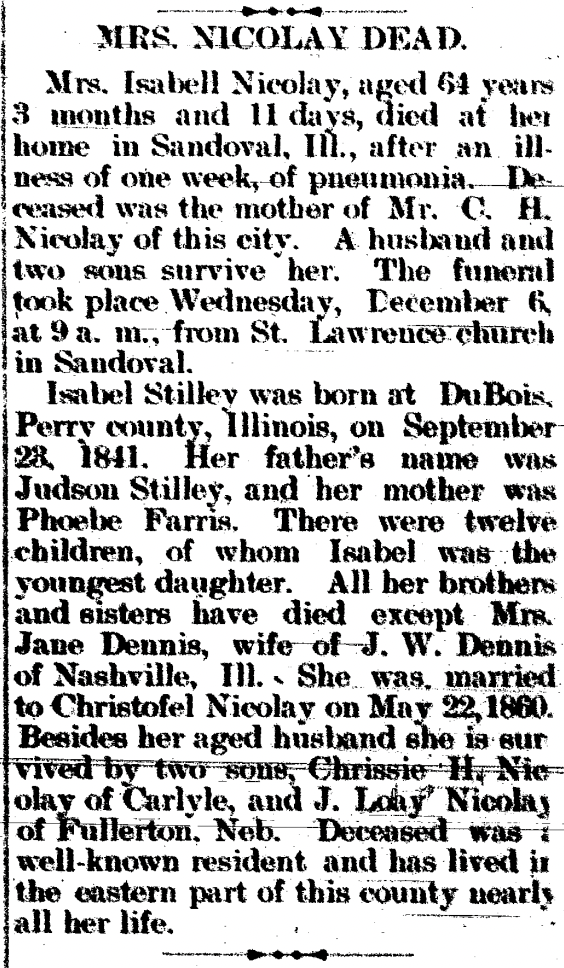
The most definitive piece of evidence regarding the Stilley family structure is a 1905 obituary of Isabelle (Stilley) Nicolay which names her as the youngest daughter of the twelve children of “Judson Stilley and Phoebe Farris” and as a sister of Mary Jane (Stilley) Dennis. However, a Marion County, Illinois cemetery index lists Isabelle’s parents as Jordan Stilley and Phoebe Farris. Considering the lack of evidence of the existence of a Judson Stilley in southern Illinois in the nineteenth century, it stands to reason that the name Judson was printed in her obituary in error and should have been Jordan.
“Mrs. Nicolay Dead,” Carlyle [Illinois] Constitution, 08 December 1905; digital image, Abraham Lincoln Presidential Library (https://presidentlincoln.illinois.gov/ : accessed 17 July 2019).
Another striking piece of evidence is a handwritten letter from a son of Wilson Stilley to his first cousin, a son of Nancy (Stilley) Hall, after Wilson’s death in 1899, which establishes that Nancy and Wilson were brother and sister, and that “Aunt Bell” (Isabelle), “Aunt Jane” (Mary Jane), and “Uncle Jerry” (Jeremiah) were their siblings as well. Some of these connections are also supported through the obituaries of both Wilson Stilley and Nancy (Stilley) Hall, which link them as siblings of Mary Jane (Stilley) Dennis, as well as through newspaper social columns, which connect Nancy, Mary Jane, and Isabelle as sisters. In those it was noted that Isabelle (Stilley) Nicolay visited “her sister” Nancy (Stilley) Hall in Saline County, Kansas in 1890 and 1892, as well as “her sister” Mary Jane (Stilley) Dennis in Washington County, Illinois in 1903.
Federal records also provide clues. The aforementioned 1848 bounty land record confirms that Hezekiah Stilley, who died while serving in the Mexican-American War, was the son of “Jourdan Stilley.” The Civil War pension files of both Wilson Stilley and James Albertus Stilley include handwritten depositions that link Wilson, James, Isabelle (Stilley) Nicolay, and Hester (Stilley) Rogers as siblings.
In addition, an 1854 Washington County, Illinois guardians’ bond held at the Illinois Regional Archives Depository at Southern Illinois University places Sarah A. Stilley, a minor, into the guardianship of William J. Stilley, presumably her brother, in a document signed also by “Jorden Stilley” and witnessed by Robert West, presumably the husband of her sister Mary A. Stilley. An 1857 court record from the same county names Sarah Ann Stilley as a “minor heir of Jordon [sic] Stilley, late of said county, deceased.”
It is highly unlikely that a singular smoking gun, so to speak, that clearly defines the relationships between Jordan Stilley, his wife, and all of his children, will ever be revealed, due to both scant documentation and an 1843 fire at the Franklin County, Illinois courthouse that destroyed many early records. However, their story has been slowly but surely puzzled together through a range of sources and an understanding of the norms of the time that make it possible to infer relationships with a reasonable level of confidence. To have raised twelve children to adulthood on the Illinois frontier was no small feat, and Jordan and Phoebe (Farris) Stilley, though their graves are unmarked and the details of their stories lost to time, are worth remembering.
Timothée Adam was only a year old when he lost his father. Born to Charles Pierre Adam and Marie Marguerite Saint Michel on 02 April 1816 in Beloeil, Quebec, he was baptized as Joseph Timothée Adam and was the seventh of eight children born to the couple; his younger sister was born just two weeks after their father’s death in August of 1817. Their mother, who had married at sixteen, was now a widow at the age of thirty, and considering how many small mouths she had to feed, it is not at all surprising that she remarried the following summer.
Although little is known about Marie Marguerite’s second husband, Louis Amable Pineau, after several generations had passed an oral tradition remained that the surname Pineau was somehow linked to the Adam line. Marie Marguerite had no children with Louis, who was ten years her junior, but he was the only father that the youngest of her children would have ever known. Her children would also have known her parents, their grandparents Joseph Michel and Marie Josephe Patenaude, as they spent their later years living in the same parish as Marie Marguerite and her family. Perhaps Joseph, who was born in exile in Massachusetts in 1757 following Le Grand Dérangement, the tragic expulsion of the French-speaking Acadians of Nova Scotia by the British, shared stories of his origins and the family’s eventual return to Canada—or perhaps not.
Timothée married Marguerite Chicoine in Saint-Marc-sur-Richelieu, a village just north of Beloeil on the Richelieu River, on 24 October 1837, when he was twenty-one. The couple then moved approximately thirty miles east to the village of Saint-Pie, where Timothée supported his family as a cultivateur, or farmer. The couple’s first ten children (of an eventual sixteen) were born in Saint-Pie, and the family appeared in the census there in 1851. It was noted that they resided in a one-level home made of wood, although interestingly, not all of their children lived within their household. Two of their daughters, who were eight and two, were found with their grandmother in another household in the same community, although perhaps this was only a temporary arrangement.
A decade later, at the time of the 1861 census, Timothée and Marguerite shared their household with all of their minor children, while their two eldest daughters, both married and with children of their own, were enumerated directly before them in the census. All were recorded as residents of Rang Saint-Charles, a rural road that runs southeast of Saint-Pie and south of the Noire River. This was not far from Saint-Paul-d’Abbotsford, where several of their younger children were baptized.
View of Mont Yamaska from Grand Rang Saint-Charles, Saint-Pie, Quebec
By June of 1865, Timothée had relocated with his family to Massachusetts. One has to wonder whether he recognized the irony in returning to the same place where his grandfather had been born in exile—but what drew him and his family to Massachusetts, a little more than a century after Le Grand Dérangement, was almost certainly the cotton mills. Contemporary news accounts referenced, sometimes scathingly, the “hordes of French Canadians” who traveled by rail from the border crossing at St. Alban’s, Vermont, to Massachusetts, where entire families crowded into tenements and worked at the mills. Indeed, the 1865 Massachusetts State Census places Timothée, Marguerite, and their ten unmarried children, who were between the ages of three and twenty-one, in Ward 8 of Springfield, Hampden County, Massachusetts, where Timothée and the five eldest children were all employed at the Indian Orchard mill.
There may have been another driving factor that caused Timothée to uproot his entire family, however, and that was the potential threat of a military draft in Canada and associated unrest that presumably might have affected his eldest sons. A Massachusetts newspaper printed the following in January 1865: “There is quite a little rebellion in Canada now, and all about a militia draft for frontier service. The French Canadians at Quebec resisted the draft made upon them last week and drove away the officers. Four companies of the volunteer militia were immediately called out and the insurrection will be a short lived one.”
By the time of the 1870 U.S. census, Timothée, by then fifty-four and with nine children still in his immediate household, continued to reside in Indian Orchard but was without an occupation. His six eldest unmarried children, who were between the ages of twelve and twenty, were all millworkers, and their earnings no doubt supported the entire family. Incredibly, the grand total of individuals in Timothée and Marguerite’s multigenerational household, which included their married children and their own large families, numbered twenty-eight.
“View of Springfield, Massachusetts on the Connecticut River,” ca. 1840-1845, Thomas Chambers (1808-1869); oil on canvas, private collection, photographed while on loan to the Metropolitan Museum of Art, New York, New York; Wikimedia Commons.
Tragedy struck in 1878, when Timothée first lost two grandsons who drowned while fishing in the Chicopee River, and then lost his wife of forty years when Marguerite succumbed to consumption at the age of sixty-two. Timothée did not appear in the 1880 U.S. census, but city directories indicate that he resided at 83 Main in Indian Orchard. His unmarried children, ranging in age from fourteen to thirty, were enumerated together on Main Street; perhaps Timothée’s absence was an accidental omission, or perhaps he was traveling at the time that the census was recorded. It is known that he ventured to Dakota Territory a short time later, as he was documented as a parishioner at St. Peter’s Parish in what is now Jefferson, Union County, South Dakota in 1885, along with two of his adult sons and their families. The recent deaths of several family members, including two of Timothée’s adult children and multiple young grandchildren, may have spurred this move away from crowded tenement life.
Timothée is absent from the Springfield, Massachusetts city directories of 1885-1895. He makes a reappearance in 1896, boarding at 69 Main, Indian Orchard; this was the home of his daughter, Marie, and her husband, Gabriel Noel. Had Timothée spent the intervening years with his children in the Midwest?
On 19 March 1897, a newspaper in Sioux City, Woodbury County, Iowa, printed the following: “T. Adams, father of P.P. Adams of Davidson Bros., died while visiting relatives at Indian Orchard, Mass., at the age of 84 years.” Timothée would have been, in fact, eighty years old at the time, but this was not the only misprint regarding his death.
The death register for the city of Springfield, Massachusetts, which encompassed Indian Orchard, does not have a record of the death of any individual by the name of Timothée Adam at that time—but it does name one “Mathieu A. Adam,” son of Pierre Adam of Canada, who was reportedly eighty years, ten months, and seventeen days at the time of his death on 09 March 1897.
The dates are close enough that they might be considered a mathematical error—Timothée would have reached the age of eighty years, eleven months, and seven days at the time of his death. His father’s middle name had been Pierre, and it’s quite possible that that is how he was more commonly known. But “Mathieu”? One guess is that entries on the death register were recorded based on other handwritten records or notes, and that a scrawled “Timothée” was mis-transcribed as “Mathieu,” another French name with a “th” in the middle. His cause of death was attributed to “Old age: Indigestion,” and Timothée’s grave, presumably near that of his wife at the Saint Aloysius Cemetery in Indian Orchard, is unmarked.
His will, filed in Springfield in March of 1896, a year prior to his death, is succinct in regards to his wishes and suggests that he may have spent extended time in the care of his second-eldest daughter Marie:
“After the payment of my just debts and funeral charges, I bequeath and devise as follows. First: To my daughter Mary Noel wife of Gabriel Noel of said Springfield, all the estate both real and personal of which I shall die seized and possessed and to which I shall be entitled at the time of my decease. I purposely give no bequest or devise in this will to my only living children, or the issue of any deceased child, having provided for them in my lifetime and I exclude them and their issue from any claim upon my estate of every nature and description. Second: I direct that my executrix hereinafter named expend the sum of Fifteen dollars for a high mass over my remains.”
Hampden County, Massachusetts Probate Records
So little is known of who Timothée Adam was as a person. He was a French Canadian by birth and an immigrant who may have faced contempt and discrimination in the United States due to his language, faith, and culture. He was a farmer and a millworker—but as his eldest surviving son was a carpenter, one can speculate that Timothée may also have possessed these skills. Two of his younger sons played the fiddle, and another sang; was Timothée musical as well? He was a lifelong Catholic, and desired that a portion of his (presumably not large) estate be set aside in order for him to receive a high mass upon his death. He was the father of sixteen known children, fourteen of whom survived to adulthood, and the names of his eldest sons suggest strong familial bonds: Timothée, Louis (like his stepfather), Joseph (like his maternal grandfather), Pierre (like his father and paternal grandfather). Notable too is the name of his youngest son, the only one of his children born outside of Canada: Prosper, named perhaps in recognition of Timothée’s hopes for his family to flourish in a new home.
Eleven years ago, when I first wrote about the accidental death of Kansas pioneer George W. Fenton, the number of historic newspapers that were readily available to search online was still relatively slim. I was aware that George’s death had made the news—but at that time, I was not yet aware that several differing accounts of the incident had circulated, nor that the news had spread throughout Kansas and beyond.
George W. Fenton—a son of English immigrants who was orphaned at the age of ten when his father perished in the Civil War—had overcome his difficult childhood in Ohio and Illinois and settled down to a farmer’s life near Gypsum Creek in Saline County, Kansas. He had been married for seven years and was the father of three young daughters when, at the age of twenty-eight, he was accidentally shot and killed by his brother-in-law.
As it turned out, George had had another brush with misfortune with a firearm only days before his death. On 02 October 1880, the Salina Herald reported: “Mr. George Fenton had his eyes badly burned by the premature discharge of a gun last week. He is now able to see out of one of them, and hopes they are not seriously injured.”
Perhaps George was still taking things easy on the afternoon of Sunday, 10 October 1880, when he and his family visited at the homestead of his mother-in-law, Nancy (Stilley) Hall. However, that is when tragedy struck. The following Thursday, the Saline County Journal reported:
A Sad Accident. A very painful accident happened last Saturday which resulted in the death of George Fenton, of Gypsum creek. Mr. Fenton with his family was upon a visit to his mother-in-law, who resides about eighteen miles south-east of town, and with whom was residing “Bud” Hall, her son and brother-in-law of Mr. Fenton. During the afternoon while those two persons were engaged in some boyish pranks, Hall playfully presented a shot gun at Fenton (which Hall supposed was unloaded), cocked it and snapped the hammer. A charge of shot was lodged in Fenton’s breast, which proved his death wound. He lived for only an hour after the shot. He leaves a wife and three children. How the charge came in the gun is a mystery, as everybody about the house supposed the gun to be unloaded. Hall is nearly distracted over the result of his carelessness. The brothers-in-law were the best of friends—no trouble ever having occurred between them. The occurrence was so clearly a case of accidental shooting that no coroner’s jury was summoned. Mr. Frank Wilkeson came to town for surgical aid and Dr. Switzer hastened quickly to the scene of the accident, but arrived after Fenton’s death. The moral to be drawn from the careless habit of handling “unloaded guns” is too plain to be commented upon here. Will people never learn better?
The Saline County Journal, 14 October 1880
On the same day that the news was first reported in The Saline County Journal, the McPherson Republican printed the following:
Again we are called upon to listen to the sad results of carelessness with fire-arms. On Sunday, October 10, in the south-eastern part of Saline county, Mr. George Fenton was accidentally shot by his brother-in-law, Bud Hall. They were both playing with the children, little dreaming of the great calamity that was about to befall one of them. Mr. Hall wishing his gun, reached through the door, and not looking at what he was taking in his hand, took hold of a gun that belonged to a person who was visiting him. Thinking it was his own gun and knowing that it was not loaded, he drew it towards him more carelessly than he would have done had he known it was not his own gun. The hammer of the gun struck against the door side and discharged it; the shot striking Mr. Fenton in the left breast and ranging upward lodged under the shoulder blade. Mr. Andrew Sloop, who had passed a moment before, was called back, and sent post haste to Roxbury for a physician. Doctor Zawadsky hastened at the call, but it was of no avail. The results were fatal, he having expired about one and a half hours after the accident, and before the Doctor arrived. Mr. Fenton leaves a wife and three children to mourn his sad loss. Mr. Hall is almost crazed, and does nothing but rave and call with endearing entreaties to the departed one. All the neighbors sympathize with the distressed family, as they show by their willing assistance. – E. October 11, 1880
McPherson Republican, 14 October 1880
Perhaps Bud had not, in fact, been so cavalier as to actually point a gun at George. The McPherson Republican account eliminates some of the blame he might otherwise have assumed by explaining that the gun—which belonged not to Bud but to an unnamed visitor—discharged accidentally when Bud reached for it behind a door. The account also informs us that medical assistance was sought not only by Frank Wilkeson, who went for Dr. Switzer of Salina, but also by Andrew Sloop, who fetched Dr. Zawadsky of Roxbury. However, both physicians arrived after George’s death, which was said to have occurred either one or one and a half hours after he was shot.
The following day, The Canton Monitor printed the following version of the events:
“We are informed by Mr. Banks, of Roxbury, that an accident occurred about five miles north of that place, by which Mr. George Fenton lost his life. The way it happened was this: Mr. Hall, a brother-in-law of Mr. Fenton, went to see him, Fenton, last Sunday. Mr. Hall was sitting in the door watching the children playing with the dogs, when he told one of them, jokingly, that he would shoot his dog, and at the same time reaching behind the door to get a shotgun, where two were standing. As he was taking one, the hammer of the gun caught some way, causing it to go off, the charge striking Mr. Fenton in the breast, killing him almost instantly. The shooting was entirely accidental, as they were the best of friends. Mr. Hall has went crazy from the accident, thus leaving two families as good as fatherless.
The Canton Monitor, 15 October 1880
This account contradicts the first in that it suggests that Bud was visiting George, when in fact The Saline County Journal was most likely correct that George was at the home of his mother-in-law, which is where Bud also resided with his family. (Frank Wilkeson, who went for the doctor, was a neighbor of the Halls.) This account also states that George died almost instantly, which is unlikely as otherwise there would have been no call to send for a doctor. However, The Canton Monitor does give a very specific and perhaps more believable account of what initiated the chain of events that resulted in George’s death. Like in the McPherson Republican, it is indicated that George and Bud were playing with the children at the time of the accident, but The Canton Monitor goes on to say that Bud was joking with the children that he would shoot his dog. (At a time when “mad dogs” were a more commonplace concern and livestock needed to be protected, this joke may have come across as slightly less alarming than it would to a modern audience!) Furthermore, the account agrees with the McPherson Republican that there was more than one gun standing behind the door, and that the hammer of the gun was caught in a way that caused it to unintentionally fire in George’s direction.
The next day, the Salina Herald printed another account of the events of October 10, more closely following the version published in the McPherson Republican and The Canton Monitor:
Sad Accident. Another sad result from the careless handling of guns occurred on Gypsum last Sunday. It appears that Geo. Fenton, living on the west branch of Gypsum creek went over to visit his mother-in-law, Mrs. Nancy Hall, who lived a short distance from him. While there himself and brother-in-law Bud. Hall were talking of hunting. Their gun was standing behind the door. Bud. Hall reached for it to shoot a dog, when the hammer caught in some way, and discharged the load in Fenton’s breast just above the heart. Mr. Wilkinson being near was informed and immediately came in for a physician, but whose service were too late, as Fenton lived only about an hour. The shooting was purely accidental, the thing to be condemned being the careless handling of firearms. Death often appears to be no warning, and almost daily is recorded sad accidents like this. Geo. Fenton was 27 years old and leaves a wife and three children to mourn his loss. He was buried Monday in McQuary’s graveyard on Gypsum Creek.
Salina Herald, 16 October 1880
The same edition of the Salina Herald also noted the following:
Mr. George Fenton, who was killed on Sunday last by the accidental discharge of a gun, was buried on Tuesday. There was a large attendance at the funeral and much sympathy expressed for the widow and her three children so suddenly bereaved of a husband and father. This adds one more instance of the criminal folly of playing with fire arms under any circumstance. Guns and [sic] playthings, but very serious matter of fact implements that carry death and destruction in their path whether accidentally or intentionally used.
Salina Herald, 16 October 1880
News of George’s death reached the Topeka papers before the end of October, and in November, it was reported in Wichita as well as in the Daily Illinois State Register in Springfield, Illinois: “George Fenton, a former resident of Buckeye Prairie, late of Saline county, Kansas, was accidentally shot and killed last week through the criminal carelessness of a a brother-in-law, who snapped a gun at him, not knowing that it was loaded.”
Elithan Davis “Bud” Hall with grandson Armond Beetch, Enid, Oklahoma Territory, circa 1905; digital image 2019, privately held by Iva Foster, 2024.
Elithan Davis “Bud” Hall did apparently recover from the grief and guilt he experienced at the loss of his brother-in-law and close friend. He went on to raise a family a family of four children and lived out his life on the Hall Homestead in Gypsum. A photograph of him as an older man with a grandchild by his side shows him with a kindly expression, and the laughter lines around his eyes make it easy to imagine him as a good-natured, fun-loving young man whose attempt at a joke went awry.
However, George’s young widow, Sarah, may never have fully recovered from the trauma of the loss of the young man she had married at the age of sixteen. Just twenty-three when she was widowed, she would remarry not once but three more times, with each marriage ending in divorce.
It is interesting that no account makes clear whose gun it was that was left loaded. A final report of the inquest held stated the following:
On Oct. 10, 1880, justice of the peace E.W. Mering was summoned to the home of E.D. Hall “near Frank Welkeson’s farm” to ascertain the circumstances stances of a man’s death. In the event that the county coroner could not attend an investigation (which turned out to be the case), Mering named six citizens to serve as jury: John C. Fahring, John M. Crumrine, Simeon Ellis, Jerome Swisher, D.C. Williams and M.M. Root.
The next day when the inquest was held at the Hall place, Mehring subpoenaed the following witnesses: W. C. Jackson, Alonzo Gosso, Mrs. William Stahl, Mrs. E.D. Hall, Elisha Davidson and James Gaultney. All appeared to testify except Elisha Davidson, who was sick.
Witnesses revealed that George Fenton was shot in the chest by a double barreled shotgun at two in the afternoon of the previous day. The gun had been in the hands of E.D. Hall, Fenton’s brother-in-law. The shooting was ruled accidental.
Whether the double barreled shotgun in question belonged to Bud, George, or one of the witnesses—other neighbors and close kin—who were present at the Hall home that October afternoon is ultimately unknown, but as the gun was in Bud’s hands, he bore full responsibility for the accident.
It was a chilly January night in 1905 when a group of six young people set out on a sleighing party, traversing the thirteen miles from Center to Bloomfield in northeastern Nebraska. The Bloomfield Monitor reported:
A jolly sleighing party from Center, composed of Mr. and Mrs. Geo. A. Neilson, Mr. and Mrs. C.A. Saunders, Miss Maud Walton and O.A. Danielson took in the “Adventures of Fra Diavolo” at the opera house in Bloomfield last Saturday night. After the play, they, in company with the Misses Neff, Peterson and Lee of the Bloomfield schools, and Miss Dunham, were invited to the hospitable and commodious home of Mr. and Mrs. W. B. Frymire, where they were regaled with oyster stews and entertained with music until the wee sma’ hour when the Center people started for home, all vowing that Bloomfield is not so worse and that Mr. and Mrs. Frymire are the best.
Bloomfield Monitor, Bloomfield, Nebraska, 26 January 1905
George A. Neilson had married Anna Leota Fenton three years prior, and both were twenty-four years old at the time of this particular sleighing party. Their son, Fenton, would celebrate his second birthday just a few days later, on January 26, and he was undoubtedly left in the care of a neighbor or his visiting grandmother while his parents were out, a nighttime outing on the snowy plains not being at all suitable for a toddler! George had managed the Edwards and Bradford Lumber Company in Center ever since his marriage, and as he was known to be an affable and outgoing young man, it is no surprise that he and his wife had a lively circle of friends.
Anna Leota (Fenton) Thoma and George Hiram Thoma, alias George A. Neilson, circa 1900-1905; digital images 2010, privately held by Melanie Frick, 2024. Composite image created by the author.
Notably, however, George A. Neilson was not his real name. Born George Hiram Thoma, son of Fred and Matilda (Hammond) Thoma of Clayton County, Iowa, George is believed to have initiated the use of an assumed name around the year 1900. He is thought to have left his home in northeastern Iowa in 1899, and as of June 1900, he can be found recorded in the U.S. Federal Census of Belden, Cedar County, Nebraska, as George Thoma. Employed as a clerk, he boarded with the family of Charles and Anna Nelson, who were Swedish immigrants, along with a number of other young men between the ages of eighteen and thirty-two: William Reynolds, Morris Nielsen, Thomas Caverhill, William Graham, Arthur Knapp, Albert Brodbrochs, Edgar Stevenson, and Ed Evans. However, a January 1901 news clipping tentatively presumed to refer to him and one of his fellow boarders uses the surname Neilson:
George Neilson and Art Knapp of Belden attended a party in Coleridge Friday evening.
The Coleridge Blade, Coleridge, Nebraska, 24 January 1901
At the time of his marriage in March 1902, which took place in northwestern Iowa, George presented himself officially as George A. Neilson. Decades later, affidavits from George, his mother, and his brother attested that this was an assumed name and that George Hiram Thoma and George A. Neilson were one and the same person. A marriage announcement used the name George Neilson as well and noted an impending move to Nebraska:
George Neilson and Miss Ota Fenton were married Sunday afternoon at the home of the bride’s mother, Mrs. John Hoffman, Rev. Fegtley officiating. Mr. Neilson has been an able assistant in the Edwards & Bradford Lumber Co. for some time past and is a worthy young man. The bride has lived in Ashton for a number of years and needs no introduction. The many friends join in wishing them many happy years of wedded life. Mr. Neilson expects soon to be moved to Nebraska where he will have charge of a lumber yard for the above named firm.
The Sibley Gazette, Sibley, Iowa, 27 March 1902
This move was to Center, where George immediately began placing newspaper advertisements for the Edwards & Bradford Lumber Company under the name George Neilson. He continued to use this alias until at least 1908, through several more moves; by 1909, when he applied for a homestead in western Nebraska, he had reverted to the use of his original name. No reason has yet been uncovered for George’s use of an alias, although it appears to have emerged sometime between June 1900 and January 1901 during his residence in Belden—or perhaps prior, if by chance he had shared his true name with the census enumerator in private.
“Beggar Prince Comic Opera Co. ‘Fra Diavolo,'” Bloomfield Monitor, 12 January 1905; wspapers.com (www.newspapers.com : accessed 25 January 2024).
As he squeezed into a crowded sleigh on the wintry evening of January 21, 1905, however, any secrets that George may have suppressed were likely at the back of his mind. Along with Leota and their group of friends, he enjoyed a play performed at Bloomfield’s opera house by a traveling theater troupe, followed by oyster stew, music, and good company at the home of the owner of a prosperous local hardware store. As night crept on to morning, it was time for the sleighing party to make their return trip to Center, and, just a month or so later, George and Leota—still, at that time, Neilsons—bade their friends a fond farewell as they moved on to the eastern Nebraska town of Newcastle.
Hedwig Cichos—Hattie to those who knew her—was first widowed at the age of thirty-one. Her husband of twelve years, Joseph Lutz, had succumbed to tuberculosis, leaving her with four young daughters to provide for on her own. The oldest was just ten and the youngest not yet three; with so many mouths to feed, it comes as little surprise that Hattie remarried before the year was out. On 29 December 1887, not quite eight months after Joseph’s death, Hattie married Albert Rindfleisch, a fellow Silesian immigrant who was more than five years her junior.
Albert and Hattie made their home in Minnesota Lake, Faribault County, Minnesota, the same village where Hattie had settled with her parents when she had immigrated to America in 1873. In the years to come, Hattie would have five children with Albert: Edward in 1888, Agnes in 1890, Albert (II) in 1892, Elsie in 1893, and Frank in 1895. The 1895 Minnesota state census, recorded before Frank’s birth, indicates that only the youngest of Hattie’s daughters from her first marriage, Melanie, eleven, still lived under her roof. Her eldest daughter, Julia, had married at the age of sixteen in 1893 and moved out of state; the whereabouts of her middle daughters, Anna and Hattie (II), for the year 1895 are unknown. According to the census, Albert was a laborer and had worked for eight months of the previous year.
In the summer of 1899, everything changed for the Rindfleisch family. First, charged with “whipping his wife,” Albert, then thirty-eight, was jailed at the county seat of Blue Earth. He somehow managed to escape the sheriff, board a train, and travel one hundred miles west—but then his luck ran out. The Slayton Gazette and Murray County Pioneer reported:
Run Over by the Cars. Albert Rindfleisch, of Minnesota Lake, was run over by the west bound freight at this place Tuesday morning and had both legs taken off below the knee. He boarded the train here intending to go to either Hadley or Lake Wilson, and as the train pulled out he was standing alone on the front end of the accommodations car. He claims the cars gave a bump and he was thrown forward. He fell between the cars with both legs across the north rail and his body north of the track. The accommodation car passed over his legs and he was not seen by the train men. His cries attracted passersby and he was taken to the depot and from there to the poor house to be cared for. Dr. Morell, the railway physician, assisted by Dr. Lowe, amputated both his legs, one just above the ankle and the other just below the knee. A bottle containing a small amount of whiskey was found near him when picked up. He had thrown it away so as not to have it on his person. This has given rise to the suspicion that he may have been under the influence of liquor at the time of the accident. He claimed to have been looking for work. He has a wife and five children at Minnesota Lake.
Slayton Gazette and Murray County Pioneer, 03 August 1899
Two months later, the same newspaper provided an update:
Sandy McDonald, sheriff of Faribault county, was here last Saturday and took back with him Albert Rindfleisch who had been an inmate of our poorhouse since he had his legs taken off by the cars here two months ago. Rindfleisch was in jail at Blue Earth for whipping his wife and escaped from the sheriff. While fleeing from the sheriff he had his legs taken off here.
Slayton Gazette and Murray County Pioneer, 12 October 1899
It is not known whether Albert ever returned home to Hattie and their children—or whether Hattie would have let him if he had tried—but when the U.S. census was recorded in the summer of 1900, Hattie was reported to be a widow. It is possible that she may have been known in her heavily German-speaking community as a Strohwitwer, a term with the English equivalent “grass widow” that indicated that a couple was separated or that the wife had been effectively abandoned. Albert and Hattie—both Catholic—never divorced, and Hattie was not in fact widowed for the second time for another thirty years.
While Hattie remained in Minnesota Lake, Albert made his way to Wisconsin. Milwaukee city directories indicate that he may have eked out a living as a peddler for a period of time, but ultimately, he spent many years at the Milwaukee County Infirmary, an almshouse and poor farm in neighboring Wauwatosa. The 1920 and 1930 U.S. censuses both indicated that he was an inmate there, although whether alcoholism or the loss of his legs was the primary factor that brought him to this last resort for food and shelter is unknown. His final days were apparently spent in a rooming house in Milwaukee, as that is where he died on 08 May 1930:
Alcoholism, domestic violence, disability—all played a part in Albert’s sad demise, his death ultimately garnering a headline only as an oddity. Hattie, for all the hardships she may have suffered in an unhappy marriage and as a single mother, was resilient. She supported herself and her children as a seamstress and through her own self-sufficiency, keeping a milk cow, chickens, and pigs on three acres of land. Her grandchildren’s memories of her industrious nature and of her home cooking and preserving—ham, bacon, sausage, braunschweiger, pickled pigs feet, sauerkraut—long outlived her. Of Albert, however, little was ever said.
When immigrant Joseph Lutz died in 1887 the age of forty-two, only one line in a Minnesota newspaper made note of his death. His brother Paul, however, survived him by more than fifty years, and when he died in 1939 he was ninety-three years old. A lengthy obituary in a Minnesota newspaper documented his death, but what is more, his birthday several years prior had warranted an informative and colorful tribute to his life both in his native Sondersdorf, a village in eastern France, and in southern Minnesota. As Joseph and Paul, only two years apart in age, both served in the Franco-Prussian War and then immigrated to America, many of Paul’s recollections relate what must have been shared experiences.
The brothers were born to François Joseph Lutz (1801-1881) and Marguerite Meister (1801-1876), Joseph on 31 May 1844 and Paul on 07 August 1846, both in what is now Sondersdorf, Haut-Rhin, Alsace, France. Their father was a farmer, and this was his second marriage; their mother was a native of the nearby border village of Roggenburg, Switzerland. Joseph and Paul were raised to work hard, although they also had the opportunity to attend school, as related in the Blue Earth County Enterprise in 1935:
“Alsace Lorraine at that time belonged to France, as it does now, although for many years between it was Germany’s. And so young Paul was born a French citizen. His father was a farmer and when Paul was still very young he was put to work. How young? Well, he says, laughing, that he thinks he began to work before he was born. He worked in the field, in the town, anywhere where there was work to be had.
“French was taught in the schools, but his family, like many others in Alsace, spoke German at home. So he grew up with a knowledge of both tongues. However, today and for many years since, it is German that he speaks fluently. There are, he says, no Frenchmen around to give him practice in that language.”
In 1866, Joseph and Paul, by then twenty-two and twenty years of age, appeared in a census in a household in Sondersdorf with their parents and younger sister, Philomene. Just a few years later, the brothers served in the Franco-Prussian War, which broke out in the summer of 1870:
“Like every other French citizen, [Paul] entered military training when old enough. His memories of that period are clear and vivid, for while he was still in the army, the Franco-Prussian war broke out. That was in 1870 and one of the causes of the bitter enmity between France and Prussia was that same Alsace Lorraine where he was born, a strip of territory at the eastern edge of France coveted by both nations and snatched first by one, then the other. When Prussia whipped France in that war of 1870, she took Alsace Lorraine as one of the indemnities and from then on France never rested until the World War brought it back again to the French.
“There wasn’t so much to the war so far as he was concerned, says Mr. Lutz, except horse meat to eat and being taken prisoner at the battle of Metz. Asked how that happened, he drolly repied [sic] that the Germans took the whole army prisoner so of course he went along. Speaking of horse meat, Mr. Lutz remarked that it wouldn’t have been so bad had they been given some beer, or at least enough water to wash it down with. But there was none of the first and little enough of the second. To make it worse he says it was tough meat with no pepper or salt. You stuck two sticks up on each side of a fire and hung the meat on a third stick laid across. After it had toasted a bit, you ate it – if possible.
“Because Germany considered Alsace her own, and to gain the good will of its people, she released the French prisoners from Alsace earlier than others. That was in 1871. Between horse meat, fighting and being a prisoner, Mr. Lutz says he’d had enough […] and straightaway came to America.”
Although comparatively little is known about Joseph Lutz’s experiences, his grandson once related that after serving in the Franco-Prussian War and coming out on the losing side, Joseph immigrated to America because he wouldn’t live under Prussian rule. It seems the brothers were allied in their feelings after having fought and been imprisoned by the Prussians—and having been forced to survive on horse meat during the Siege of Metz, which has been documented. A passenger list has been located that may indicate that the brothers immigrated together, arriving in New York aboard the Nevada in May 1871, mere months after the war’s end.
Joseph Lutz (1844-1887), circa 1875-1885; digital image 2010, privately held by Melanie Frick, 2021.
Although the Blue Earth County Enterprise recorded in 1935 that Paul and his wife Josephine Lutz married in Sondersdorf and immigrated together, settling first near Burlington, Des Moines County, Iowa before making the move to Minnesota, records indicate that the couple actually married in Des Moines County, Iowa, in 1872. “Asked if they came by train to Burlington, Mr. Lutz chuckled and said, ‘Well, you needn’t think I walked.'” Perhaps the plan all along had been that Paul and Josephine would reunite and marry once in America and free of the strife of their homeland. Joseph, it seems, had not made any such promises to any young women from their home village; he instead married a Silesian immigrant, Hedwig Cichos, in Faribault County, Minnesota, in 1875.
The brothers’ paths diverged to a degree in Minnesota; Paul farmed, as their father had before him, whereas Joseph lived in town, making a living first as a butcher and then as a saloon keeper. Of farm life, the Blue Earth County Enterprise shared that Paul owned one hundred and twenty acres “two miles west of Bass Lake,” and noted, “Memories of early days in southern Minnesota come to [Paul] as he talks. He tells of hauling grain to Delavan and Easton in the winter, using oxen-drawn sleds. Many a time, he says, blizzards would spring up and there was nothing for it but to give the oxen their heads and trust them to find the way home. They never failed.” Of Joseph, the newspaper shared, “Joe Lutz, early Mapleton butcher, was [Paul’s] brother. His shop was on Second Street just back of where the Wiedman drug store stands today. The frame building that housed it is the same one that stands there still, says Mr. Lutz.”
Joseph was indeed known to have been a butcher in Mapleton in the early 1880s; in the 1870s, however, he had operated a one-story frame butcher shop in Minnesota Lake, behind which were rooms where his family lived. After his stint as a butcher in Mapleton, he returned to Minnesota Lake but this time kept a saloon. Family lore notes that Joseph was a generous-hearted man who was known to give away cuts of meat to new immigrants in his community—to the occasional dismay of his wife, who chided him that these newcomers would not even have a pot with which to cook the meat!
Joseph would succumb to tuberculosis not quite sixteen years after his arrival in America; it seems especially tragic that he was stricken with this disease as he might otherwise have enjoyed as many years as his brother. At the time of Paul’s eighty-ninth birthday, the Blue Earth County Enterprise wrote, “Paul Lutz feels much younger than his years. His mind is far keener toward what is going on in this world than that of many a younger man. Age has as yet brought little failing to his senses. His speech is filled with humor that indicates his cheery optimism and enjoyment of life. His hearing is good. He walks up town every day. He administrates for himself the affairs of the farm he owns near Bass Lake. Paul Lutz has enjoyed and is still enjoying a full life with a clear memory that is truly remarkable.”
Note: An updated post about this photograph, including a new date and additional identifications, was published in September 2021 and is available here.
A century ago, numerous grandchildren and great-grandchildren of the French Canadian blacksmith Leon Chicoine and his wife Marie Vary were in the habit of gathering annually for an extended family reunion at Riverside Park in Sioux City, Woodbury County, Iowa.
In the summer of 1925, the Sioux City Journal printed the following:
200 ATTEND FAMILY PICNIC AT RIVERSIDE
More than 200 members of the Chicoine family, residing in Sioux City and surrounding territory, held their annual picnic at Riverside park Sunday. Several hundred of the family, which is one of the pioneer families of this part of the country, are located in northwestern Iowa, southeastern South Dakota and northeastern Nebraska.
The majority of those who attended the picnic were from Sioux City, Jefferson, S.D., Elk Point, S.D., and Salix, Ia. The oldest member of the family present was Mrs. Philip Bernard, Sioux City, 70 years old, and the youngest was Rose Chicoine, 6-month-old daughter of Mr. and Mrs. Fedora Chicoine, of Jefferson. A basket dinner and a program of games and sports occupied the afternoon and evening.
The following year, a large group photograph—or rather several photographs pieced together—was taken at the family gathering, and featured just shy of one hundred and fifty individuals. The photograph is labeled Griebel Photo along with a street address; according to the 1926 Sioux City Directory, a Henry Griebel was indeed at that address, but his home and studio were elsewhere in 1925. Thus, the 1926 date provided for this photograph seems plausible—and the decade itself is undeniable when taking into account that the women almost uniformly have their hair bobbed! Riverside Park, the location of the reunion, was a popular summer gathering place along the Sioux River, offering swimming, boating, and other recreational activities. 1926 marked the final year that Riverside Park would host the popular Interstate Fair, and an amusement park would open there the following year.
Chicoine Family Reunion, Riverside Park, Sioux City, Woodbury County, Iowa, 1926; digital image 2021, courtesy of Jeanette Borich; privately held by Ken Chicoine, 2021.
There is, fortunately, a key for this photograph, with many thanks to the late Maurice Chicoine. However, it is incomplete and not without error. If you recognize any kin in the photograph, please feel free to comment so that the key can be confirmed and/or updated accordingly. The names from the original key are transcribed below:
Photo 1 Top Row: Agnes Chicoine, Emma Chicoine, Pauline Lambert, Elsie Montagne, Carrie Chicoine, Odile Chicoine, Luella Limoges Chicoine, Delia Brault, Albina Chicoine, Louise Ryan Chicoine, Edna Quintal Chicoine, Mrs. Alphonse Chicoine, Mrs. Bob Wyant, Mrs. Quintal
Photo 1 Middle Row: Alphonse Chicoine, Alex Chicoine, Denis Chicoine, Edgar Chicoine, Edmond Chicoine, Odias Chicoine, Elmer Chicoine, Leo Chicoine, Conrad Chicoine, Emil Chicoine
Photo 1 Front Row: Orville Chicoine, Ferdinand Chicoine, Donald Chicoine, …?, Ilian Bertrand, Wallace Chicoine, Theresa Chicoine, Doris Chicoine, Bernice Chicoine, Veronica Chicoine, Madonna Chicoine, Marc Chicoine, Hubert Chicoine
Photo 2 Top Row: Ora Quintal, Ella Quintal, Rose Montague, Martin Chicoine, Cora Chicoine, Marty …?, Martin Quintal, Adrian Chicoine, Leander Bertrand, Mrs. J. B. Fountain, Ruth Chicoine?, Aloysius Bourassa, Esther Bourassa, Laura Montagne Chicoine, Orise Montagne, Rachel Chicoine Dougherty holding Richard, Dalma Beaubien Montagne
Photo 2 Middle Row: Eugene Chicoine, Philip Bernard, Joe Montagne, Bert Crevier and baby, Fedora Chicoine, Leonard Chicoine, J. B. Fountain, William Chicoine?, T. D. Dougherty and child, Art Chicoine, Louis Beaubien, Clarence Montagne
Photo 2 Front Row: Claire Montagne, Madonna Chicoine, Gabriel Sirois, Oswald Montagne and child, Lucille Crevier, Maurice Chicoine
Photo 3 Top Row: Priest from Salix, Wiska Derauleau, Viola Montagne, Rosella Montagne, …?, Mr. Adams, Mrs. Adams, Sophia Menard, Mrs. Eugene Bosse, Joe Chicoine, Mrs. Joe Chicoine, Obeline Chicoine Lambert, Corrine Chicoine, Mayme Chicoine, Gertie Crevier Chicoine, Leona Chicoine Crevier, Yvone Morin Chicoine, Beatrice Chicoine, Rose Langle Chicoine, Arsenia Allard Chicoine
Photo 3 Middle Row: Joe Gregoire, Sylvester Montagne, Laurence and child, …?, Ernest Menard, Maxine Chicoine, Charlotte Crevier, …?
Photo 4 Top Row: Simone Sirois, Bertha Sirois, Genevieve Sirois, Happy Jauron with child, Mrs. Jauron, Delphine Chicoine, Irene Trudeau, Marie Perrault Chicoine, Amanda Chicoine, Regina Benjamin Chicoine, Elise Chicoine Benjamin, Marcella Chicoine, Christina Chicoine Bourassa, Mrs. Alex Bourassa
Photo 4 Middle Row: Fabien Lambert, Raymond Chaussee, Joe Chicoine, Hermidas Chicoine, Gerome Gadbois and child, Alfred Chicoine, Isaac Benjamin, Alex Bourassa, John Bourassa, Gerard Chicoine
Photo 4 Front Row: …?, …?, Pauline Chicoine, Janette Chicoine, Loretta Chicoine, …?, Bourassa child, Roger Bourassa
Not named in the key are my great-great-grandparents, Henry Joseph Adam and his wife Melanie Veronica Lutz, immediately recognizable to me although I never met either one. Two individuals standing near them, recorded as “Mr. and Mrs. Adams,” are, I believe, Henry’s uncle and aunt, Peter Adam and his wife Elizabeth Courtmanche. Both Peter and Henry’s father Timothy Adam, who died several years before this photograph was taken, were sons of Timothée Adam and Marguerite Chicoine, Marguerite being a daughter of the aforementioned Leon Chicoine and Marie Vary.
I was introduced to this photograph upon meeting for the first time a distant cousin and fellow genealogist, Jeanette Borich, in 2019. We were stunned to find that my great-great-grandmother Melanie (Lutz) Adam was standing immediately to the right of her stylishly-dressed grandmother Viola (Beaubien) Montagne in this photograph, and like to think that they would be pleased that their descendants are in touch nearly a century later.
As much as I love research in historic newspaper collections, it’s not often that I find an ancestor’s name attached to a truly colorful piece. There are the expected mentions at milestones and sometimes occasional notations of one’s comings and goings in small town social columns—but rarely has an ancestor sparked his or her own headline or been featured not just in the local news, but in the newspaper of the state’s capital.
In 1927, my nineteen-year-old great grandfather managed just that. Gerald Joseph Adam, the son of Henry Joseph Adam and Melanie Veronica Lutz, was born in Sioux City, Woodbury County, Iowa, in 1908. Nineteen years later, he became involved in a spirited disagreement regarding the ownership of a particular dog. When this dispute went to court, it caught the attention of a journalist who saw the humor in the situation, and thus half a page—including photographs and sketches—was allotted to the story in the Des Moines Register.
Gerald was a recent graduate of Sioux City’s Central High School and was employed as a doorman at the downtown Princess Theater. He was also the proud owner of a German Shepherd named Fraulein. However, when another Sioux City resident attempted to claim Fraulein as his own, Gerald wound up in court—with his mother and their family cat in tow—to settle his case. He ultimately emerged victorious, but the full story, which featured several unconventional attempts to demonstrate ownership of his dog, is transcribed below:
“Boo-Hoo” Cried Baby Phyllis But Sioux City Justice Found Evidence Inconclusive.
BY WILLIS F. FORBES.
Sioux City, Ia., Nov. 4. – Old King Solomon of biblical fame undoubtedly was a wise old bird, but it is doubtful if ever in all his varied and colorful career he was called on to settle a more perplexing judicial problem than that which recently confronted Charles Lockie, a Sioux City justice of the peace.
Like that famous trial over which the biblical Solomon presided, the case which confronted this modern magistrate was one of disputed ownership. It had to do with a dog – and a beautiful dog it was – a fine, bright eyed, intelligent German police dog of undoubted aristocratic ancestry.
The contending claimants were Gerald Adam and C. C. Terrill, both well known and highly respected citizens with unimpeachable reputations for veracity.
Each claimed the dog and appeared in court, ably seconded by legal talent, ready and eager to produce conclusive evidence of their right to ownership.
Adam testified that he had purchased the dog from Miss Alice Spalding, well known Sioux City society woman, and that the dog later had disappeared. Miss Spalding took the stand and corroborated Adam’s story, positively identifying the animal as one she had sold to Adam.
Terrill, seconded by other witnesses, contended that the dog belonged to him. He said that the animal had been given to him when a pup and that he had raised it. F. Heitzman, who, Terrill said, had given him the dog, was present and substantiated this story. He also identified the dog.
Right at the beginning a dispute arose among the litigants as to the dog’s name. Adam said that its proper name was Fraulein, that being the name which appeared on its pedigree papers. Terrill said that the correct name was Lady, as that was what she had been christened when he first obtained her.
Unfortunately, the dog seemed to understand both German and English, as she responded to one name as readily as to the other.
For purposes of discussion in court the justice ruled that the dog would be known merely as Exhibit No. 2, and a tag bearing that inscription was attached to her collar.
Both sides of the case were prepared with ingenious plans to prove to the justice that the dog was theirs.
Mrs. Adam, the plaintiff’s mother, informed the court that she could prove it was her son’s dog by means of its fondness for cats. She said that Fraulein had always played with cats and she had brought with her the family cat to prove her contention.
The Terrill faction, however, strenuously objected to this test as being no test as all. They had brought with them another dog which they claimed was a full brother of Lady and they said that it wouldn’t chase the cat, either.
So, as the justice and the spectators breathlessly looked on, the cat was released in front of Lady’s alleged brother.
Apparently the brother dog was little interested in the fate of his sister for he had to be awakened from a sound sleep. He opened his eyes just in time to see Miss Kitty retire beneath the office safe.
The dog slowly got to his feet, ambled over to the safe and poked his nose under the strong box in the general vicinity of the cat.
Whether or not he and the pussy came to some sort of a whispered understanding during this process could not be ascertained, but when the cat finally was retrieved and held in front of the dog’s nose he merely sniffed and retired to his corner where he proceeded to go to sleep once more.
The male dog was much better behaved in the courtroom than was the female, who had to be taken out of the room so that the hearing could be conducted quietly. But, of course, he was only a disinterested spectator and she was Exhibit No. 2.
This test having failed, the Terrills presented a test which they said would prove conclusively they were the rightful owners.
They said that whenever anyone spanked a baby in Lady’s presence she would strenuously object. So they had brought 6-year-old Phyllis Theison, Terrill’s granddaughter, to court to prove the argument.
The second test was conducted rather informally in an adjoining room where Exhibit No. 2 had been taken in disgrace. It was carried out without the consent of the justice.
While the spanking process was going on the dog began to whine and jabber. If whining and jabbering could be construed as a protest against the spanking, then the dog protested. But it had been protesting so much during the whole trial that even this could hardly be taken as conclusive proof of identity.
Mrs. Adam further contended that Exhibit No. 2 was her son’s dog because it had a habit of sleeping on a davenport with its head on a pillow and because it would stand on its hind legs and drink out of the kitchen sink.
But unfortunately there was no inviting davenport nor kitchen sink included in the courtroom furniture, so these tests could not be carried out.
Somebody suggested that, inasmuch as Exhibit No. 2 and the male dog claimed to be her brother, resembled each other, a blood test might serve to settle the argument.
This was deemed inadvisable, however, and finally in desperation Justice Lockie asked if either side could produce identification marks to uphold their claim.
The Adam faction hailed this suggestion with delight. They pointed out that the registration papers which Miss Spalding had given them when she had sold Fraulein identified the animal by three little birthmarks on its neck.
The Terrill faction countered this argument by saying the marks were scars left by vaccination and they offered to produce the veterinarian who had done the vaccinating to prove it. So court was adjourned for the day so the Terrills could bring their witness to testify.
The next day Exhibit No. 2 came very near being held in contempt of court for she was late in arriving. The justice and witnesses gathered in court promptly at the designated hour, but Fraulein, or Lady, whichever you prefer to call her, failed to appear.
As it was necessary for the veterinarian to examine the disputed marks before he could testify, there was nothing to do but wait. It probably was the first time in the history of Woodbury county that a court waited for a dog.
But finally Exhibit No. 2 made her appearance and the veterinarian, after examining the spots, decided that they were birthmarks. He said he had vaccinated Terrill’s dog on her left hip.
So far as Terrill was concerned it was a “dawg-gone” case, for the learned justice decided that the dog was the rightful possession of the Adam family, the baby spanking and cat playing tests notwithstanding.
Several days after Nancy (Stilley) Hall of Gypsum, Saline County, Kansas celebrated her seventieth birthday on 19 June 1889, a large crowd of family members and friends gathered to honor her.1 A warm account of the affair was printed in the Gypsum Advocate:
A Birthday Social
Last Saturday evening about the time the Sun was taking its good night leave, and later on, a good many persons were seen wending their way toward the west part of the city. The residence of E. D. Hall seemed to be the objective point. After about seventy persons had gathered there, consisting of the aged, the middleaged [sic], youths and children Mrs. Nancy Hall was congratulated on having reached the alloted [sic] years of three score and ten. She is still blessed with reasonably good health and clearness of mind. Mrs. Hall came to this Valley 20 years ago when there were but few settlers in it. She was a widow with 8 children, but two of them boys, aged 9 and 15 years, viz E. D. and John Hall. She located on a quarter section 4 miles south of this city with but one or two settlers in sight. The five daughters that came with her to Kansas, now all married and in good and comfortable circumstances, to wit; Mrs. Wm. Stahl, Mrs. McCance, Mrs. Hoffman, Mrs. Gaultney, and Mrs. Geo. Miller were present and most all of their children. Mrs. H. has 8 children, 33 grandchildren and 4 Great grand children. The other portion of the assembly was composed of members of the baptist church of which Mrs. H. has long been a member, and neighbors and acquaintances. Elder Stitt made an address very appropriate to the time and occasion. Several suitabl [sic] gifts were made Mrs. Hall and presented by Mr. Amos, who alluded to the fact that they came mostly from dutiful and grateful children who knew and appreciated her best. Mrs. Hall very feelingly expressed her thanks and gratitude for the evidence and indications of respect that had been shown her. A bountiful supper was served by the daughters and grand daughters. The baptist chior [sic] furnished good music and singing. The occasion was a pleasant one and will long be remembered, as celebrating the 70th birthday of Mrs. Nancy Hall.2
Nancy had indeed ventured from Illinois to Kansas in 1869 as a fifty-year-old widow, and in 1872, she filed for a one hundred and sixty acre homestead nestled against that of the expansive cattle ranch of author and historical figure Frank Wilkeson.3 With the help of her children, she settled into life as a Kansas pioneer at her home near Hobbs Creek, where she farmed crops including wheat, corn, and oats and looked out from her homestead upon a view of the rolling plains.4 She was likely a charter member of the First Baptist Church of Gypsum, the choir of which provided musical entertainment at her birthday celebration.5
Nancy died nine years later due to an accidental fall from a buggy.6 The Gypsum Advocate reported at that time that “Grandma Hall” was “a general favorite with young and old.”7



 Homestead Genealogy