Tag Archives: wedding

Wedding Wednesday: Puffed Sleeves, Revisited

It has been nearly a decade since I first featured this photograph on Homestead Genealogy, and at that time, I had never seen the original. The old photocopy in my possession was washed out and grainy, the young couple’s faces barely discernible, and the border with the photographer’s mark was not included. When a nearly pristine original made its way to me last year, I was elated: finally, every detail of the 1896 wedding portrait of my great-grandparents Mathias and Elisabeth (Hoffmann) Noehl of North Washington, Chickasaw County, Iowa, could be fully appreciated, and, in addition, the photographer’s mark offered a new clue about the couple’s lives as newlyweds.

Mathias Noehl and Elisabeth (Hoffman) Noehl, St. Peter, Nicollet County, Minnesota, 1896; digital image 2023, privately held by Melanie Frick, 2024. Courtesy of Richard Buscher (1933-2023).

In this photograph, Elisabeth, with dark hair and eyes and full brows that would be the envy of many young women of today, gazes steadily into the distance, her right hand on her husband’s shoulder and her left holding what is likely a Catholic prayerbook. Her dark dress boasts the elegantly puffed sleeves so popular in the mid-1890s, and a floor-length veil is affixed to the back of her head. A substantial floral arrangement is perched atop her head, cascading over her forehead, while smaller floral sprigs are fastened to her collar and her gathered bodice. These may well have been wax flowers, and appear to be orange blossoms, which were a popular choice for bridal wreaths. Elisabeth, who had immigrated to America from Germany at the age of twenty, had celebrated her twenty-seventh birthday less than a week prior to her marriage.

Mathias, blond and with a fair complexion, gazes in the opposite direction as his bride, his posture upright but casual as he poses seated in a wicker chair, one elbow resting on the arm. He wears a dark suit and vest with a white shirt and necktie, and a floral corsage has been attached to the front of his jacket. What may be a watch chain peeks out underneath. Mathias wears his hair short and has a full mustache; like Elisabeth, his expression is serious. Twenty-eight years old, Mathias had by that point spent a decade in America after emigrating from his native Germany.

Years later, he wrote of his meeting with Elisabeth:

“One day I was standing in front of the house of a venerable old priest, in whose service for five years I found living a good woman. She was reflecting what vocation she should choose. The old pastor had advised her to spend the rest of her life with him, as housekeeper, but on the other side of the house, the nuns beckoned to her, “Come and join us, Lizzie.” Then it happened that I passed by. I was in a neglected condition. My suit of clothes appeared to have seen better days. A hailstorm seemed to have come over my hat. My blond hair lay around my temples unkempt like dried up flowers of the cemetery. When she heard that I had come from her neighborhood village, Holsthum, she said to herself, “That is a disgrace to the whole valley of Prüm. He must be hidden from the streets of North Washington, even if I have to marry him. Perhaps there is hidden in that neglected and careless fellow a good provider, and, if I succeed in making a good Christian out of him, I can earn besides a good crown in heaven.” She thought further, “This is Leap Year and Eve had the job in paradise, a breath-taking job it was, to make the marriage offer. At my first attack, he fell on my breast. Father Probst then tied me to him, on the twenty-second day of September 1896, and he made the knot so tight that I could not think to get away from him anymore.”

Memoirs of Mathias Noehl (Translation)

Although the couple married in Iowa, the mark of the photographer Bancroft on this cabinet card reveals that their wedding portrait was not taken there. St. Peter, Minnesota was well over one hundred miles from North Washington, Iowa, where their marriage had been solemnized on 22 September 1896. What could have brought Mathias and Elisabeth there? I don’t have a good answer. It seems highly unlikely that the couple, certainly not well-to-do, would have set off on a leisurely honeymoon tour of the Midwest; more plausible is that they ventured to Minnesota, where Mathias had spent his first years in America, in order to visit Mathias’s aunts and uncles and/or to scout out a potential place to settle. Mathias and Elisabeth did later reside in Minnesota, but only briefly; after their first two children were born in Iowa, their third child was born in Meeker County, Minnesota in the spring of 1900 following a failed stint in Alberta. However, within months, the family had returned to Chickasaw County, Iowa. A few years later, they made a brief attempt to homestead in Saskatchewan, but, again, ultimately returned to Iowa to raise their nine children. In any case, it is known that Mathias had connections in Minnesota, and undoubtedly some familiarity with the rail lines—one of which did indeed pass through St. Peter.

As North Washington was a small community—its population has hovered between about one hundred to one hundred fifty residents for the past century—a photographer was presumably not available to Mathias and Elisabeth on the day of their marriage. Thus, the couple may have made a point to seek out a photographer during their travels north. Whether Elisabeth traveled with her own veil and flowers or obtained them from the photographer, it seems that this “photo op” must have been carefully planned, and indeed, as Mathias’s parents remained in Germany, it may have meant a great deal to the couple to have a portrait taken in order for Mathias to be able to introduce his parents to his bride.

Copyright © 2024 Melanie Frick. All Rights Reserved.

Continue reading
A South Dakota Marriage

Fred Nielson was twenty-six years old and Christina Marie Schmidt was twenty-one when they married on 08 March 1890 before the Justice of the Peace in Yankton, Yankton County, South Dakota.1 Both Fred and Christina had emigrated from Denmark as children, and for more than fifteen years their families had been neighbors as they farmed less than a mile from each other in eastern Bon Homme and western Yankton counties in southeastern South Dakota.2 Whether the couple first became acquainted as children or young adults is not known, but their first known photograph together, their wedding portrait, survives today.

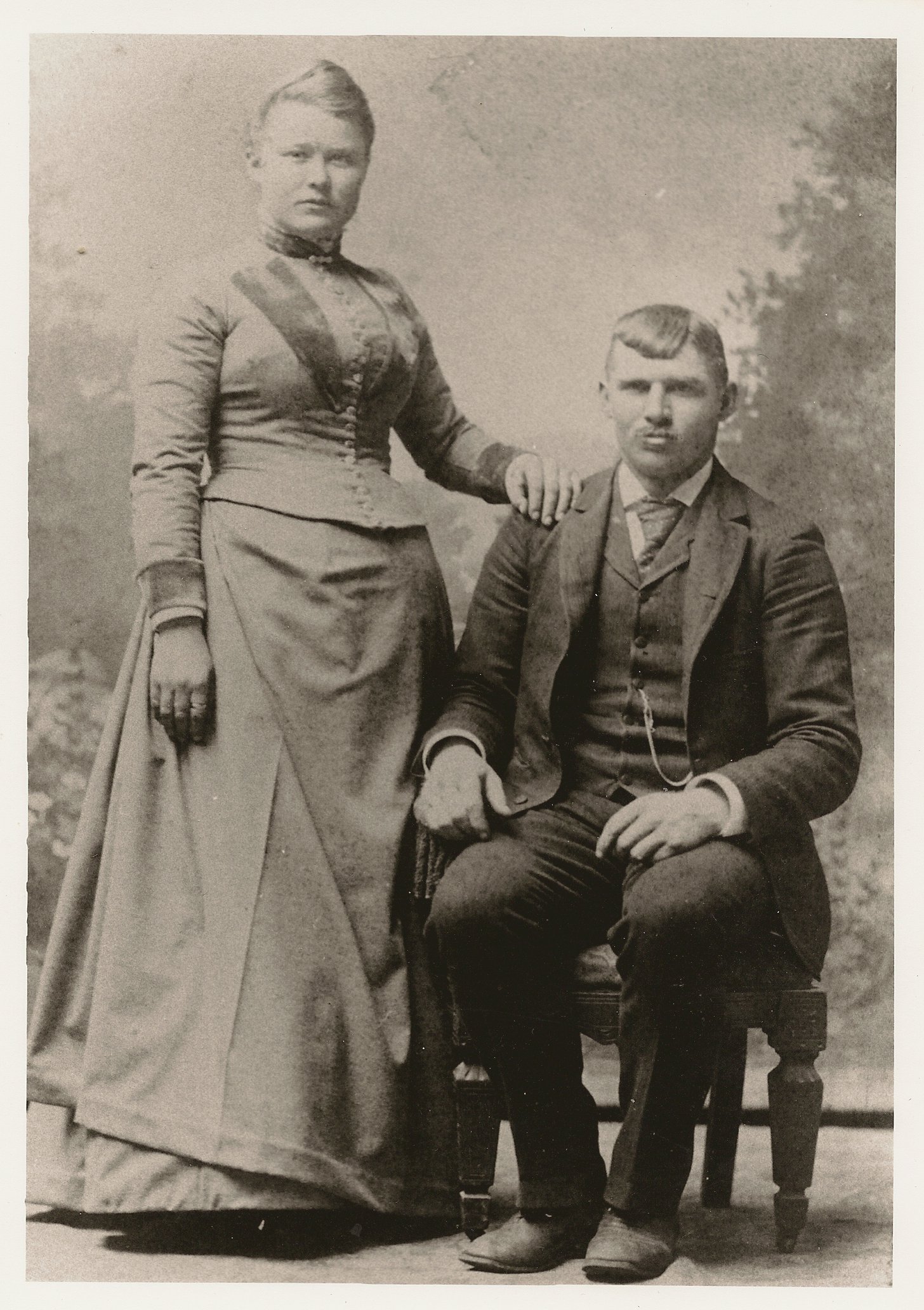
In the photograph, Christina stands in a heavy skirt and bodice, perhaps wool, with contrasting velvet panels on the high collar, cuffs, and bodice. Her hair is styled without the frizzled bangs that she wore a few years prior, and is instead swept smoothly off her forehead. A horizontal pin at her throat appears to match the pin worn in the earlier photograph. She rests one hand on the shoulder of her husband, who is seated. Fred wears a three-piece suit that is rather tightly fitted, as well as a white collared shirt and tie. A watch chain affixed to his vest is also visible. Fred’s hair has been combed and parted neatly, and he sports a small mustache.

Fred and Christina (Schmidt) Nielsen, South Dakota, 1890; digital image 2010, privately held by Melanie Frick, 2018.

Posed before a painted backdrop of a pastoral scene that doesn’t quite reach the floor, the husband and wife look directly at the camera. Both sturdy, fair-haired Scandinavians, their expressions are serious as was typical in portraits of this era. Although this image is a photocopy, it can be assumed that the original portrait was a cabinet card, a style of photograph mounted on card stock emblazoned with the photographer’s emblem that was popular at the end of the nineteenth century.

Fred and Christina (Schmidt) Nielson would go on to welcome nine children into their family and would live to celebrate twenty-eight years of marriage together.3

Copyright © 2018 Melanie Frick. All Rights Reserved.
Continue reading

A Marriage in Mecklenburg-Schwerin

Although more and more genealogical records are being digitized and made available online, images of German church books—those faded ledgers filled with seemingly indecipherable old script that record baptisms, marriages, and burials—are often few and far between. That’s why it was a cause for celebration when I discovered that the scope of Ancestry.com’s “Germany, Lutheran Baptisms, Marriages, and Burials, 1519-1969” encompassed the middle-of-nowhere German communities where a number of my ancestors lived and worshiped in the nineteenth century.

I knew something about the lives of Ernst and Friederike (Wegner) Stübe in America, where they had immigrated with their two-year-old daughter in 1869, but I had known little about their lives in the old country, the former Mecklenburg-Schwerin. Thanks to this record collection, I learned the following:

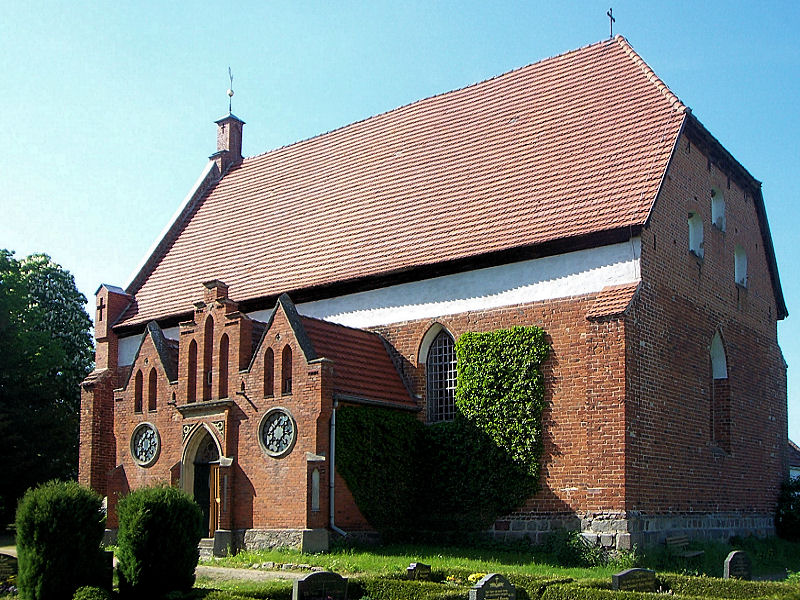
  • Ernst was christened Ernst Daniel Joachim Stübe following his birth on 29 January 1839 in present-day Starkow, Thelkow, Rostock, Mecklenburg-Vorpommern, Germany, the son of Hans Arend Heinrich Stübe and Maria Elisabeth Ewert.1 He was baptized on 3 February 1839 at the village church of nearby Walkendorf, which still stands today.2

“Dorfkirche in Walkendorf,” 2008, Walkendorf, Rostock, Mecklenburg-Vorpommern, Germany; Wikimedia Commons, copyright Ch. Pagenkopf.

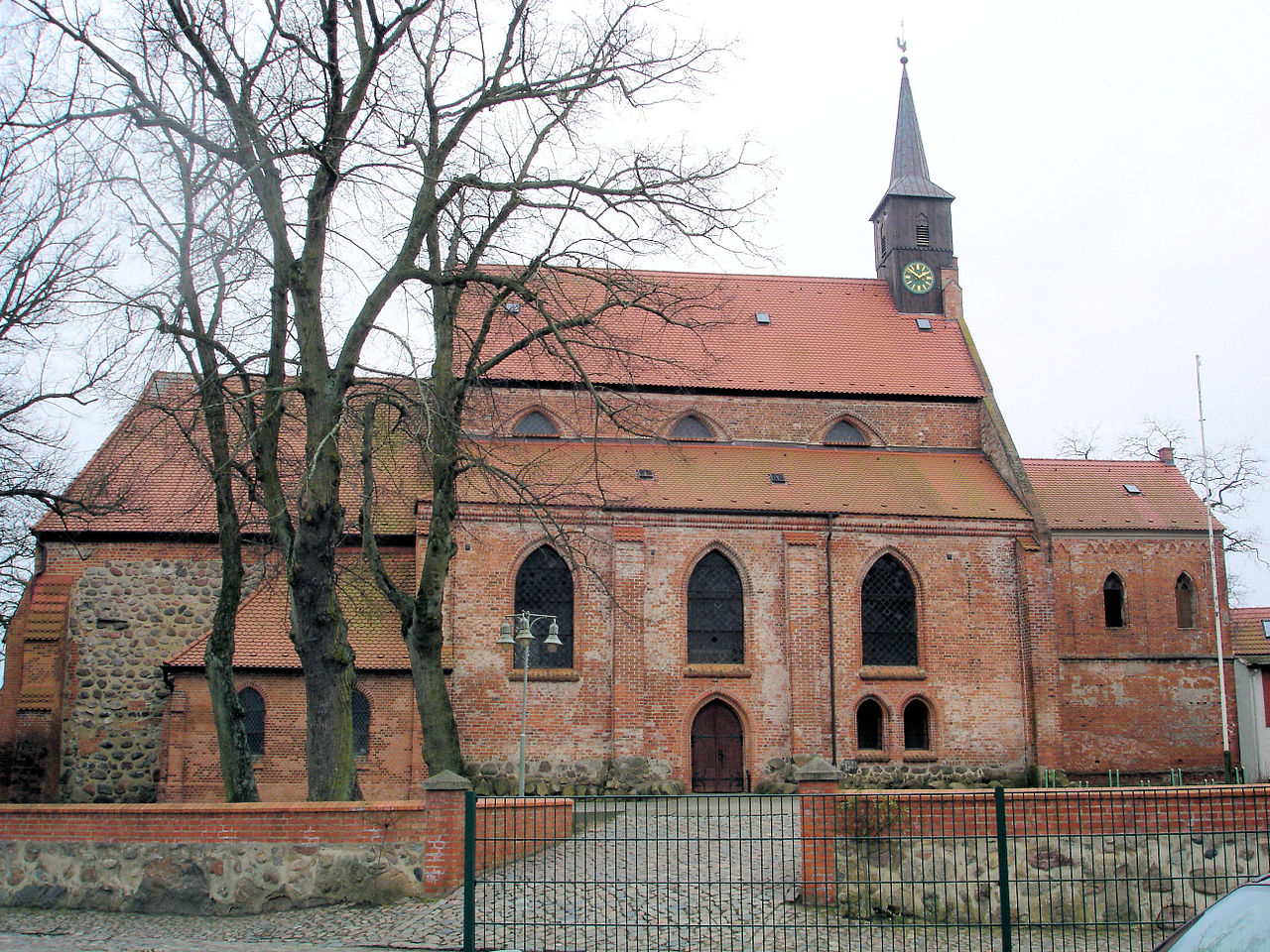
  • Friederike was christened Friederike Johanna Dorothea Christiana Wegner following her birth on 9 August 1841 in present-day Selpin, Rostock, Mecklenburg-Vorpommern, Germany, the daughter of Johann Wegner and Regina Lewerenz.3 She was baptized on 15 August 1841 at the village church of nearby Vilz, which still stands today.4

“Kirche in Vilz bei Tessin,” 2008, Vilz, Rostock, Mecklenburg-Vorpommern, Germany; Wikimedia Commons, copyright Schiwago.

It is likely that Ernst and Friederike grew up on the manorial estates where their fathers were day laborers (Tägelohner).5 Serfdom had ceased in Mecklenburg-Schwerin only in 1820; landless men remained tied to the land where they toiled as contracted laborers on these estates, their wives often working alongside them.6 As children, Ernst and Friederike would have lived in estate-owned huts that were shared with their immediate families as well as, perhaps, their extended families or the families of other laborers.7

Childhood, however, was brief; by the time they were seven years old, Ernst and Friederike may have been hired out to work, or at the very least by the time they reached adolescence. Granted room and board for their services as a farm hand and maid, respectively, they would also have received a modest annual wage.8 Throughout their years of service, they may have moved among different estates and had the opportunity to mingle with a number of other young people at local festivals, and perhaps this is ultimately how they became acquainted.9

  • When they married on 24 October 1866, Ernst was twenty-seven and Friederike was twenty-five; they were married at St. Johannis in present-day Tessin, Stadt Tessin, Mecklenburg-Vorpommern, Germany, which still stands today.10

“Stadtkirche St. Johannis in Tessin,” 2008, Tessin, Rostock, Mecklenburg-Vorpommern, Germany; Wikimedia Commons, copyright Schiwago.

As it so happens, Ernst and Friederike’s wedding day fell upon the date that the contract year for laborers typically concluded; as this was the beginning of a three-day holiday after which contracts might be renewed or laborers shifted to different estates, the young couple may have decided that this would be a practical time to marry and set up house once permission had been granted for their marriage.11 Indeed, as marriage restrictions in Mecklenburg-Schwerin remained strict at this time, a wedding was a true celebration and traditionally included several days of feasting.12

Following their marriage, Ernst and Friederike appear to have lived on the grounds of the estate Friedrichshof, located between Selpin and Walkendorf, where Ernst, like his father before him, was a day laborer.13 Friedrichshof is no more, although notably, it was the birthplace of Richard Wossidlo, a renowned folk historian and ethnographer.14 It was likely here at Friedrichshof where the Stübe couple’s first child, Emma, was born on 27 September 1867.15 Two years later, amidst a stream of emigrants from Mecklenburg-Schwerin, Ernst, Friederike, and Emma Stübe boarded a ship at Hamburg, and the rest, as they say, is history.16 

Copyright © 2017 Melanie Frick. All Rights Reserved.
Continue reading
A Goodly Bit of Romance

The newspaper headline must have brought a few chuckles: “OLD FOLKS HAVE ROMANCE.” The story continued, “Romance is not all reserved for young people, as the marriage of Isaac N. Holman, aged 70, of Decatur, Neb., to Mrs. Sarah E. Fenton, aged 51, of Springdale, in Sioux City, will testify. […] This is the third marriage for each of the contracting parties. Both are well along the avenue of life and to them the marriage represents good judgment as well as a goodly bit of romance. They have known each other a long time and the mutual admiration they have entertained has grown gradually until the marriage yesterday placed its happy seal upon their growing affection.” Following their marriage on 24 August 1908 at the home of the Reverend W. H. Montgomery of the Haddock Methodist Episcopal Church in Sioux City, Woodbury County, Iowa, the couple was to visit Omaha. They would settle in Decatur, Burt County, Nebraska, where Holman, “said to be quite well to do,” made his home.1

That evening, their story appeared in another Sioux City newspaper: “LOOKING FOR LAND HE FINDS HELPMATE.” This version of the story was written with a level of flowery detail that, while entertaining, I don’t quite trust:

“I.N. Holman, a wealthy retired farmer of Decatur, Neb., came to Sioux City several months ago on a land deal. At the office of a real estate dealer he met a charming black-eyed widow, Mrs. Sarah E. Fenton, who had chanced in there on business. When they were introduced, he immediately lost all interest in Sioux City property or any property for that matter, and devoted all his time to the widow. Holman is 70 years old, and he pressed his suit with such ardor that before he returned to Decatur he had made a contract for something which he wouldn’t trade for all the farms in Iowa, namely the attractive widow. Today he returned to close the deal, which he says is the best he ever made. A license was issued this afternoon, the bride giving her age as 51. They will be married this evening and after a two weeks’ wedding trip will make their home at Decatur. “Maybe people think we’re foolish,” said the bride, blushing like a school girl, “but we don’t, we’re too happy.”2

This is far from the whole story. First, there are, in fact, two stories presented by these competing news articles. Did the couple meet at the land office, or had they been acquainted for years? This we may never know for sure; it seems unlikely, but not impossible, that the couple had crossed paths before meeting in Sioux City. Second, the “attractive widow” most likely did not have the black eyes of Bess the landlord’s daughter, charming as the description may be.3 And was she even a widow? Well, yes and no. Her first husband, George W. Fenton, died tragically in 1880 when accidentally shot by her brother-in-law.4 Her second husband, however, was still alive and well at the time of her third marriage; Sarah had divorced John Hoffman in 1902 citing his drunkenness and death threats.5 However, it would have been far from unusual for a woman to claim widowhood over divorce.

SarahEHall

Sarah Ellen (Hall) Fenton Hoffman Holman Eklof, Iowa or Nebraska, ca. 1908; digital image 2001, privately held by Melanie Frick, 2015.

Finally, would Isaac and Sarah live happily ever after? Unfortunately not. Isaac was granted a divorce from Sarah in 1914;6 a probate petition filed by his son the previous year, while suggesting that Isaac “indulged in intoxicating liquors to excess” and was “changeable, forgetful, and stubborn,” also stated that “the amount of money demanded from him by his current wife annoyed him considerable.”7 Oh dear. Isaac did not remarry before his death in 1922,8 but Sarah would marry – and divorce – once more.9 She resumed the use of the Holman name and at the time of her death in 1930, she was referenced as the widow of Isaac Newton Holman. Her short-lived marriage to this “wealthy landowner” was, perhaps, her one claim to local fame and financial stability.10

Lesson learned? Never assume. I had assumed that because this was the couple’s third marriage, and because they married in a community with a population greater than thirty thousand, that no mention would be made of their marriage in the local newspaper. In fact, I didn’t bother to check until their names turned up in the Findmypast database featuring a newspaper from across the state, and then learned that more than one version of the story existed. As it turns out, you never know what details of your ancestor’s experience might have made a compelling story deemed worthy of reprint!

Copyright © 2015 Melanie Frick. All Rights Reserved.

Continue reading

Wedding Wednesday: Puffed Sleeves

On a late September day in 1896, Elizabeth Hoffman of North Washington, Chickasaw County, Iowa affixed a gauzy, floor-length veil to her hair. It may have been crowned with flowers, although the faded photograph does not make this clear. Flowers or foliage of some kind – perhaps even autumn leaves? – were indeed attached to the front of her dress, although she wore no white gown. Her best dress was likely black or another dark color and fashionably made with a gathered bodice, narrow waist, and sleeves generously puffed to the elbow. (Anne Shirley would have been envious.)

Elizabeth’s attire is evidence that, at this time, even recent immigrants living in rural areas of the United States were aware of the latest fashion trends. Corsets were not worn by all women in the 1890s, and Elizabeth, already slim, was not dramatically corseted if she was at all.1 The gathered bodice was of a style worn throughout the decade, and while the care of these full leg o’ mutton sleeves was time-consuming, they were at the height of popularity in the middle of the decade.2

MathiasElizabethWedding

Mathias Noehl and Elizabeth Hoffman, wedding, North Washington, Iowa, 1896; digital image 2001, original held by J.H., 2015.

At the age of twenty-seven – her birthday had been just the week before – Elizabeth was to marry a fellow immigrant, Mathias Noehl.3 As it so happened, he hailed from the village of Holsthum, Bitburg-Prum, Rheinland-Pfalz, Germany, which neighbored her own home village of Prümzurlay.4 By all accounts, however, their first meeting took place in northeastern Iowa, where Mathias encountered Elizabeth, whom he called Lizzie, at the Immaculate Conception Church in North Washington. She lived there as the housekeeper of Father Probst and the Sisters of Charity.5 The couple was married there on 22 September 1896 and may have celebrated with Elizabeth’s mother and siblings, who had also made Chickasaw County their home.6

A copy of Mathias and Elizabeth’s wedding portrait was shared with me by a relative; I suspect the original is a cabinet card photograph, popular at the turn of the century. I can’t make out much of the setting (is it grass or a rug at their feet?), but Mathias sits in a wicker chair while Elizabeth stands to the side, her right hand on his shoulder. In her left hand is clutched a small book, perhaps a prayerbook. As was typical of the time, neither of the newlyweds smile, and their faces are so faded in the copy that it’s difficult to see the direction of their gazes. Mathias has short hair; in his memoirs, he wrote that that, upon meeting Elizabeth, his blond hair was “unkempt like dried up flowers of the cemetery,” so a haircut may have been in order!7 He has a tidy mustache and wears a wool suit and white shirt. At twenty-eight, having recovered from an earlier heartbreak during his first years in America, he was prepared to settle down and start a family.8 Mathias and Elizabeth would go on to raise nine children on their farm.

This wedding portrait is one of several photographs that I have in my digital collection of the family of Mathias and Elizabeth (Hoffman) Noehl, both immigrants who came to Iowa from Germany in the late nineteenth century. For more photographs of the family of Mathias Noehl (1868-1950) and Elizabeth Hoffman (1869-1957), check out my new Noehl Family Album

Copyright © 2015 Melanie Frick. All Rights Reserved.

Continue reading

Wedding Wednesday: The Parish Church

    "St. Peter's Church, Gamston," 2007, Gamston, Nottinghamshire, England; Wikimedia Commons, copyright Richard Croft.

“St. Peter’s Church, Gamston,” 2007, Gamston, Nottinghamshire, England; Wikimedia Commons, copyright Richard Croft.

It would have come as no surprise to the congregation of the parish church of Gamston, Nottinghamshire, England when a shoemaker’s son and a cottager’s daughter married on 14 April 1840.1 For three consecutive Sundays, the banns had been read by the church rector, and as no impediments arose in response to his announcement of the couple’s intentions,2 they were married on the Tuesday before Easter.3

John Fenton and Ann Bowskill (also spelled Bouskill), a bachelor and spinster “of full age,” had their union solemnized in the parish church of Gamston, also known as St. Peter’s Church.4 Just a few years earlier, it had been described in a local gazetteer as a historic but perhaps somewhat dilapidated structure: “The Church dedicated to St. Peter, ‘has once been antique,’ but its brasses have been all destroyed or stolen, and its sculptured ornaments are hid behind many coats of whitewash.”5 St. Peter’s Church dates to the thirteenth century, and received what was apparently a much needed restoration in 1855.6

Gamston, located near the community of Retford, was described as “a good village on the east bank of the Idle, where there is a corn mill and a candlewick manufactory.”7 John and Ann did not remain here in Ann’s hometown following their marriage, however, nor did they return to Bole, where John’s father was the village shoemaker.8 In fact, they seemed intent on pursuing opportunities of their own, as within a year of their marriage, they settled in Worksop, about ten miles northwest of Gamston.9

It would have taken the couple several hours on foot to reach Worksop from Gamston, but a pleasant view would have awaited them upon their arrival:

“On the approach from the east, the appearance of the town, lying in a valley, overtopped by the magnificent towers of the church, and baked by swelling hills finely clothed with wood, is extremely picturesque. Its situation is indeed delightful, and both nature and art have contributed to its beauty, for the houses are in general well built; the two principle streets spacious and well paved, and the inns clean and comfortable […]”10

Worksop was deemed a “clean and pleasant market town,” and if John, described as a laborer in the 1841 census, was not already trained in another profession, he may have found employment in agriculture, at a malt kiln, or at one of the many corn mills.11 It was in Worksop that the couple’s eldest children were born, before, within a decade, they immigrated to America.12

Continue reading

Wedding Wednesday: A Question of Nationality

I’m not sure if it was meant as a joke, or if newlyweds Gerald and Fern (Thoma) Adam of Sioux City, Woodbury County, Iowa were genuinely confused. When asked to state their nationalities at the time of their marriage, their answers should have been simple; they were the American-born children of American-born parents, after all, so there was really no question that they were American themselves. Jerry, however, stated that he was of French nationality, while Fern declared that she was German-English.1

GeraldAdam1929

Gerald Joseph Adam, Sioux City, Iowa, ca. 1929; digital image 2012, privately held by Melanie Frick, 2014.

FernThomaAdam1929

Fern Lavonne Thoma, Sioux City, Iowa, ca. 1929; digital image 2012, privately held by Melanie Frick, 2014.

From a genealogical perspective, I love it. How often does one have the chance to learn what their forebears knew of their own ancestry? However, if I didn’t already know so much about this couple and their heritage, I might have been thrown off. Jerry’s ancestry was indeed French – and French Canadian, and Polish. Fern’s ancestors, many of whom were likely early arrivals on American soil, can thus far be traced to Germany and the British Isles.

I don’t know when exactly the couple met while on their way downtown to the movie theater, but Jerry and Fern married in their hometown on 8 June 1929 – eighty-five years ago this week.2 Fern was twenty-one, and although Jerry would not celebrate his twenty-first birthday for eleven more days,3 he claimed to be the same age as Fern.4 Their wedding attendants were close friends Merle Montgomery and Dorothy Thompson,5 and, following their ceremony, led by Reverend R. M. LeCair of St. Jean Baptiste Church, the couple took a “motor trip” to the Black Hills of South Dakota.6

Gerald_Adam_Fern_Thoma_Marriage_1929

“Iowa, Marriage Records, 1923-1937,” digital images, Ancestry.com (http://www.ancestry.com : accessed 10 June 2014), Gerald Adam and Fern Thoma, 8 June 1929, Sioux City; citing “Iowa Marriage Records, 1923–37,” microfilm, State Historical Society of Iowa, Des Moines.

If your ancestors married in Iowa between 1923 and 1937, be sure to visit Ancestry.com’s digital image collection, “Iowa, Marriage Records, 1923-1937,” new this year. This database has plenty of detail to offer, as marriage records included such information as age, place of residence, occupation, place of birth, father’s name, mother’s maiden name, number of marriages, and the names of the officiant and witnesses. It’s also an opportunity to see the signatures of the couple – likely the last time the bride would sign her maiden name. Have you found any surprises in this record set?

Continue reading

Wedding Wednesday: Swell Times in Chicago

HelenLeonardWedding

Leonard and Helen (Nelson) Wiese, Chicago, Cook, Illinois, 1924; digital image 2010, privately held by Melanie Frick, 2014.

On the evening of 5 January 1924, Leonard John Christian Wiese and Helen Margaret Nelson were married in Chicago, Cook County, Illinois.1 Leonard had been raised in Chicago, the son of German immigrants,2 whereas Helen had been raised in rural Yankton County, South Dakota, the daughter of Danish immigrants.3 The couple met when Leonard sought work in South Dakota, and he and Helen bonded over a shared love of music.4 Leonard and his bride-to-be then moved to Chicago, where they were wed in the home of Leonard’s widowed mother.5 Since Helen’s family was not able to be with them, she wrote a detailed letter home describing their wedding day:

My dear folks,

Now I think that this letter will have to be passed around so I won’t have to repeat all the details of the past few days. We are married! Yes. Now then I will endeavor to tell you the points which I think will be of interest to you.

My dress was very plain but everyone liked it. Dark brown brocaded silk with short sleeves and sort of a drape on the skirt. I have a new coat and hat and new satin shoes.

Well, there were eighteen grown people here. We were married at 9:30. Stanley Smith played the wedding march and Irene and I came from upstairs and met the other two in the room. After the ceremony, a shower of rice descended upon us and the best man and several of the others took advantage of the privilege of kissing the bride. So it was on the order of some of the weddings you read about!!!

Then we had dinner. Turkey, chicken, mashed potatoes, peas, corn relish, cranberries, dressing, Jello, coffee, etc. A huge wedding cake adorned the center of the table. This cake was made to order. You people are going to have some of it. I baked two angel food cakes and a sponge cake. That’s all I did in helping preparations.

I spent some time at the hairdresser’s! Oh, I looked real swell!!!

After supper we had music and some of the men played cards. Then after awhile we started the Victrola and we all danced.

Continue reading

A Wedding Party

Not everyone had a wedding portrait made. In my experience, it was even less common for a wedding portrait to include the wedding attendants or witnesses. However, when Henry Joseph Adam and Melanie Veronica Lutz married on 24 October 1905, they posed for a formal photograph with four attendants.

HenryAdamMelanieLutzWedding1905

Henry and Melanie (Lutz) Adam wedding photograph, 1905, Sioux City, Iowa; digital image 2010, privately held by Melanie Frick, 2013.

Melanie, the bride, appears to wear her brown hair loose behind her shoulders, unless this is an illusion created by a shadow. The dark material of her dress, featuring a pleated bodice and v-neck, contrasts with a high white collar. A decorative watch is pinned at her bodice, and a small brooch is at her throat. To the right, her attendant, Permelia Adam, wears a white pleated bodice with full sleeves and a large bow off-center at the collar. Blanche Adam also wears a white bodice, although it features decorative buttons and lace detail. An elegant string of pearls rests at her throat, above the high collar. Like Permelia, Blanche wears a large bow in her hair.

Henry, the groom, wears a dark suit with a crisp white collar and white bow tie. His suit fastens higher than those of his attendants; Theodore Adam wears a polka dot tie, and Herman Adam sports a vest and bow tie. The men have all combed their dark hair with side parts and fashionable waves.

Carnations were apparently in vogue in 1905, or perhaps they were a favorite of the bride. Melanie wears two long-stemmed white carnations, facing downward, pinned to her bodice. Henry wears one as well, although the stem is hidden by his lapel. Although Permelia seems to wear a carnation, the stem is so long that the blossom itself cannot be seen, and the male attendants wear darker flowers that are indistinct against their suits. Only Blanche goes without a flower.

The Adam-Lutz wedding was held at St. Jean the Baptiste Catholic Church in Sioux City, Woodbury, Iowa on a Tuesday morning. Forty guests attended, the majority of whom were relatives.1 As Melanie had no family in the area, it is understandable that only her husband’s relations would have made up their wedding party; Permelia and Theodore were Henry’s brother and sister, while Blanche and Herman were his cousins. After the ceremony, an informal wedding breakfast was served at the home of Henry’s parents, which was decorated, unsurprisingly, with flowers.2


SOURCES
1“Adam-Lutze,” Sioux City (Iowa) Tribune, 28 October 1905.
2“Adam-Lutze,” Sioux City (Iowa) Tribune, 28 October 1905.

Wedding Wednesday: “A Very Pretty Wedding”

On 17 January 1934, Roy Lewis Christian Walsted and Frances Marie Noehl were married in Sioux City, Woodbury County, Iowa.1 Roy was Lutheran, the son of Danish immigrants; Frances was Catholic, the daughter of German immigrants. While Roy was raised in the city, Frances had grown up on a farm. Both had settled in Sioux City apart from their families, seeking employment. Roy worked as a clerk at the Sioux City Gas and Electric Company,2 and Frances was employed in the household of Richard Mullins.3 She provided companionship to his teenage daughter, who was confined to a wheelchair.4 One can’t be sure how Roy and Frances met, but their modest wedding ceremony was described in detail in a local newspaper:

Miss Frances Noehl is Married at Sioux City, Iowa, Recently

Is a Daughter of Mr. and Mrs. Matt Noehl of South of New Hampton.

Bride of Mr. Roy Walsted of Sioux City.

FrancesNoehl

Frances Marie (Noehl) Walsted photograph, ca. 1934, Sioux City, Iowa; digital image ca. 2001, privately held by Melanie Frick, 2013.

A very pretty wedding was solemnized at the Church of the Blessed Sacrament at Sioux City, Iowa, Wednesday morning, January 17, 1934, when Miss Frances Noehl, daughter of Mr. and Mrs. Matt Noehl of New Hampton, became the bride of Roy Walsted, Sioux City, son of Mr. and Mrs. James Walsted of Chicago. They were married at 7 a.m. by Reverend Leo Berger. The couple was attended by Mr. and Mrs. Harold McDonald, friends of the couple.

They entered the church and advanced to the alter to the strains of Lohengrin’s wedding march played by Mrs. R. J. Mullins.  Mr. R. J. Mullins sang a solo accompanied by Mrs. Mullins at the piano and Dr. Meis playing the violin.

The bride wore an ankle-length gown of light green crepe, with accessories to match. She carried a beautiful bouquet of American Beauty roses. The bridesmaid wore a dress of black chiffon velvet with accessories to match.

Both the bridegroom and best man wore dark gray suits.

After the ceremony they motored to the home of Mr. and Mrs. John P. Hansen at Morningside, an uncle and aunt of the bridegroom, where a lovely three course breakfast was served to the bridal party and immediate relatives of the couple. After breakfast the newlyweds left on a brief wedding trip to Omaha after which they will make their home at Morningside. Mr. Walsted is employed at the Sioux City Gas and Electric Company.

Mr. and Mrs. Leo Buscher and children, Lillian and Richard, of LeMars, Iowa, were present at the wedding ceremony. Mrs. Buscher is a sister of the bride.

The bride is well and favorably known here, and her many friends in this community join us in congratulating her and extending wishes to her and her husband for a happy future filled with success and contentment.5

What did your grandparents wear when they married? Did they take a honeymoon? And, most importantly, did they marry at 7:00 in the morning?


SOURCES
1 “Miss Frances Noehl is Married at Sioux City, Iowa, Recently,” undated clipping, ca. January 1934, from unidentified newspaper; Adam Family, privately held [personal information withheld].
2 “U.S, City Directories, 1821-1989,” database, Ancestry.com (http://www.ancestry.com : accessed 9 October 2013), entry for Roy Walsted; citing “Polk’s Sioux City Directory, 1933 (R.L. Polk & Co., 1932),” 332.
3 “U.S, City Directories, 1821-1989,” database, Ancestry.com (http://www.ancestry.com : accessed 9 October 2013), entry for Frances Noehl; citing “Polk’s Sioux City Directory, 1933 (R.L. Polk & Co., 1932),” 248.
4 Kay (Walsted) Adam, conversations with the author, 2003; notes in author’s files.
5 “Miss Frances Noehl is Married at Sioux City, Iowa, Recently,” undated clipping, ca. January 1934, from unidentified newspaper.