Category Archives: Photograph Analysis

A July 4th Celebration

On 04 July 1910, a group of twenty people—plus one dog—came together for a photograph somewhere in Yankton County, South Dakota. Presumably, they had gathered to celebrate Independence Day, and several chairs were brought outside for their assemblage before a backdrop of trees. All present appear to be well if not formally dressed for the day. The men wear no jackets and several go without vests or ties, suggesting that the weather was quite warm, and several of the women and girls, most of whom wear light-colored, summer dresses, have their sleeves pushed to their elbows. At least one woman wears an apron. A man’s straw boater hat is cast to the side, and a dog rests, alert, at a girls’ feet. However, despite the fact that this was a warm summer day and that even the men have shed some layers, the children all seem to have been required to wear stockings and shoes as there are no comfortably bare feet in sight.
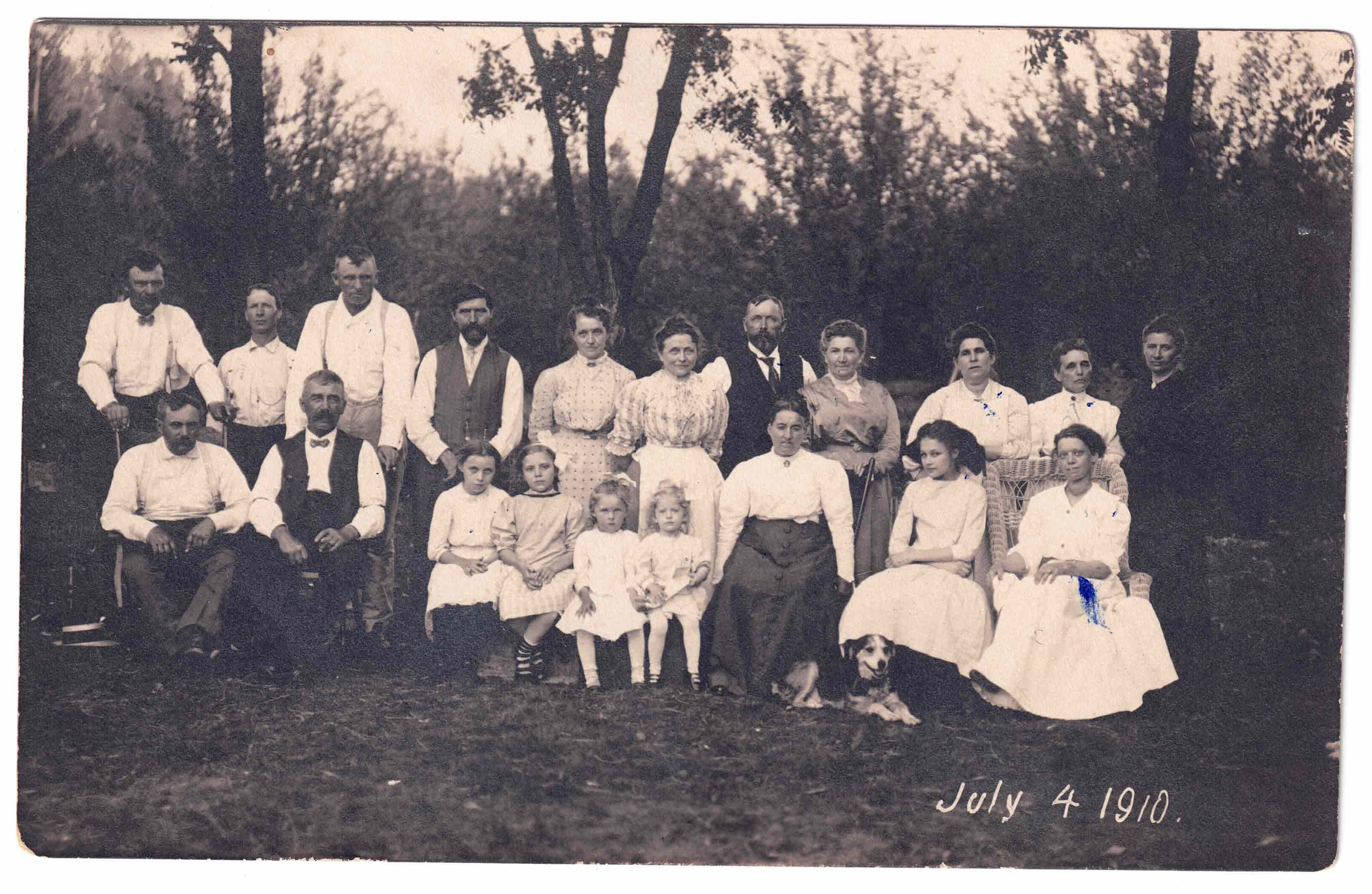
Independence Day celebration featuring descendants of Niels and Juliane (Hennike) Olsen and friends, Yankton County, South Dakota, 1910; digital image 2025, privately held by Greg Smith. Back, left to right: Jens Christian Nielsen?, Marius Larsen, Henry Schaller, John Nielsen, Cecilia (Nielsen) Boysen, Stena (Nielsen) Callesen, Jacob Nissen, Elizabeth Bruhn, Mrs. Schaller, Dorothea (Neilsen) Nissen, and Mary (Jacobsen) Nielsen. Front, left to right: Chris Callesen?, Erick Boysen, Herta Scheel Callesen, Cleora Nielsen, Grace Nielsen?, Violet Larsen, Jennie (Burton) Nielsen?, Henrietta Bruhn, and Helena (Nielsen) Larsen.

Thanks to a loose handwritten note that accompanied this photograph, as well as comparisons made with a 1902 group photograph that included many of the same individuals, most people have been identified with reasonable certainty. Present were at least five if not six of the eight adult children of the late Niels and Juliane (Hennicke) Olsen, Danish immigrants who had settled in Yankton County, Dakota Territory, in the early 1870s: John, Cecilia, Christina (Stena), Dorothea, and Helena Nielsen (also spelled Nielson or Nelson), along with their spouses. Their brother Jens Christian and his wife may have been there as well. Also present were several friends, who, according to the handwritten note, were members of the Henry Schaller and Henry Bruhn families.

The woman in the apron near the center of the photograph, who, given her attire, may have been the hostess of the event, is Christina “Stena” (Nielsen) Callesen (1860-1951). In 1910, Stena and her husband Christian “Chris” Callesen were living in Utica, Yankton County, South Dakota with their nine-year-old foster daughter Herta. Chris, whose name appears twice in the handwritten list of identifications, is likely seated at far left, while the child at left is Herta. Herta Scheel Callesen had been living with the Callesens since she was four years old and lost her father. Her mother, left with seven young children to feed, had made what must have been a difficult decision to allow her youngest daughter to be separated from the family—including from her twin brother—and raised by the Callesens. Stena was known to have had only one child of her own, a daughter who died in infancy. Herta, however, was one of as many as six children that the Callesens fostered or adopted over the years, some for only a short while and some, like Herta, to adulthood.

Seated to the right of Herta Scheel Callesen is her cousin Cleora Nielsen, the youngest daughter of John and Mary (Jacobsen) Nielsen. Cleora, eight years old, had been born in South Dakota but now lived in Santa Clara County, California. She and her parents had most likely returned to South Dakota for a summer visit with relatives; it is possible that her older siblings, the youngest already sixteen, remained in California, as they are not pictured here.

Next to Herta and Cleora are two young girls, between, perhaps, the ages of two and four. Only one was identified in the handwritten note, although it is not immediately clear which one: two-year-old Violet Larsen, the only child of Marius and Helena (Nielsen) Larsen. Tragically, Violet would live only to the age of four, and I have no other photographs of her. Although it was not indicated which girl is Violet, because the child on the right appears to me to be closer to the age of two—she fidgets with her skirt and her feet don’t quite reach the ground from the bench on which she appears to be sitting—that is my guess. There also seems to be a space left between the names of Cleora and Violet in the handwritten note.

Could the bigger of the two littlest girls be, perhaps, Grace Nielsen, four-year-old daughter of Jens Christian and Jennie (Burton) Nielsen? Jens, known familiarly as J. C. or Chris, was not named in the handwritten note accompanying the photograph, nor was his wife, but he bears some resemblance to the man at back left and his wife to the unidentified woman seated in the front row to the right of the children. The Nielsens, like the Callesens, lived in the small farming community of Utica, so it is reasonable to consider that they might have been present to spend the holiday with kin.

Jens Christian Nielsen, known as J.C. or Chris, is pictured at left in 1902. Could he be the man at right in 1910?

JaneJennie” (Burton) Nielsen is pictured at left in 1902. Could she be the woman at right in 1910?

The fact that this photograph was taken during a census year is particularly helpful in confirming the identities of the children, as it is possible to see exactly who resided in which household just a few months prior. It can be determined that the Bruhn and Schaller families, for example, did not have any young daughters who might have been seated beside little Violet Larsen. Unexpectedly, the census provided another important clue about this photograph: the identity of the photographer. It had seemed curious that family friend Henry Bruhn was not pictured alongside his wife, Elizabeth, and fourteen-year-old daughter, Henrietta, but according to the 1910 United States census, Henry Bruhn was, in fact, a photographer, and therefore may very well have been the person behind the camera.

Census records are of course less helpful when attempting to determine the identities of adults who are close in age, particularly considering the similarities in appearance among those with both shared heritages and lifestyles. Perhaps this is why whoever created the handwritten note accompanying the photograph named Chris Callesen twice! Cross-referencing with other more confidently identified photographs is key, and fortunately, in Chris’s case, there are two other known photographs that can be used as points of comparison and provide some degree of confidence.

Christian “Chris” Callesen is pictured at upper left in 1902 and at lower left in 1911. It is believed that he is the man at right in 1910.

Large group photographs like this are particular treasures in a family archive as they provide insight not only into the bonds of family and friendship, but also the occasions that brought people together. As they are less formal than studio portraits, they can also offer greater glimpses into personality and personal style, as well as the surroundings in which people lived. For a number of the Olsen descendants and their friends, 04 July 1910 looked to be a pleasant day spent in the fresh air, perhaps with a bountiful noon meal to share.

Copyright © 2025 Melanie Frick. All Rights Reserved.

Continue reading

Fred the Farmer

Frederick Thoma might never have had any intention of becoming a farmer. Born on 04 December 1857 in Garnavillo, Clayton County, Iowa, Fred was the eldest of eleven children born to Bavarian immigrants Wilhelm Heinrich Thoma and Anna Margaretha Poesch. His father, a respected community leader, owned and operated a general store in the town of Garnavillo, which is where Fred and his siblings were raised. In 1876, when Fred was eighteen, his father died; three years later, on 29 December 1879, he married Matilda J. Hammond, the daughter of a prosperous local farmer.

Fred and Matilda, who were known familiarly as Fritz and Tillie, had five children: George Hiram (born 1880), Leonard Christopher (born 1885), Ludelia Maria (born 1887), Roselyn Anna (born 1892), and Norma Evaline (born 1895). All lived to adulthood with the exception of Norma, who died in a diphtheria outbreak at the age of ten. This was not the first time that Fred had lost a loved one to communicable disease: two of his brothers had died of consumption, both when they were twenty-four, in 1886 and 1890. One can imagine that each of these losses would have had a profound impact on Fred.

As a young married man, Fred was a store clerk in Garnavillo; according to local news clippings, he then, over the course of several years, opened an agricultural warehouse, carrying “a full line of cultivators, reapers, etc.,” and next operated a saloon or billiard hall, dealing in “pure Wines and Liquors, choice Cigars, etc.,” before briefly entering the “fruit and fancy grocery business.” By 1895, however, when he was thirty-seven, the census recorded that he was a laborer, and his occupation remained the same in both 1900 and 1905. It seems that his business endeavors were ultimately unsuccessful, and family lore gives a clue as to why.

Decades later, Fred’s granddaughter recalled that his vice was alcohol, noting that his eldest son had left home as a teenager for this reason, and also that Fred’s wife, upon receiving an inheritance from the estate of her parents, bought a farm in order to remove Fred from town and from the temptation of the saloon. Indeed, in March of 1910, a local newspaper reported that Matilda Thoma had purchased 80 acres from William D. Harnack and his wife for $4800, and by the time of the U.S. census that April, the couple resided on their farm in rural Clayton.

The move northeast from Garnavillo into rural Clayton Township was a distance of about five miles, and it brought Fred and Matilda closer to the family of their eldest daughter and son-in-law who also farmed there. Newspaper clippings make mention of Fred and his son-in-law engaging in farm work, participating in a barn raising, and hauling sand across the Mississippi River at Clayton.

A newly uncovered photograph of Fred Thoma—in fact, the only photograph of him known to exist—shows him as a mustachioed farmer in overalls and a brimmed hat, standing beside a team of horses in front of a two-story farmhouse. It’s a beautifully kept home, featuring, at the time this photograph was taken circa 1910-1924, an inviting front porch complete with a wicker rocker, potted plants, and vines growing on a trellis. The front porch shelters two front doors, and curtains can be seen at the windows. A screened-in back porch is also visible around the side of the house, and leafy tree branches frame the shot. Fred, photographed, perhaps, after a brief rest in the Windsor chair behind him, appears relaxed and has an amiable expression.

Frederick Thoma (1857-1925), Clayton, Clayton County, Iowa, circa 1910-1924; digital image 2024, privately held by Julie Jentz, 2024.


Fred and Matilda farmed in rural Clayton between 1910 and 1924, when Fred’s poor health necessitated their return to town. In the summer of 1924, Fred had spent some weeks at the Prairie du Chien Sanitarium, where, weakened from a bout of influenza and suffering from dropsy, he had sought medical attention; his health not improved, that fall he auctioned off his livestock and numerous farming implements in a public sale. Late in the year, he and Matilda resettled in the town of Clayton; they lived there for only two months, during which time they would have celebrated forty-five years of marriage, before Fred’s death at the age of sixty-seven on 10 January 1925. The funeral was held at St. Paul Lutheran Church in Garnavillo, with members of the Garnavillo Turnverein, a German-American social club of which he was a member, in attendance.

Fred’s career as a farmer may have made up less than a decade and a half of his adult life, but one can hope that these were at the least peaceful, pleasant years for him and his family—years during which Matilda was able to put to use her skills and knowledge from a childhood spent on a farm, and Fred was able to face fewer temptations, connect with his adult children and young grandchildren, and engage in fulfilling work. The farmhouse where he and Matilda spent these quiet years still stands today on Great River Road between Garnavillo and Clayton.

Copyright © 2025 Melanie Frick. All Rights Reserved.

Continue reading

Wedding Wednesday: Puffed Sleeves, Revisited

It has been nearly a decade since I first featured this photograph on Homestead Genealogy, and at that time, I had never seen the original. The old photocopy in my possession was washed out and grainy, the young couple’s faces barely discernible, and the border with the photographer’s mark was not included. When a nearly pristine original made its way to me last year, I was elated: finally, every detail of the 1896 wedding portrait of my great-grandparents Mathias and Elisabeth (Hoffmann) Noehl of North Washington, Chickasaw County, Iowa, could be fully appreciated, and, in addition, the photographer’s mark offered a new clue about the couple’s lives as newlyweds.

Mathias Noehl and Elisabeth (Hoffman) Noehl, St. Peter, Nicollet County, Minnesota, 1896; digital image 2023, privately held by Melanie Frick, 2024. Courtesy of Richard Buscher (1933-2023).

In this photograph, Elisabeth, with dark hair and eyes and full brows that would be the envy of many young women of today, gazes steadily into the distance, her right hand on her husband’s shoulder and her left holding what is likely a Catholic prayerbook. Her dark dress boasts the elegantly puffed sleeves so popular in the mid-1890s, and a floor-length veil is affixed to the back of her head. A substantial floral arrangement is perched atop her head, cascading over her forehead, while smaller floral sprigs are fastened to her collar and her gathered bodice. These may well have been wax flowers, and appear to be orange blossoms, which were a popular choice for bridal wreaths. Elisabeth, who had immigrated to America from Germany at the age of twenty, had celebrated her twenty-seventh birthday less than a week prior to her marriage.

Mathias, blond and with a fair complexion, gazes in the opposite direction as his bride, his posture upright but casual as he poses seated in a wicker chair, one elbow resting on the arm. He wears a dark suit and vest with a white shirt and necktie, and a floral corsage has been attached to the front of his jacket. What may be a watch chain peeks out underneath. Mathias wears his hair short and has a full mustache; like Elisabeth, his expression is serious. Twenty-eight years old, Mathias had by that point spent a decade in America after emigrating from his native Germany.

Years later, he wrote of his meeting with Elisabeth:

“One day I was standing in front of the house of a venerable old priest, in whose service for five years I found living a good woman. She was reflecting what vocation she should choose. The old pastor had advised her to spend the rest of her life with him, as housekeeper, but on the other side of the house, the nuns beckoned to her, “Come and join us, Lizzie.” Then it happened that I passed by. I was in a neglected condition. My suit of clothes appeared to have seen better days. A hailstorm seemed to have come over my hat. My blond hair lay around my temples unkempt like dried up flowers of the cemetery. When she heard that I had come from her neighborhood village, Holsthum, she said to herself, “That is a disgrace to the whole valley of Prüm. He must be hidden from the streets of North Washington, even if I have to marry him. Perhaps there is hidden in that neglected and careless fellow a good provider, and, if I succeed in making a good Christian out of him, I can earn besides a good crown in heaven.” She thought further, “This is Leap Year and Eve had the job in paradise, a breath-taking job it was, to make the marriage offer. At my first attack, he fell on my breast. Father Probst then tied me to him, on the twenty-second day of September 1896, and he made the knot so tight that I could not think to get away from him anymore.”

Memoirs of Mathias Noehl (Translation)

Although the couple married in Iowa, the mark of the photographer Bancroft on this cabinet card reveals that their wedding portrait was not taken there. St. Peter, Minnesota was well over one hundred miles from North Washington, Iowa, where their marriage had been solemnized on 22 September 1896. What could have brought Mathias and Elisabeth there? I don’t have a good answer. It seems highly unlikely that the couple, certainly not well-to-do, would have set off on a leisurely honeymoon tour of the Midwest; more plausible is that they ventured to Minnesota, where Mathias had spent his first years in America, in order to visit Mathias’s aunts and uncles and/or to scout out a potential place to settle. Mathias and Elisabeth did later reside in Minnesota, but only briefly; after their first two children were born in Iowa, their third child was born in Meeker County, Minnesota in the spring of 1900 following a failed stint in Alberta. However, within months, the family had returned to Chickasaw County, Iowa. A few years later, they made a brief attempt to homestead in Saskatchewan, but, again, ultimately returned to Iowa to raise their nine children. In any case, it is known that Mathias had connections in Minnesota, and undoubtedly some familiarity with the rail lines—one of which did indeed pass through St. Peter.

As North Washington was a small community—its population has hovered between about one hundred to one hundred fifty residents for the past century—a photographer was presumably not available to Mathias and Elisabeth on the day of their marriage. Thus, the couple may have made a point to seek out a photographer during their travels north. Whether Elisabeth traveled with her own veil and flowers or obtained them from the photographer, it seems that this “photo op” must have been carefully planned, and indeed, as Mathias’s parents remained in Germany, it may have meant a great deal to the couple to have a portrait taken in order for Mathias to be able to introduce his parents to his bride.

Copyright © 2024 Melanie Frick. All Rights Reserved.

Continue reading
One of Dakota’s Pioneer Mothers

There can be no question that Christina Marie (Schmidt) Nelson was a strong and capable woman.

Born in Skrydstrup, Gram, Haderslev, Denmark on 11 October 1868, to Jens Madsen Schmidt and Anne Bramsen, Christina immigrated to America with her parents and older sister when she was just twenty months of age. A dugout on a homestead in Dakota Territory was her first home in America; it was from this homestead in Bon Homme County that she spent long hours tending her family’s cattle, experienced devastating prairie fires and blizzards, witnessed interactions with displaced Native Americans, and even once encountered General George Armstrong Custer when he stopped for a drink of water. She was fortunate enough to attend a one-room log schoolhouse through eighth grade, and, in 1889, when she was twenty-one, she married her neighbor and fellow Danish immigrant Frederick Nelson.

Over the course of the next twenty years, Christina gave birth to nine healthy children: Anna Sophie (1891), Julia Marie (1892), Ole James (1894), Andrea Mathilda (1896), Louise Christine (1899), Helena Margaret (1900), Mary Magdalene (1904), Frederick Andrew (1908), and Myron Alvin (1910). Education was of apparent importance to Christina and Fred, as he was known; although their oldest son attended school only through eighth grade, destined to become a farmer like his parents before him, their younger sons and daughters all attended school at least until the age of sixteen. They even saw to it that their four youngest daughters had the opportunity to attend a “normal school” in nearby Springfield, South Dakota, where they received the necessary training to become schoolteachers.

The Fred and Christina Nelson Family, Yankton County, South Dakota, 1912; digital image 2011, privately held by Lori Dickman. Back row, from left: Julia, Anna, Ole, and Andrea Nelson. Front row, from left: Mary, Louise, Christina with Myron, Fred with Fred Jr., and Helena Nelson.

A formal portrait of the Nelson family was taken in July of 1912, likely in Yankton, which was not far from the family’s home in Lakeport; the girls sport bare forearms for the season, their fabric colors light and featuring gingham, stripes, and lace. Christina, while dressed in a dark gown, wears a white collar and whimsical crocheted flowers at her throat. As to the occasion for the photograph, it was not a milestone anniversary year—Christina and Fred would have celebrated their twentieth anniversary the previous spring. However, Christina perhaps realized that, at forty-three, her childbearing years were behind her and now was the time to have a portrait taken of the entire family all together. Furthermore, as her eldest daughter had married in March of 1912, having her first child leave the nest might also have sparked sentimentality and a wish to document the fact that, at least for a short while, all nine Nelson children had been under one roof.

Christina and Fred would go on to celebrate their twenty-fifth anniversary in 1916, but two years later, a matter of weeks after her fiftieth birthday, Christina would be dealt several harsh blows in short succession. First, Spanish Influenza hit the household, and then, in a turn of events that shocked both the family and their wider community, she lost Fred to suicide, and, one month later, daughter Andrea to undetermined medical circumstances.

Christina persevered. She faced another trial when her father died the following spring, but it was a blessing that her eldest son was home from his service in the Great War and able to help manage the family farm while she continued to raise her two youngest sons. She continued to live on the farm with support from her sons well into her old age; even in 1950, when she was eighty-two, the census reported that she was still “keeping house” for her three bachelor sons. It was at this farmhouse that her children and grandchildren frequently gathered to celebrate birthdays and holidays.

Christina died on 23 January 1961 at the age of ninety-two and is buried alongside her husband and three of their nine children at the Elm Grove Cemetery in Yankton County, South Dakota. A brief biography included in a local history book several years prior had noted, “Mrs. Nelson is well-known by her many friends and relatives as a person who always has a warm welcome hand extended to all those who call at her home. Even today, at the age of eighty-five, she is active with her household duties and retains an active interest in what is going on about her. She is cordial and sympathetic with the many young people who come her way. She is truly one of Dakota’s pioneer mothers who still looks ahead and enjoys her home and family.”

Copyright © 2022 Melanie Frick. All Rights Reserved.

Continue reading

What the Well Dressed Secretary Wore

It was 1925 when Fern Thoma graduated from Central High School and entered the workforce in her hometown of Sioux City, Woodbury County, Iowa. Her first known job was as a clerk at S.S. Kresge, a five-and-dime store. Fern did not remain a clerk for long, however; when a likely more lucrative position as a switchboard operator presented itself, she took it. As she recalled years later, however, she immediately found the fast-paced work environment to be much too stressful, and was relieved when her mother told her that she didn’t have to keep the job!

A position as a bookkeeper at the Sioux City Cooperative Dairy Marketing Association, which collaborated with local farmers to market and distribute dairy products, was much more to her liking. Fern had received a certificate of proficiency in typewriting during her final year of high school; perhaps this helped to qualify her for a bookkeeper’s duties. She held this position from 1926 until the summer of 1929, when she married at the age of twenty-one and moved with her husband to Nebraska.

Fern Thoma, Sioux City, Iowa, 1927; digital image 2014, privately held by Melanie Frick, 2022. Collection courtesy of David Adam.

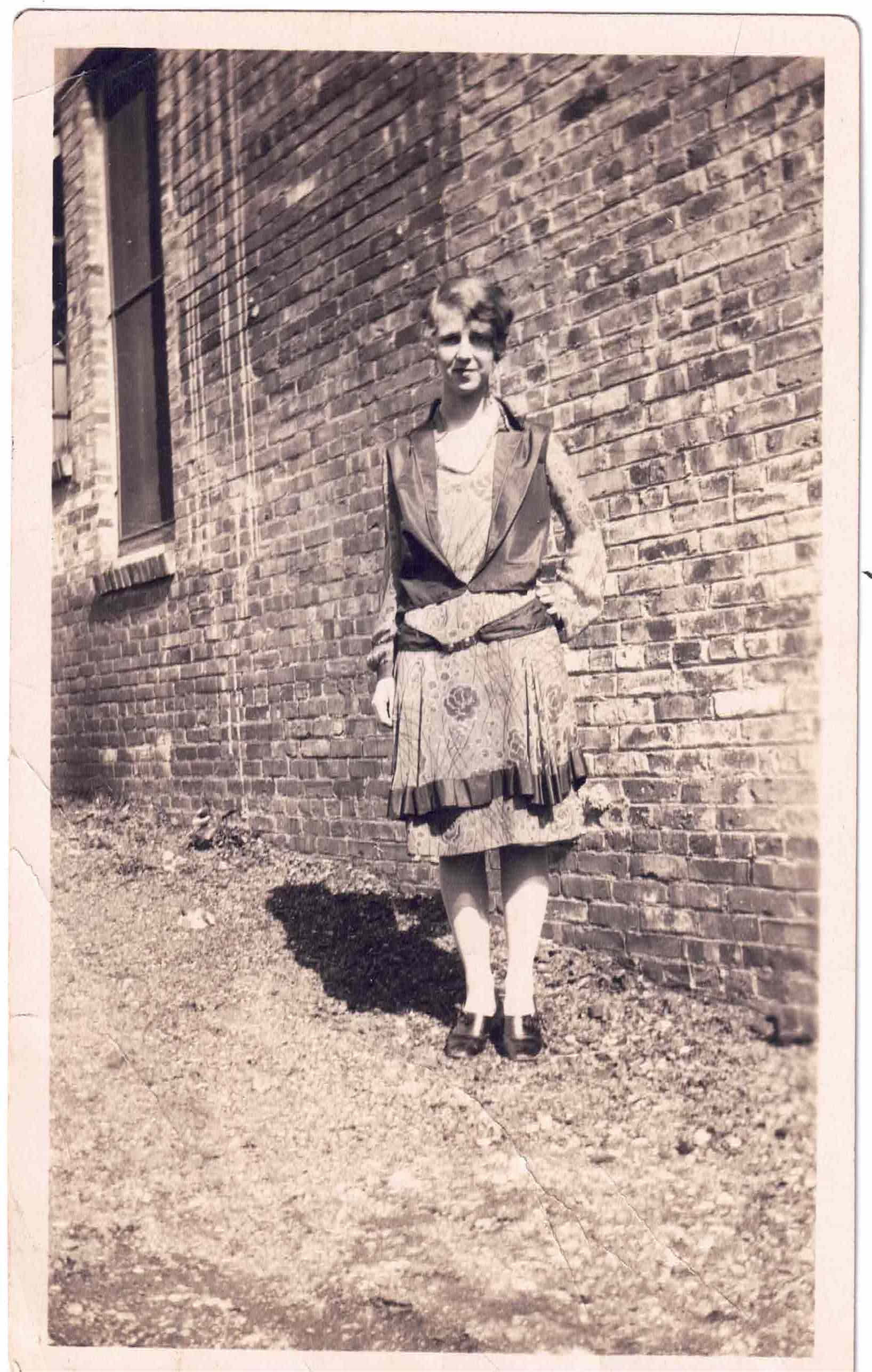
A photograph of Fern, dated 19 May 1927, is labeled in her handwriting, “Yours truly in front of Coop Dairy where I worked until I got married and we moved to Norfolk Nebr. What the well dressed secretary wore.” Fern can be seen wearing a loose-fitting, drop-waisted dress with a pleated, tiered skirt. The fabric is patterned with a rose print, and a collared open vest in a solid color is worn over her dress. Short, waved hair frames her face, and she wears heeled shoes. She stands before the brick exterior wall of a building, the bright midday sun casting her shadow behind her.

The “Coop Dairy,” as Fern called it, was located on Howard Street, near the Floyd River. Fern lived with her parents, and although they moved houses several times in the late 1920s, they remained within a half mile or so of Fern’s workplace. The well dressed secretary would have needed comfortable shoes for the ten-minute walk to and from the dairy!

Copyright © 2022 Melanie Frick. All Rights Reserved.

Continue reading

The Chicoine Family Reunion, Revisited

Note: The following provides an update to the post “The Chicoine Family Reunion,” which was published in March 2021. 

When I first shared a photograph of a Chicoine family reunion held at Riverside Park in Sioux City, Woodbury County, Iowa, which took place nearly one hundred years ago, alongside a key prepared by the late Maurice Chicoine, a number of individuals were unidentified and the date of the photograph, as stated on the key, was presumed to be the summer of 1926. Now, after collaboration with numerous descendants of those pictured, additional blanks have been filled in—and the photograph is now believed to have been taken a year prior, on precisely 02 August 1925.

Why the change of date? In addition to the discovery of an original copy of the photograph that belonged to Maurice Chicoine and is now in the possession of Karen Chicoine, which is marked 1925, the presence or absence of several babies provide the primary clues. For example, Thomas and Rachel (Chicoine) Dougherty are pictured holding their children Annette and Richard; Annette, who was born in February 1925, clearly looks to be under a year old. Oswald Montagne, also pictured with an infant, had a daughter Marie who was born in September 1924. In addition, Emma (Chicoine) Beauchemin, pictured without an infant in arms, was expecting; her son would be born in December 1925.

Although initially, the details recorded in a 1925 newspaper clipping about the reunion led me to believe that it was taken the following year, given the other evidence it seems that this was not actually the case. The Sioux City Journal wrote on 04 August 1925 that at the reunion, “The oldest member of the family present was Mrs. Philip Bernard, Sioux City, 70 years old, and the youngest was Rose Chicoine, 6-month-old daughter of Mr. and Mrs. Fedora Chicoine, of Jefferson.” Mrs. Philip Bernard, Delphine (Chicoine) Bernard, is present in the photograph, but Mrs. Fedora Chicoine and her infant daughter (who was actually named Dorothy; her mother was Rose) were not; it is, of course, entirely plausible that they had left the gathering early or were occupied off-camera at the time that the photograph was taken. Furthermore, the newspaper reporter named the wrong infant altogether—Annette Dougherty was two months younger! For that matter, Delphine (Chicoine) Bernard was not the actual oldest member of the family in attendance; that honor may have gone to her sister Elise (Chicoine) Benjamin.

Finally, the location of the photographer’s studio, stamped on the photograph, initially gave me pause. The photographer, Henry Griebel, was listed at the stamped address in the 1926 Sioux City Directory, but his home and studio were elsewhere in the 1925 Sioux City Directory. However, upon consideration, there was ample time for the photographer to have changed locations between January and August 1925. 

Chicoine descendant and fellow genealogist Michael Malloy graciously created the below key (click to view the full-size image) of what is now believed to be a photograph of the 1925 Chicoine Family Reunion, with superimposed text over the individuals in the image to aid in identification:

chicoine-family-reunion-picture

Chicoine Family Reunion, Riverside Park, Sioux City, Woodbury County, Iowa, 1925; digital image with superimposed text 2021, courtesy of Michael Malloy, digital image 2021, courtesy of Jeanette Borich; privately held by Ken Chicoine and Karen Chicoine, 2021.

An updated list of identities is below:

Photo 1 Top Row: Agnes Chicoine, Emma Chicoine, Pauline Lambert, Elsie Montagne, Carrie Chicoine, Odile Chicoine, Luella (Limoges) Chicoine, Delia Brault, Albina Chicoine, Louise (Ryan) Chicoine, Edna (Quintal) Chicoine, Louisa (Chartier) Chicoine, Margaret (Norton) Wyant, Selena (Rubida) Quintal
Photo 1 Middle Row: Alphonse Chicoine, Alex Chicoine, Denis Chicoine, Edgar Chicoine, Edmond Chicoine, Odias Chicoine, Elmer Chicoine, Leo Chicoine, Conrad Chicoine, Emil Chicoine
Photo 1 Front Row: …?, Ferdinand Chicoine, Donald Chicoine, Orville Chicoine, Ella Jane Bertrand, Wallace Chicoine, Teresa Chicoine, Doris Chicoine, Bernice Chicoine, Veronica Chicoine, Madonna Chicoine, Marc Chicoine
Photo 2 Top Row: Ora Quintal, Ella Quintal, Loretta Quintal, Rose Montagu, Martin Chicoine, Cora (Chicoine) Brouillette, Martin Chicoine, Martin Quintal, Adrian Chicoine, Leander Bertrand, Mary E. (Bourassa) Fontaine, Ruth Chicoine, Aloysius Bourassa, Esther Bourassa, Laura (Montagne) Chicoine, Orise (Bernard) Montagne, Rachel (Chicoine) Dougherty with Richard Dougherty, Dalma (Cyr) Beaubien
Photo 2 Middle Row: Eugene Chicoine, Philip Bernard, Joe Montagne, Bert Crevier with Dean Crevier, Fedora Chicoine, Leonard Chicoine, Jean Baptiste Fontaine, William Chicoine?, Thomas D. Dougherty with Annette Dougherty, Arthur Chicoine, Louis Beaubien, Clarence Montagne
Photo 2 Front Row: Hubert Chicoine, Claire Montagne, Sylvia Madonna Chicoine, Gabriel Sirois, Oswald Montagne with Marie Jean Montagne, Lucille Crevier, Maurice Chicoine
Photo 3 Top Row: Evelyn (Cyr) Deranleau, Priest from Salix, Wiska (Cyr) Gregoire, Viola (Beaubien) Montagne, Melanie (Lutz) Adam, …?, Peter Adam, Elizabeth (Courtmanche) Adam, Sophia (Chicoine) Menard, Aglae (Sirois) Bosse, Joseph F. Chicoine, Marie (Pepin) Chicoine, Obeline (Chicoine) Lambert, Corrine (Montagne) Chicoine, Mayme Chicoine, Gertie (Crevier) Chicoine, Leona (Chicoine) Crevier, Yvonne (Morin) Chicoine, Beatrice Chicoine, Rose (Langle) Chicoine, Arsenia (Allard) Chicoine
Photo 3 Middle Row: Joe Gregoire, Sylvester Montagne, Laurence Chicoine with Irene Chicoine, Henry Adam, Ernest Menard, Maxine Chicoine, Charlotte Crevier, …?
Photo 4 Top Row: Simone Sirois, Bertha (Chicoine) Sirois, Genevieve Sirois, Happy Jauron with Elizabeth Jauron, Eva Marie (Chicoine) Jauron, Delphine (Chicoine) Bernard, Irene Trudeau, Marie (Perrault) Chicoine, Amanda Chicoine, Regina (Benjamin) Chicoine, Elise (Chicoine) Benjamin, Marcella Chicoine, Christina (Chicoine) Bourassa, Marie Philomine (Brouillette) Bourassa
Photo 4 Middle Row: Fabien Lambert, Raymond Chaussee, Joe Chicoine, Hermidas Chicoine, Jerome Gadbois with …?, Alfred Chicoine, Isaac Benjamin, Alex Bourassa, John Bourassa, Gerald Chicoine, Joseph Lambert, Francis Lambert
Photo 4 Front Row: …?, …?, …?, Pauline Chicoine, Janette Chicoine, Loretta Chicoine, …?, Gerald A. Chicoine, Roger Bourassa

Can you identify any of the remaining unnamed individuals in the photograph?


Copyright © 2021 Melanie Frick. All Rights Reserved.

Continue reading

The Chicoine Family Reunion

Note: An updated post about this photograph, including a new date and additional identifications, was published in September 2021 and is available here.

A century ago, numerous grandchildren and great-grandchildren of the French Canadian blacksmith Leon Chicoine and his wife Marie Vary were in the habit of gathering annually for an extended family reunion at Riverside Park in Sioux City, Woodbury County, Iowa.

In the summer of 1925, the Sioux City Journal printed the following:

200 ATTEND FAMILY PICNIC AT RIVERSIDE

More than 200 members of the Chicoine family, residing in Sioux City and surrounding territory, held their annual picnic at Riverside park Sunday. Several hundred of the family, which is one of the pioneer families of this part of the country, are located in northwestern Iowa, southeastern South Dakota and northeastern Nebraska.

The majority of those who attended the picnic were from Sioux City, Jefferson, S.D., Elk Point, S.D., and Salix, Ia. The oldest member of the family present was Mrs. Philip Bernard, Sioux City, 70 years old, and the youngest was Rose Chicoine, 6-month-old daughter of Mr. and Mrs. Fedora Chicoine, of Jefferson. A basket dinner and a program of games and sports occupied the afternoon and evening.

The following year, a large group photograph—or rather several photographs pieced together—was taken at the family gathering, and featured just shy of one hundred and fifty individuals. The photograph is labeled Griebel Photo along with a street address; according to the 1926 Sioux City Directory, a Henry Griebel was indeed at that address, but his home and studio were elsewhere in 1925. Thus, the 1926 date provided for this photograph seems plausible—and the decade itself is undeniable when taking into account that the women almost uniformly have their hair bobbed! Riverside Park, the location of the reunion, was a popular summer gathering place along the Sioux River, offering swimming, boating, and other recreational activities. 1926 marked the final year that Riverside Park would host the popular Interstate Fair, and an amusement park would open there the following year.

Chicoine Family Reunion, Riverside Park, Sioux City, Woodbury County, Iowa, 1926; digital image 2021, courtesy of Jeanette Borich; privately held by Ken Chicoine, 2021.

There is, fortunately, a key for this photograph, with many thanks to the late Maurice Chicoine. However, it is incomplete and not without error. If you recognize any kin in the photograph, please feel free to comment so that the key can be confirmed and/or updated accordingly. The names from the original key are transcribed below:

Photo 1 Top Row: Agnes Chicoine, Emma Chicoine, Pauline Lambert, Elsie Montagne, Carrie Chicoine, Odile Chicoine, Luella Limoges Chicoine, Delia Brault, Albina Chicoine, Louise Ryan Chicoine, Edna Quintal Chicoine, Mrs. Alphonse Chicoine, Mrs. Bob Wyant, Mrs. Quintal

Photo 1 Middle Row: Alphonse Chicoine, Alex Chicoine, Denis Chicoine, Edgar Chicoine, Edmond Chicoine, Odias Chicoine, Elmer Chicoine, Leo Chicoine, Conrad Chicoine, Emil Chicoine

Photo 1 Front Row: Orville Chicoine, Ferdinand Chicoine, Donald Chicoine, …?, Ilian Bertrand, Wallace Chicoine, Theresa Chicoine, Doris Chicoine, Bernice Chicoine, Veronica Chicoine, Madonna Chicoine, Marc Chicoine, Hubert Chicoine

Photo 2 Top Row: Ora Quintal, Ella Quintal, Rose Montague, Martin Chicoine, Cora Chicoine, Marty …?, Martin Quintal, Adrian Chicoine, Leander Bertrand, Mrs. J. B. Fountain, Ruth Chicoine?, Aloysius Bourassa, Esther Bourassa, Laura Montagne Chicoine, Orise Montagne, Rachel Chicoine Dougherty holding Richard, Dalma Beaubien Montagne

Photo 2 Middle Row: Eugene Chicoine, Philip Bernard, Joe Montagne, Bert Crevier and baby, Fedora Chicoine, Leonard Chicoine, J. B. Fountain, William Chicoine?, T. D. Dougherty and child, Art Chicoine, Louis Beaubien, Clarence Montagne

Photo 2 Front Row: Claire Montagne, Madonna Chicoine, Gabriel Sirois, Oswald Montagne and child, Lucille Crevier, Maurice Chicoine

Photo 3 Top Row: Priest from Salix, Wiska Derauleau, Viola Montagne, Rosella Montagne, …?, Mr. Adams, Mrs. Adams, Sophia Menard, Mrs. Eugene Bosse, Joe Chicoine, Mrs. Joe Chicoine, Obeline Chicoine Lambert, Corrine Chicoine, Mayme Chicoine, Gertie Crevier Chicoine, Leona Chicoine Crevier, Yvone Morin Chicoine, Beatrice Chicoine, Rose Langle Chicoine, Arsenia Allard Chicoine

Photo 3 Middle Row: Joe Gregoire, Sylvester Montagne, Laurence and child, …?, Ernest Menard, Maxine Chicoine, Charlotte Crevier, …?

Photo 4 Top Row: Simone Sirois, Bertha Sirois, Genevieve Sirois, Happy Jauron with child, Mrs. Jauron, Delphine Chicoine, Irene Trudeau, Marie Perrault Chicoine, Amanda Chicoine, Regina Benjamin Chicoine, Elise Chicoine Benjamin, Marcella Chicoine, Christina Chicoine Bourassa, Mrs. Alex Bourassa

Photo 4 Middle Row: Fabien Lambert, Raymond Chaussee, Joe Chicoine, Hermidas Chicoine, Gerome Gadbois and child, Alfred Chicoine, Isaac Benjamin, Alex Bourassa, John Bourassa, Gerard Chicoine

Photo 4 Front Row: …?, …?, Pauline Chicoine, Janette Chicoine, Loretta Chicoine, …?, Bourassa child, Roger Bourassa

Not named in the key are my great-great-grandparents, Henry Joseph Adam and his wife Melanie Veronica Lutz, immediately recognizable to me although I never met either one. Two individuals standing near them, recorded as “Mr. and Mrs. Adams,” are, I believe, Henry’s uncle and aunt, Peter Adam and his wife Elizabeth Courtmanche. Both Peter and Henry’s father Timothy Adam, who died several years before this photograph was taken, were sons of Timothée Adam and Marguerite Chicoine, Marguerite being a daughter of the aforementioned Leon Chicoine and Marie Vary.

I was introduced to this photograph upon meeting for the first time a distant cousin and fellow genealogist, Jeanette Borich, in 2019. We were stunned to find that my great-great-grandmother Melanie (Lutz) Adam was standing immediately to the right of her stylishly-dressed grandmother Viola (Beaubien) Montagne in this photograph, and like to think that they would be pleased that their descendants are in touch nearly a century later.

Copyright © 2021 Melanie Frick. All Rights Reserved.

Continue reading

Identifying “Mother” in a Vintage Photograph

When making an attempt to identify the subject of an old family photograph such as this one, the provenance of the photograph is of the utmost importance.

This photograph was part of a collection of family photographs once held by Cecilia Marie Christensen Petersen (1900-1993). Cecilia Marie, who was called Marie, was the biological daughter of Christen Christensen and Cæcilie Marie Jensen of Denmark. Cæcilie sadly died within days of her daughter’s birth. Marie was thus raised by her paternal aunt, Kristine Marie Christensen, and Kristine’s husband, Jens Christian Petersen. When Marie was five years old, she emigrated from Denmark to America with her adoptive parents; her biological father remained in Denmark.

Unidentified photograph, circa 1905, Vestervig, Thisted, Denmark; digital image 2016, privately held by Nicole Kilanowski, 2016.

Pictured in the photograph is an older woman, rather heavyset, in a loose-fitting dark dress. The dress has a horizontal gathered seam across the bodice, and a flounce over the shoulders. It hangs loosely with what looks to be an asymmetrical gathered seam across her hips. A brooch is fastened at her throat and a ring is on the fourth finger of her right hand; in Denmark, among other countries, this is the customary placement of a wedding ring. The woman’s face is lined and her hair appears gray. She stands looking down at a small dog who is perched atop a table, and holds the dog steady with both hands. The dog itself could be a terrier of some kind; it is possible that it is a Danish-Swedish Farmdog, a breed known for its rat-catching abilities as well as its mild and friendly demeanor as a house dog.

This is not the most straightforward photograph to date, particularly as older women may not have worn the latest fashions. However, an approximate date after 1900 seems reasonable; for one thing, by that point, I suspect that photographs—even in a small village in Denmark—would not have been so unusual or costly that it would have been unthinkable to be photographed with a pet.

Reverse of unidentified photograph, circa 1905, Vestervig, Thisted, Denmark; digital image 2016, privately held by Nicole Kilanowski, 2016.

The reverse side of this photograph has a handwritten note that, translated from its original Danish, reads: “Vestervig. Karbol’s greetings. Mother.” Vestervig is a village in northern Denmark. One can assume that Karbol is the dog and that “Mother” is the woman pictured. One might also assume that the recipient of this message was not currently in Vestervig. Perhaps Karbol was a beloved family pet and “Mother” wished to send a whimsical greeting to one of her offspring away from home.

Although this photograph was in Marie’s possession, the woman pictured here appears far too old to be Marie’s mother—either biological or adoptive—based on the assumption that this photograph was taken around the time of Marie’s birth at the turn of the last century. However, it is possible that she was one of Marie’s grandmothers: her biological maternal grandmother, her biological paternal grandmother/adoptive maternal grandmother, or her adoptive paternal grandmother, all of whom were living at the time of the 1901 Danish Census.

  • Marie’s biological maternal grandmother, Marie Andresen (1835-1912), was a resident of Vamstrup Parish, Ribe, Denmark. This was a distance of more than one hundred miles from Vestervig, the place name written on the back of the photograph.
  • Marie’s biological paternal grandmother/adoptive maternal grandmother, Ane Nielsen (1844-1905), was a resident of Vestervig Parish, Thisted, Denmark.
  • Marie’s adoptive paternal grandmother, Maren Knudsen (1838-1923), was a resident of Hurup Parish, Thisted, Denmark, a distance of about five miles from Vestervig, as of 1901, but by 1906 was a resident of Vestervig.

It would seem that only Marie’s biological maternal grandmother, Marie Andreasen, can be ruled out with any confidence, as she lived a long distance from Vestervig. Marie’s biological paternal grandmother/adoptive maternal grandmother, Ane Nielsen, and her adoptive paternal grandmother, Maren Knudsen, are both strong contenders as both were residents of Vestervig in the early 1900s.

Ane Nielsen was the youngest of Marie’s grandmothers and was sixty years old when she died in early 1905. Although the woman in this photograph looks to me as though she could be older than sixty—or even seventy—it also seems reasonable to consider that a hardworking farmwife and mother of eleven children might well look older than one might expect a woman of the same age to look today. If this is indeed Ane, then, to whom might she have directed this photograph and the accompanying message? One possibility is that she might have mailed it to her daughter Kristine, Marie’s adoptive mother/paternal aunt. Although Kristine did not venture to America until after Ane’s death, she had moved from Vestervig to Copenhagen with her husband and child in 1902. Copenhagen being a significant distance from Vestervig, mother and daughter certainly must have corresponded, and if they happened to have shared a fondness for the family dog, Ane might well have sent this photograph and note simply to bring a smile—perhaps intending that it amuse her young granddaughter as well.

Maren Knudsen, however, is also a plausible potential subject of this photograph. She was sixty-seven years old in 1905, the year that her son, Jens Christian, her daughter-in-law, and their adopted daughter Marie immigrated to America. She lived until 1923, so would have had many years during which she could have corresponded with her son and at some point passed this photograph on to him.

Can this, then, be identified as a photograph of either Ane Nielsen (1844-1905) or of Maren Knudsen (1838-1923), both of Vestervig, Denmark? It seems likely that it is a photograph of one of the two women, but unless another photograph of either Ane or Maren turns up for comparison—or a more conclusively identified copy of this same photograph—it is impossible to be absolutely certain. A handwriting comparison could also be conducted thanks to the inscription on the back of the photograph. In either case, the bond between this woman and her dog is certainly charming to behold and the photograph was surely treasured by whomever received it.

Copyright © 2021 Melanie Frick. All Rights Reserved.

Continue reading

A German American Family in Chicago

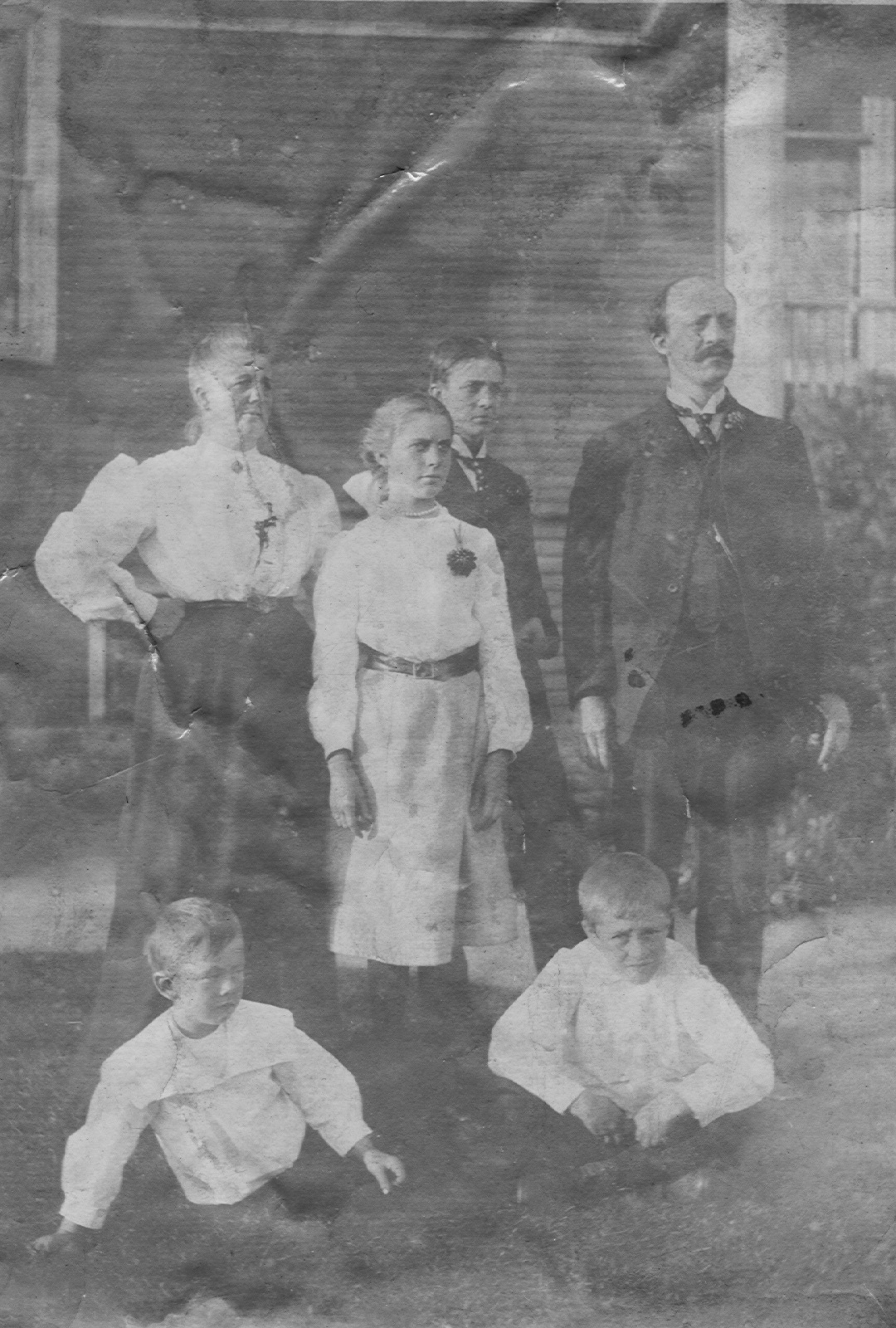
Several years after German immigrants Fred and Emma (Stube) Wiese of Chicago, Cook County, Illinois posed for a photograph together in their garden, they were photographed outdoors once again, this time with their children.

Fred and Emma (Stube) Wiese with children, from left, Leonard, Rose, George, and Oliver, circa 1904, Chicago, Illinois; digital image circa 2000, provenance of the original unknown.

Their youngest son, Leonard, seated at left, provides the biggest clue in dating this photograph, as his age is the easiest to pinpoint: assuming that he was, perhaps, three years old here, it can be dated circa 1904.1 George, standing between his parents, would have turned seventeen that year, Rose would have turned twelve, and Oliver, seated at right, would have turned eight.2 Sadly, Fred and Emma’s oldest daughter, Lillie, had died of meningitis as an eight year old in 1897.3

The Wiese family is pictured outside what may have been their own Victorian-style home at 2502 North Neva Avenue in Chicago’s Montcalm neighborhood.4 Only one of the six looks directly at the camera. Perhaps a second photographer was off to the side, where the other five members of the family directed their attention. This image is a scan of an original of an undetermined medium; it is rather heavily damaged with wrinkles, scuffs, and blotches.

Fred, who was a cigar maker by trade, sports a full mustache and wears a dark suit and tie.5 He is in his late thirties here.6 Emma, also in her late thirties, wears a white collared shirtwaist with a brooch at her throat, paired with a walking skirt in a darker color.7 A belt with a decorative clasp can be seen at her waist. A skilled seamstress, Emma was especially known for crocheting elegant garters, a talent she used to help support her family in her later years.8 It can well be imagined that she had a hand in making sure that she, her husband, and their children were well-dressed.

George wears a suit and tie much like his father’s; his fair-haired younger brothers sport rather voluminous white shirts and dark pants. Rose’s hair is pulled back into a braid and set off with a large bow; her simple shirtwaist and skirt, which falls mid-calf, are accessorized with a belt tied at her waist, a corsage, and a string of beads at her neck. These beads resemble pearls, although her mother was also known to make fragrant, darker-colored beads out of crushed rose petals which she would then alternate with pearl beads to create a necklace.9

This is the only known photograph of Fred and Emma (Stube) Wiese with their children. Despite the beating that the original print appears to have taken, it remains a special memento of a day in the life of this German American family in Chicago.

Copyright © 2019 Melanie Frick. All Rights Reserved.

Continue reading
A Mother and Her Sons

Kathrine (Christensen) Walsted had lived in America for nearly thirteen years when she was photographed with her two young sons in 1919.1 She had immigrated from Denmark at the age of twenty; now in her early thirties, she resided with her husband and children in a small rental house in Sioux City, Woodbury County, Iowa.2

Kathrine (Christensen) Walsted with sons Roy Louis Walsted and James Herman Walsted, circa 1919, Sioux City, Iowa; digital image 2010, privately held by Melanie Frick, 2019.

It is a bit puzzling why her husband of nine years, Jens Jacob Walsted, known as James, was not photographed with her. Although James registered for the draft in September of 1918, it is not believed that he ever served in World War I.3 However, as he was a bricklayer by trade, it is possible that he traveled at times to work on building projects. Perhaps his wife wanted to surprise him with a portrait to keep with him when away. This may also be why Kathrine alone was photographed with her eldest son when he was an infant, several years prior.

Of course, James may simply not have enjoyed having his photograph taken! Although he lived to the age of seventy-five, only three informal photographs of him have been uncovered.4 One gives a glimpse of him as a young man, while the other snapshots were taken in his later years.

In any case, in this photograph, Kathrine appears elegant yet warm, with a faint smile at her lips and a hint of a dimple at her cheek. Her thick hair is pinned up in a bun, the trend of the bob having not yet swept America, and soft curls escape at her temples. She wears what might have been a white cotton voile waist.5

Her eldest son, Roy, seven or eight years old here, wears a dark suit and tie.6 His hair is neatly trimmed and combed to the side, and his expression is wide-eyed and solemn. Young James, named for his father, looks to be about a year and a half old, his fair hair in a bowl cut.7 His loose-fitting garment appears to feature some embroidery; as Kathrine was known to have been a member of a local needlecraft club, perhaps this was her own handiwork.8

Notably, Roy had barely recovered from a life-threatening brush with polio when his brother was born in November 1917. In September of that year, the Sioux City Journal had reported, “Roy Walstead [sic], 6-year-old son of Mr. and Mrs. James Walstead [sic], 406 South Helen avenue, Morningside, is expected to recover completely from an attack of infantile paralysis, according to the attending physician. The boy is able to walk alone now and in six months he is expected to have recovered entirely. If recovery is complete it will constitute one of the few cases on record, according to the physician.”9

Roy did indeed recover, although he always walked with a limp, and it has been said that his younger brother was his staunch defender against bullies. However, Kathrine was surely grateful to have both of her sons by her side and in good health when, one hundred years ago, she dressed them in their finest clothes and ventured with them to the portrait studio.

Copyright © 2019 Melanie Frick. All Rights Reserved.

Continue reading