Tag Archives: antique photograph

A July 4th Celebration

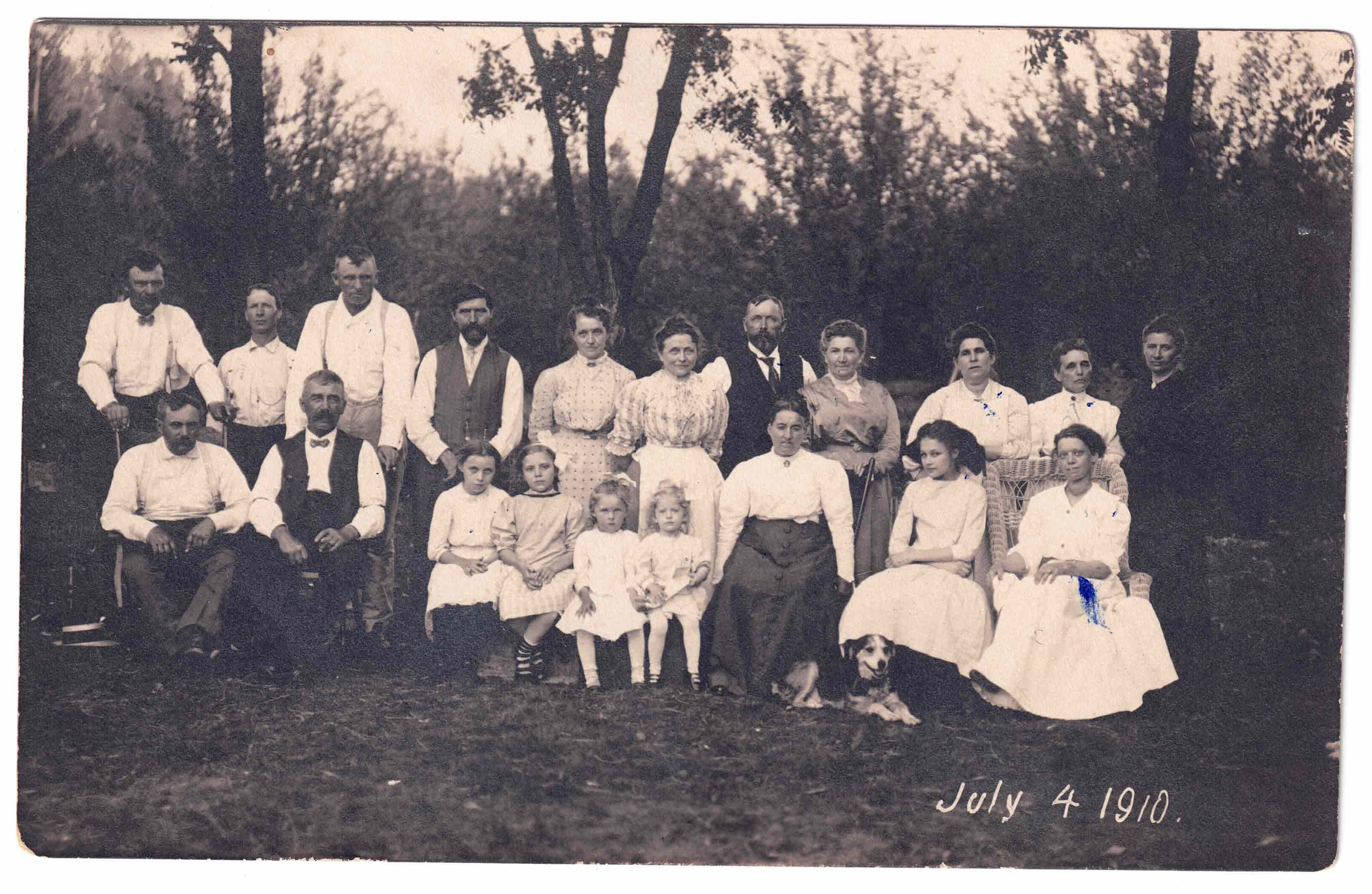
On 04 July 1910, a group of twenty people—plus one dog—came together for a photograph somewhere in Yankton County, South Dakota. Presumably, they had gathered to celebrate Independence Day, and several chairs were brought outside for their assemblage before a backdrop of trees. All present appear to be well if not formally dressed for the day. The men wear no jackets and several go without vests or ties, suggesting that the weather was quite warm, and several of the women and girls, most of whom wear light-colored, summer dresses, have their sleeves pushed to their elbows. At least one woman wears an apron. A man’s straw boater hat is cast to the side, and a dog rests, alert, at a girls’ feet. However, despite the fact that this was a warm summer day and that even the men have shed some layers, the children all seem to have been required to wear stockings and shoes as there are no comfortably bare feet in sight.

Independence Day celebration featuring descendants of Niels and Juliane (Hennike) Olsen and friends, Yankton County, South Dakota, 1910; digital image 2025, privately held by Greg Smith. Back, left to right: Jens Christian Nielsen?, Marius Larsen, Henry Schaller, John Nielsen, Cecilia (Nielsen) Boysen, Stena (Nielsen) Callesen, Jacob Nissen, Elizabeth Bruhn, Mrs. Schaller, Dorothea (Neilsen) Nissen, and Mary (Jacobsen) Nielsen. Front, left to right: Chris Callesen?, Erick Boysen, Herta Scheel Callesen, Cleora Nielsen, Grace Nielsen?, Violet Larsen, Jennie (Burton) Nielsen?, Henrietta Bruhn, and Helena (Nielsen) Larsen.

Thanks to a loose handwritten note that accompanied this photograph, as well as comparisons made with a 1902 group photograph that included many of the same individuals, most people have been identified with reasonable certainty. Present were at least five if not six of the eight adult children of the late Niels and Juliane (Hennicke) Olsen, Danish immigrants who had settled in Yankton County, Dakota Territory, in the early 1870s: John, Cecilia, Christina (Stena), Dorothea, and Helena Nielsen (also spelled Nielson or Nelson), along with their spouses. Their brother Jens Christian and his wife may have been there as well. Also present were several friends, who, according to the handwritten note, were members of the Henry Schaller and Henry Bruhn families.

The woman in the apron near the center of the photograph, who, given her attire, may have been the hostess of the event, is Christina “Stena” (Nielsen) Callesen (1860-1951). In 1910, Stena and her husband Christian “Chris” Callesen were living in Utica, Yankton County, South Dakota with their nine-year-old foster daughter Herta. Chris, whose name appears twice in the handwritten list of identifications, is likely seated at far left, while the child at left is Herta. Herta Scheel Callesen had been living with the Callesens since she was four years old and lost her father. Her mother, left with seven young children to feed, had made what must have been a difficult decision to allow her youngest daughter to be separated from the family—including from her twin brother—and raised by the Callesens. Stena was known to have had only one child of her own, a daughter who died in infancy. Herta, however, was one of as many as six children that the Callesens fostered or adopted over the years, some for only a short while and some, like Herta, to adulthood.

Seated to the right of Herta Scheel Callesen is her cousin Cleora Nielsen, the youngest daughter of John and Mary (Jacobsen) Nielsen. Cleora, eight years old, had been born in South Dakota but now lived in Santa Clara County, California. She and her parents had most likely returned to South Dakota for a summer visit with relatives; it is possible that her older siblings, the youngest already sixteen, remained in California, as they are not pictured here.

Next to Herta and Cleora are two young girls, between, perhaps, the ages of two and four. Only one was identified in the handwritten note, although it is not immediately clear which one: two-year-old Violet Larsen, the only child of Marius and Helena (Nielsen) Larsen. Tragically, Violet would live only to the age of four, and I have no other photographs of her. Although it was not indicated which girl is Violet, because the child on the right appears to me to be closer to the age of two—she fidgets with her skirt and her feet don’t quite reach the ground from the bench on which she appears to be sitting—that is my guess. There also seems to be a space left between the names of Cleora and Violet in the handwritten note.

Could the bigger of the two littlest girls be, perhaps, Grace Nielsen, four-year-old daughter of Jens Christian and Jennie (Burton) Nielsen? Jens, known familiarly as J. C. or Chris, was not named in the handwritten note accompanying the photograph, nor was his wife, but he bears some resemblance to the man at back left and his wife to the unidentified woman seated in the front row to the right of the children. The Nielsens, like the Callesens, lived in the small farming community of Utica, so it is reasonable to consider that they might have been present to spend the holiday with kin.

Jens Christian Nielsen, known as J.C. or Chris, is pictured at left in 1902. Could he be the man at right in 1910?

JaneJennie” (Burton) Nielsen is pictured at left in 1902. Could she be the woman at right in 1910?

The fact that this photograph was taken during a census year is particularly helpful in confirming the identities of the children, as it is possible to see exactly who resided in which household just a few months prior. It can be determined that the Bruhn and Schaller families, for example, did not have any young daughters who might have been seated beside little Violet Larsen. Unexpectedly, the census provided another important clue about this photograph: the identity of the photographer. It had seemed curious that family friend Henry Bruhn was not pictured alongside his wife, Elizabeth, and fourteen-year-old daughter, Henrietta, but according to the 1910 United States census, Henry Bruhn was, in fact, a photographer, and therefore may very well have been the person behind the camera.

Census records are of course less helpful when attempting to determine the identities of adults who are close in age, particularly considering the similarities in appearance among those with both shared heritages and lifestyles. Perhaps this is why whoever created the handwritten note accompanying the photograph named Chris Callesen twice! Cross-referencing with other more confidently identified photographs is key, and fortunately, in Chris’s case, there are two other known photographs that can be used as points of comparison and provide some degree of confidence.

Christian “Chris” Callesen is pictured at upper left in 1902 and at lower left in 1911. It is believed that he is the man at right in 1910.

Large group photographs like this are particular treasures in a family archive as they provide insight not only into the bonds of family and friendship, but also the occasions that brought people together. As they are less formal than studio portraits, they can also offer greater glimpses into personality and personal style, as well as the surroundings in which people lived. For a number of the Olsen descendants and their friends, 04 July 1910 looked to be a pleasant day spent in the fresh air, perhaps with a bountiful noon meal to share.

Copyright © 2025 Melanie Frick. All Rights Reserved.

Continue reading
Fred the Farmer

Frederick Thoma might never have had any intention of becoming a farmer. Born on 04 December 1857 in Garnavillo, Clayton County, Iowa, Fred was the eldest of eleven children born to Bavarian immigrants Wilhelm Heinrich Thoma and Anna Margaretha Poesch. His father, a respected community leader, owned and operated a general store in the town of Garnavillo, which is where Fred and his siblings were raised. In 1876, when Fred was eighteen, his father died; three years later, on 29 December 1879, he married Matilda J. Hammond, the daughter of a prosperous local farmer.

Fred and Matilda, who were known familiarly as Fritz and Tillie, had five children: George Hiram (born 1880), Leonard Christopher (born 1885), Ludelia Maria (born 1887), Roselyn Anna (born 1892), and Norma Evaline (born 1895). All lived to adulthood with the exception of Norma, who died in a diphtheria outbreak at the age of ten. This was not the first time that Fred had lost a loved one to communicable disease: two of his brothers had died of consumption, both when they were twenty-four, in 1886 and 1890. One can imagine that each of these losses would have had a profound impact on Fred.

As a young married man, Fred was a store clerk in Garnavillo; according to local news clippings, he then, over the course of several years, opened an agricultural warehouse, carrying “a full line of cultivators, reapers, etc.,” and next operated a saloon or billiard hall, dealing in “pure Wines and Liquors, choice Cigars, etc.,” before briefly entering the “fruit and fancy grocery business.” By 1895, however, when he was thirty-seven, the census recorded that he was a laborer, and his occupation remained the same in both 1900 and 1905. It seems that his business endeavors were ultimately unsuccessful, and family lore gives a clue as to why.

Decades later, Fred’s granddaughter recalled that his vice was alcohol, noting that his eldest son had left home as a teenager for this reason, and also that Fred’s wife, upon receiving an inheritance from the estate of her parents, bought a farm in order to remove Fred from town and from the temptation of the saloon. Indeed, in March of 1910, a local newspaper reported that Matilda Thoma had purchased 80 acres from William D. Harnack and his wife for $4800, and by the time of the U.S. census that April, the couple resided on their farm in rural Clayton.

The move northeast from Garnavillo into rural Clayton Township was a distance of about five miles, and it brought Fred and Matilda closer to the family of their eldest daughter and son-in-law who also farmed there. Newspaper clippings make mention of Fred and his son-in-law engaging in farm work, participating in a barn raising, and hauling sand across the Mississippi River at Clayton.

A newly uncovered photograph of Fred Thoma—in fact, the only photograph of him known to exist—shows him as a mustachioed farmer in overalls and a brimmed hat, standing beside a team of horses in front of a two-story farmhouse. It’s a beautifully kept home, featuring, at the time this photograph was taken circa 1910-1924, an inviting front porch complete with a wicker rocker, potted plants, and vines growing on a trellis. The front porch shelters two front doors, and curtains can be seen at the windows. A screened-in back porch is also visible around the side of the house, and leafy tree branches frame the shot. Fred, photographed, perhaps, after a brief rest in the Windsor chair behind him, appears relaxed and has an amiable expression.

Frederick Thoma (1857-1925), Clayton, Clayton County, Iowa, circa 1910-1924; digital image 2024, privately held by Julie Jentz, 2024.


Fred and Matilda farmed in rural Clayton between 1910 and 1924, when Fred’s poor health necessitated their return to town. In the summer of 1924, Fred had spent some weeks at the Prairie du Chien Sanitarium, where, weakened from a bout of influenza and suffering from dropsy, he had sought medical attention; his health not improved, that fall he auctioned off his livestock and numerous farming implements in a public sale. Late in the year, he and Matilda resettled in the town of Clayton; they lived there for only two months, during which time they would have celebrated forty-five years of marriage, before Fred’s death at the age of sixty-seven on 10 January 1925. The funeral was held at St. Paul Lutheran Church in Garnavillo, with members of the Garnavillo Turnverein, a German-American social club of which he was a member, in attendance.

Fred’s career as a farmer may have made up less than a decade and a half of his adult life, but one can hope that these were at the least peaceful, pleasant years for him and his family—years during which Matilda was able to put to use her skills and knowledge from a childhood spent on a farm, and Fred was able to face fewer temptations, connect with his adult children and young grandchildren, and engage in fulfilling work. The farmhouse where he and Matilda spent these quiet years still stands today on Great River Road between Garnavillo and Clayton.

Copyright © 2025 Melanie Frick. All Rights Reserved.

Continue reading

Wedding Wednesday: Puffed Sleeves, Revisited

It has been nearly a decade since I first featured this photograph on Homestead Genealogy, and at that time, I had never seen the original. The old photocopy in my possession was washed out and grainy, the young couple’s faces barely discernible, and the border with the photographer’s mark was not included. When a nearly pristine original made its way to me last year, I was elated: finally, every detail of the 1896 wedding portrait of my great-grandparents Mathias and Elisabeth (Hoffmann) Noehl of North Washington, Chickasaw County, Iowa, could be fully appreciated, and, in addition, the photographer’s mark offered a new clue about the couple’s lives as newlyweds.

Mathias Noehl and Elisabeth (Hoffman) Noehl, St. Peter, Nicollet County, Minnesota, 1896; digital image 2023, privately held by Melanie Frick, 2024. Courtesy of Richard Buscher (1933-2023).

In this photograph, Elisabeth, with dark hair and eyes and full brows that would be the envy of many young women of today, gazes steadily into the distance, her right hand on her husband’s shoulder and her left holding what is likely a Catholic prayerbook. Her dark dress boasts the elegantly puffed sleeves so popular in the mid-1890s, and a floor-length veil is affixed to the back of her head. A substantial floral arrangement is perched atop her head, cascading over her forehead, while smaller floral sprigs are fastened to her collar and her gathered bodice. These may well have been wax flowers, and appear to be orange blossoms, which were a popular choice for bridal wreaths. Elisabeth, who had immigrated to America from Germany at the age of twenty, had celebrated her twenty-seventh birthday less than a week prior to her marriage.

Mathias, blond and with a fair complexion, gazes in the opposite direction as his bride, his posture upright but casual as he poses seated in a wicker chair, one elbow resting on the arm. He wears a dark suit and vest with a white shirt and necktie, and a floral corsage has been attached to the front of his jacket. What may be a watch chain peeks out underneath. Mathias wears his hair short and has a full mustache; like Elisabeth, his expression is serious. Twenty-eight years old, Mathias had by that point spent a decade in America after emigrating from his native Germany.

Years later, he wrote of his meeting with Elisabeth:

“One day I was standing in front of the house of a venerable old priest, in whose service for five years I found living a good woman. She was reflecting what vocation she should choose. The old pastor had advised her to spend the rest of her life with him, as housekeeper, but on the other side of the house, the nuns beckoned to her, “Come and join us, Lizzie.” Then it happened that I passed by. I was in a neglected condition. My suit of clothes appeared to have seen better days. A hailstorm seemed to have come over my hat. My blond hair lay around my temples unkempt like dried up flowers of the cemetery. When she heard that I had come from her neighborhood village, Holsthum, she said to herself, “That is a disgrace to the whole valley of Prüm. He must be hidden from the streets of North Washington, even if I have to marry him. Perhaps there is hidden in that neglected and careless fellow a good provider, and, if I succeed in making a good Christian out of him, I can earn besides a good crown in heaven.” She thought further, “This is Leap Year and Eve had the job in paradise, a breath-taking job it was, to make the marriage offer. At my first attack, he fell on my breast. Father Probst then tied me to him, on the twenty-second day of September 1896, and he made the knot so tight that I could not think to get away from him anymore.”

Memoirs of Mathias Noehl (Translation)

Although the couple married in Iowa, the mark of the photographer Bancroft on this cabinet card reveals that their wedding portrait was not taken there. St. Peter, Minnesota was well over one hundred miles from North Washington, Iowa, where their marriage had been solemnized on 22 September 1896. What could have brought Mathias and Elisabeth there? I don’t have a good answer. It seems highly unlikely that the couple, certainly not well-to-do, would have set off on a leisurely honeymoon tour of the Midwest; more plausible is that they ventured to Minnesota, where Mathias had spent his first years in America, in order to visit Mathias’s aunts and uncles and/or to scout out a potential place to settle. Mathias and Elisabeth did later reside in Minnesota, but only briefly; after their first two children were born in Iowa, their third child was born in Meeker County, Minnesota in the spring of 1900 following a failed stint in Alberta. However, within months, the family had returned to Chickasaw County, Iowa. A few years later, they made a brief attempt to homestead in Saskatchewan, but, again, ultimately returned to Iowa to raise their nine children. In any case, it is known that Mathias had connections in Minnesota, and undoubtedly some familiarity with the rail lines—one of which did indeed pass through St. Peter.

As North Washington was a small community—its population has hovered between about one hundred to one hundred fifty residents for the past century—a photographer was presumably not available to Mathias and Elisabeth on the day of their marriage. Thus, the couple may have made a point to seek out a photographer during their travels north. Whether Elisabeth traveled with her own veil and flowers or obtained them from the photographer, it seems that this “photo op” must have been carefully planned, and indeed, as Mathias’s parents remained in Germany, it may have meant a great deal to the couple to have a portrait taken in order for Mathias to be able to introduce his parents to his bride.

Copyright © 2024 Melanie Frick. All Rights Reserved.

Continue reading

The Thatcher’s Family

When Matthias Hoffmann died in 1879 at the age of fifty-eight, he left a widow and six children, the youngest of whom was only four years old. Matthias, a thatcher by trade, had lived with his family in the village of Prümzurlay, Eifelkreis Bitburg-Prüm, Rhineland-Palatinate, Germany, near Luxembourg. He and his wife, Anna Marbach, had married in the village of Ernzen on 24 September 1861, and six children were born to them over the next fourteen years: Clara (1861), Nicolaus (1864), Jacob (1867), Elisabeth (1869), Eva (1872), and Matthias (1875).

It is not known how the Hoffmann family supported themselves after Matthias’s death, but as Anna did not remarry, she and her eldest daughters may have been able to earn an income from spinning, weaving, or the like, while her eldest sons may have hired out as shepherds or farm laborers. Perhaps Nicolaus, who was fourteen when his father died, was fortunate enough to have already had an apprenticeship in place; eventually he married and settled in the area, living out his life in Germany.

Prümzurlay, Rheinland-Pfalz, Germany photograph, 2009; privately held by Melanie Frick, 2024.

For the others, however, new horizons were sought. Jacob, the second eldest son, who had been twelve years old at the time of his father’s death, was the first to immigrate to America. He traveled alone from Antwerp to New York in the spring of 1887 when he was twenty years old. One can well imagine the hard work that he—and his mother and siblings—must have undertaken in order to book his passage, quite likely with the expectation that he would pave the way for the rest of the family to eventually join him overseas. Jacob then made his way to northeastern Iowa.

Three years later, in the spring of 1890, his sisters Clara and Elisabeth followed. Within a month of their arrival in North Washington, Chickasaw County, Iowa, Clara, who was twenty-eight, married fellow immigrant John Seelhammer. One wonders whether they had been acquainted in Germany, or whether Jacob may have facilitated the match. Elisabeth, twenty, was not so quick to settle down; she found employment as a housekeeper for the local priest, Father Probst, who was a native of Luxembourg.

In the spring of 1891, matriarch Anna (Marbach) Hoffmann, who was by then fifty-five years old, voyaged from Antwerp to New York with her two youngest children, Eva, eighteen, and Matthias, sixteen. They too were bound for Chickasaw County, Iowa, where they would reunite with Jacob, Clara, and Elisabeth.

The 1895 Iowa state census indicates that Anna and at least four of her children resided in Chickasaw County: Anna headed a household that included her sons Jacob and Matthias, both of whom farmed; Clara lived with her husband, a shoemaker, and their children; Elisabeth resided at her place of employment with Father Probst and the Sisters of Charity. Eva is absent from the 1895 Iowa state census, but whether this is because she had moved elsewhere or was simply missed by the census enumerator is not known.

It was in Chickasaw County that Jacob married Margaret Nosbisch in 1895, and where Elisabeth married fellow immigrant Mathias Noehl in 1896. In 1898, however, tragedy struck the Hoffmann family, when Matthias, the youngest child of Matthias and Anna (Marbach) Hoffmann, died at the age of twenty two or twenty three. Another blow occurred that year when Jacob and his wife lost a child at one day old.

It was also in 1898, however, that Eva married in Chicago to Mathias Weyer, and by 1900, her mother had joined her there. Chicago wasn’t a surprising destination for them; Anna’s mother and two of her sisters had settled there decades earlier. Although her mother had since passed away, Anna would have had the opportunity to reunite with her sisters and to meet her nieces and nephews.

Ultimately, Anna seems to have remained in Chicago until her death in 1907; the cause was attributed to asthma. Clara and Elisabeth both raised large families in Chickasaw County, with Clara having eight children and Elisabeth nine. Eva had one child with her first husband, a farm laborer and beer peddler; after she was widowed, she remarried in 1913 to Milton Jonas, and lived out her life in Chicago.

Jacob, whom a local newspaper described as being “of that hustling, genial disposition which makes him companionable and agreeable whether the weather, or something else is or is not just to his liking,” set his sights on South Dakota shortly after the dawn of the new century, and later settled in Hidalgo County, Texas, with his wife and son—who was ultimately the only one of his six children to survive infancy.

Brother and sister Jacob Hoffmann and Elisabeth (Hoffmann) Noehl, Hidalgo County, Texas, 1940; digital image courtesy of Jacky Sommer, 2018.

Whether the scattered Hoffmann siblings were able to remain in close contact in the decades following their mother’s death is unknown, but it is known that Jacob returned to Iowa to bury his wife in 1929, and there is also evidence—in the form of a photograph—that Elisabeth visited her older brother Jacob at his orange grove in Mission, Texas, in 1940. Eva had died in 1936; Jacob would pass away in 1954, Clara in 1955, and Elisabeth in 1957. Of the fate of their brother Nicolaus who was said to have remained in Germany, however, nothing is yet known.

Copyright © 2024 Melanie Frick. All Rights Reserved.

Continue reading

Back to School

I first glimpsed this photograph behind clouded glass more than fifteen years ago. I was visiting the Garnavillo Historical Society in northeastern Iowa, a short distance from the Mississippi River, and I was thrilled to spy the face of my great-great-grandfather as a little boy in this cabinet card photograph of the Garnavillo School. However, due to its semi-permanent placement inside glass, it wasn’t until more recent efforts by the historical society to refresh their exhibits and digitize their collections that I was, happily, able to obtain a clear copy.

Garnavillo School, circa 1888, Clayton County, Iowa; digital image 2023, privately held by the Garnavillo Historical Society, 2023. Image shared with permission.

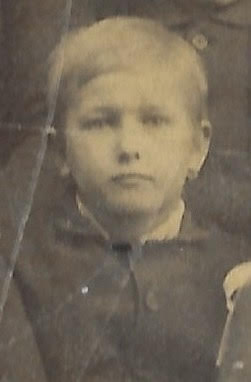
George Hiram Thoma, the son of Frederick Thoma and Matilda Hammond, was born in Garnavillo, Clayton County, Iowa on 29 September 1880. His parents were natives of Clayton County, and, right around the time that George would have started school, his father was known to have operated a restaurant in Garnavillo. Pictured here in the second row, fifth from right, fair-haired George, perhaps eight years old, regards the photographer with a still and serious expression, mimicking his teacher more so than some of his wiggly classmates. Thirty-six students were present for “Picture Day” at the Garnavillo School; this photograph, initially believed to have been taken circa 1886, was in fact more likely taken about two years later based on the birth dates of some of the youngest children pictured.

The teacher, Julia Downey, was said to have taught school in Clayton County for thirteen years prior to her 1893 marriage. Her students, with birth year in parentheses if available, are identified below:

Front row, left to right: Sophia Maack (1877), Ora Ahlitz (1879), Emma Harnack (1879), Severa Wirkler (1881), Harvey Maurer (1882), Norma Maurer (1884), Edna Brumm (1883), Adelia Kuhlman (1880).

Second row, left to right: Aerney Tangeman (1881), Alto (Realto) Schumacher (1881), Erwin Wirkler (1880), Billy Gilmore ( ), Will Schumacher (1880), George Thoma (1880), Gretchen Gilmore ( ), Waldemar Krasinsky (1880), Louise Rohde (1881), Elizabeth Siebertz ( ).

Third row, left to right: George Tangeman (1878), George Hill (1882), Paul Rantzow (1879), Miss Julia Downey, Orville Roebken (1879), Gruel ( ), Abner Roebken (1881), Fred Nieter (1880), Fred Stickfort (1879), Emil Schumacher (1879).

Back row, left to right: Irving Maurer (1879), Bruno Tangeman (1879), Ed Breitsprecher (1879), William Blunck (1877), Henry H. Stickfort (1878), Julius H. Rohde (1879), Gruel ( ), Elmer G. Brumm (1878), Arthur (Art) Gruetzmacher (1878).

Courtesy of the Garnavillo Historical Society

Garnavillo boasted a brick, two-story schoolhouse with four rooms; however, this photograph seems to have been taken instead at the studio of the photographer, Mr. Tangeman, as a hanging backdrop is evident. The students pictured here were between the ages of approximately four and eleven, and one can imagine that a field trip to the photographer’s studio would have made for an exciting school day for them.

George Hiram Thoma, detail from Garnavillo School, circa 1888, Clayton County, Iowa; digital image 2023, privately held by the Garnavillo Historical Society, 2023. Image used with permission.

Little is known about young George’s school days, although he was apparently a motivated student as would go on to complete high school. The high school that he attended was not in Garnavillo, however, but in the town of Postville in neighboring Allamakee County. As his grandparents resided there, it is possible that he boarded with them during his high school years. As a teenager, George worked for a time at a local hardware store, volunteered with the fire department, and then, according to family lore, made his way west with his bicycle and changed his name—but that’s another story!

Copyright © 2023 Melanie Frick. All Rights Reserved.

Continue reading

Matilda the Midwife

“Matilda was a midwife,” so goes the family story, “and delivered a lot of babies in the county.” Despite a lack of definitive documentation, and almost certain lack of opportunity for any formal training, this nevertheless seems plausible. Matilda J. (Hammond) Thoma (1859-1947) of Clayton County, Iowa birthed five children of her own, and it does not seem unlikely that she might have assisted at the births of others in her close-knit community. She had numerous nieces and nephews whose births she might have supported, and she may even have served as midwife at the births of some of her own grandchildren. Indeed, it was her granddaughter Ina Fischer, born in 1907, who recalled nearly eighty years later that Matilda had been a midwife, and a 1920 newspaper announcement indicated that another granddaughter, Jacqueline Chaney, was in fact born at Matilda’s home.

Matilda (Hammond) Thoma and Franque (Friend) Curtis photograph, circa 1922, Clayton County, Iowa; digital image 2023, privately held by Melanie Frick, 2023.

Here, in one of only two photographs known to exist of Matilda, she poses with granddaughter Franque Friend. Matilda would have been in her early sixties at the time that this photograph was taken circa 1922; her hair, loosely coiled into a bun atop her head, seems to have gone mostly white. She wears a somewhat rumpled striped dress with buttons up the front and a wide collar in a contrasting fabric; this was not a studio portrait, but a casual snapshot apparently taken at home. Matilda appears to sit on a sofa near a window, a potted plant beside her, and striped wallpaper is visible in the background. She offers a small smile to the camera. Young Franque, perhaps ten years old here, stands next to her grandmother, grinning beneath the broad brim of a straw hat with a fringe of dark hair just peeking out. She wears a white dress with scalloped cuffs, a bow at the collar, and a leather belt.

Matilda, the daughter of Hiram H. Hammond (1813-1896) and Eva Margaret Stoehr (1831-1906), spent more than sixty-five years in Clayton County, Iowa, where she was born and later married Frederick Thoma (1857-1925). Four of their five children lived to adulthood; the youngest sadly died in a diphtheria outbreak at the age of ten. Following her husband’s death, Matilda eventually relocated, first to Texas with her daughter Roselyn and then to Wisconsin where she lived with her granddaughter Jacqueline. Few other details are known of her life, but what little is known suggests that she was a kind, competent, and maternal individual—just the sort to lend a hand as a midwife.

Copyright © 2023 Melanie Frick. All Rights Reserved.

Continue reading

The Sattlermeister of Trarbach

August Heitz, one of a dozen children born to Carl Theodor Heitz and Anna Maria Moog, was born on 26 March 1846 in Trarbach, Bernkastel-Wittlich, Rhineland-Palatinate, Germany. His father was a tanner, and August was destined to work with leather as well: following an apprenticeship to learn the trade, and time spent as a journeyman to hone his skills, he became a sattlermeister, or master saddler.

Trarbach, Marktplatz vor dem Stadtbrand von 1857 [Marketplace before the Town Fire of 1857], Holzstich; ; Wikimedia Commons, copyright Bligny.

August was thirty-one, likely well established in his trade, when he married Julianna Carolina Faust on 18 August 1877. Julianna, then twenty-one years of age, was the daughter of a cooper and likewise a native of Trarbach. The couple settled in their hometown, idyllically situated along the Mosel River and surrounded by abundant vineyards, and raised five children there: Julchen, Carolina, Anna Maria, Ida, and Adolf Heitz. A sixth child, August, died in infancy.

As a saddler in the final years before automobiles became widespread, August would have worked to make and repair saddles, bridles, and harnesses. He would also have trained others who wished to learn his trade, and the handwritten contract of at least one of his apprentices is extant. On 20 June 1901, the widow Anna Faust contracted her son, Otto, to a three-year apprenticeship under August Heitz, paying him a one-time fee of fifty marks for his tutelage. August promised to provide Otto with thorough instruction, health insurance and “contributions from his means,” whereas Otto agreed to diligent, orderly work and conduct. Otto would also be free on certain days to assist his mother “with her own work.” Interestingly, this contract notes that August was a tapezierer, or upholsterer, in addition to being a saddler.

It is unknown whether August also shared his knowledge of his trade with his surviving son, Adolf, as he ultimately made his career as a wine merchant. This trade was shared by two of August’s sons-in-law, as well, the husbands of both Julchen and Ida; Carolina’s husband was an innkeeper. Only Anna Maria did not marry; she joined a religious order.

August Heitz photograph, circa 1910, Germany; digital image 2011, privately held by Melanie Frick, 2023.

Little else is known of August’s life in Trarbach, although it appears that through his trade he was able to provide a comfortable life for his family. The only known photograph of him seems to have been taken when he was in his sixties, sometime around the year 1910. Sporting a dapper mustache and a pleasant expression, he wore a collared shirt, necktie, vest, and double-breasted wool suit coat for the occasion.

August Heitz died at the age of sixty-seven on 23 December 1913, survived by his wife, five children, and, eventually, six grandchildren.

Copyright © 2023 Melanie Frick. All Rights Reserved.

Continue reading

A Young Member of the Catholic Cadet Corps

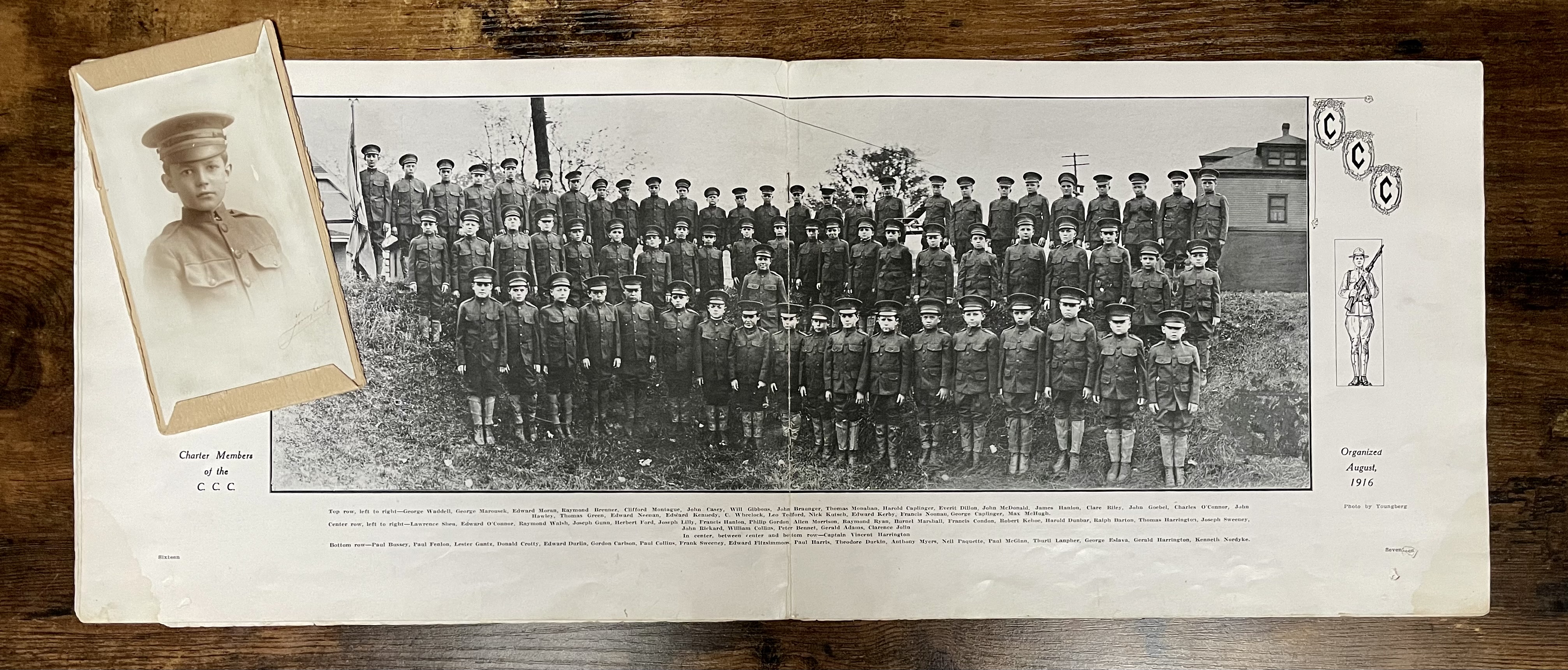
In the summer of 1916, Gerald “Jerry” Adam of Sioux City, Woodbury County, Iowa, celebrated his eighth birthday. Shortly thereafter, he became a charter member of the city’s newly-established Catholic Cadet Corps under the leadership of Reverend Henry A. Janse, Reverend Thomas M. Parle, Sergeant C. A. Butler, and Charles Parsons.

Gerald Joseph Adam and the Charter Members of the C.C.C. (Gerald pictured second row, second from right), 1917 Year Book of the Catholic Cadet Corps (Perkins Bros. Co. : Sioux City, Iowa, 1917); privately held by Melanie Frick, 2023. Collection courtesy of David Adam.

“The Catholic Cadet Corps was organized for the Catholic boys of Sioux City. It is now a citywide organization, and at the present time has a membership of 170. Companies are being formed in the various parishes of the city, so that all the Catholic boys of the city can enjoy the benefits of the C.C.C. For years the need of some such organization has been felt to solve the ‘boy problem.’ Until recently our Catholic boy had no organization of his own and experience has taught us that many of our boys drifted into the Y.M.C.A. on that account.

The Y.M.C.A. is a protestant organization in which our boy is not welcome, in which he can neither vote nor hold office and in which it is constantly insinuated that he is not even a Christian. Naturally this environment is not conducive to the best interest of our boy. The C.C.C. movement was inaugurated with the purpose of giving the Catholic boy surroundings which are in harmony with his faith. A tremendous amount of work has been done to make the C.C.C. attractive, instructive and helpful.”

1917 Year Book of the Catholic Cadet Corps

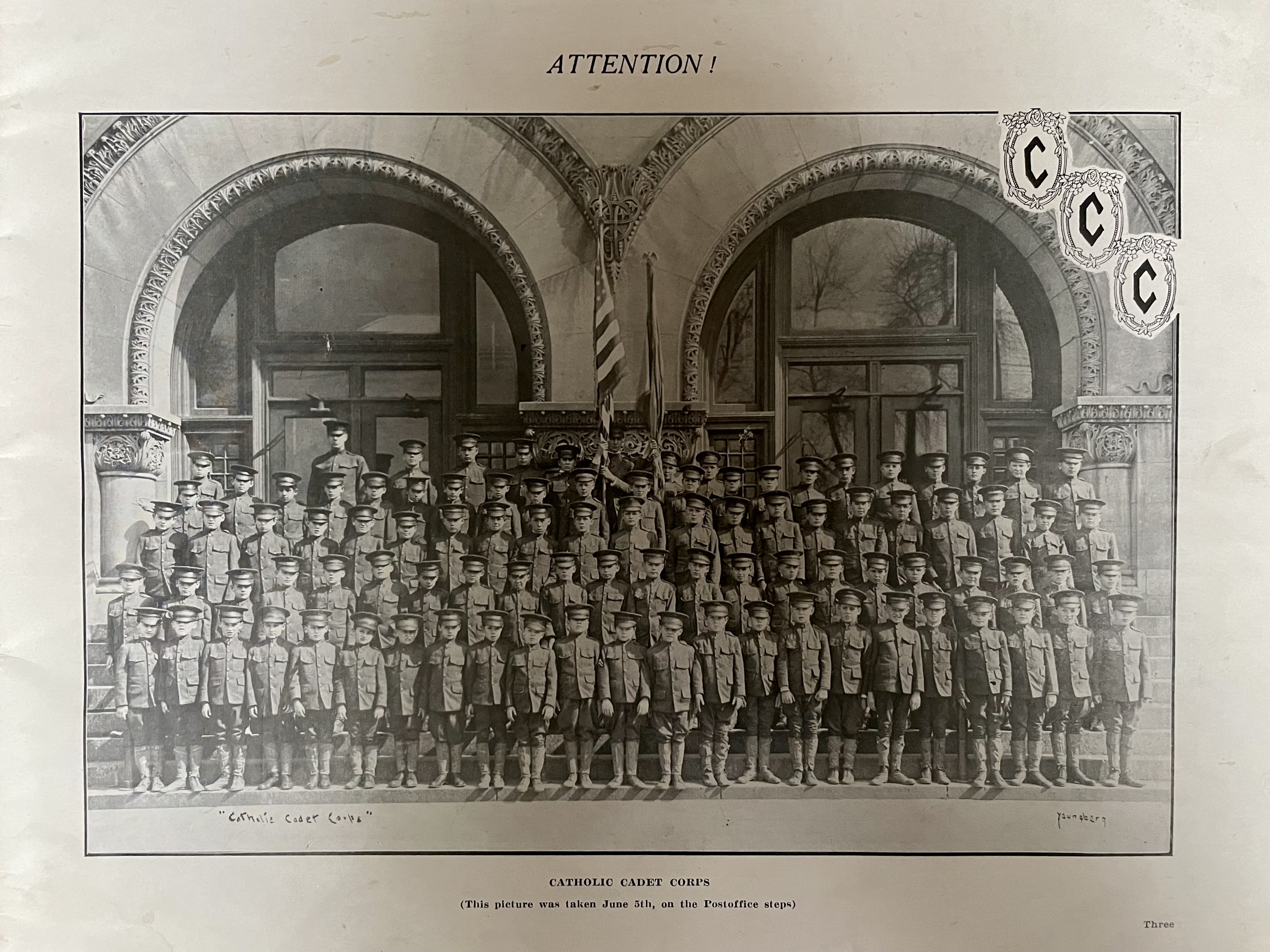
As a member of the Catholic Cadet Corps, Jerry would have participated in military drills and athletics, marched in parades and decorated the graves of Civil War veterans. He may have been among the group of young cadets who sang “America” at a local theater on Decoration Day 1917 to much applause. The C.C.C. also organized an ambulance corp that took part in numerous aid efforts, and afforded recreational opportunities for its members such as hiking, picnicking, and swimming at the nearby Trinity College.

Catholic Cadet Corps, June 5, 1917 (Gerald Adam pictured second row, sixth from right), 1917 Year Book of the Catholic Cadet Corps (Perkins Bros. Co. : Sioux City, Iowa, 1917); privately held by Melanie Frick, 2023. Collection courtesy of David Adam.

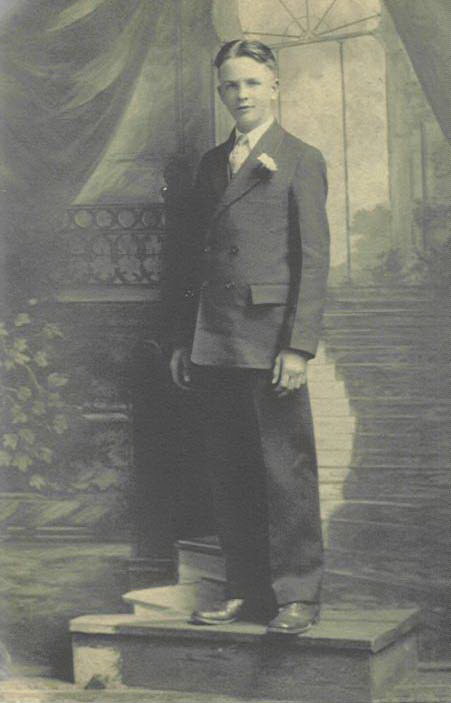
Perhaps most significantly, the Catholic Cadet Corps may have provided Jerry with a sense of community and belonging at a place and time when Catholicism was not necessarily mainstream. “Boys of the C.C.C. are not ashamed of being Catholics—they are proud of it in this free land of the U.S.A.” The 1917 Year Book of the Catholic Cadet Corps made clear that uniforming each young member in a tailored wool suit was an intentional choice. “The fact that the Cadets have the best uniforms in the city makes them think more of their personal appearance, increases their self-respect and has a good influence on their every day lives—they strive to be as good as they look. The boys wear their uniforms to school. This places all the boys on the same level—no distinction between rich and poor—all are Cadets and all try to do their best in school.” Jerry even wore his uniform for a family photograph believed to have been taken circa 1916.

It is not known how long Jerry might have been involved with the Catholic Cadet Corps, but the year he turned ten was a tumultuous one for him. Not only was 1918 marred by war and a global pandemic, but his father was away for long stretches of time due to his employment at a naval shipyard, and then, tragically, his younger brother died at age five following a horrific accident. Jerry was left an only child with a grieving mother and a father occupied with the war effort; it can well be imagined that the leadership and friendship offered by the C.C.C. may have filled a void for him at this time.

Jerry would not be a lifelong Catholic, but his experiences in the Catholic Cadet Corps may have influenced him regardless. At the age of eighteen, he joined the Marine Corps Reserve, and at twenty, he and his bride—although she was not Catholic—were married by Reverend Le Cair of St. Jean Baptiste Catholic Church in Sioux City. Although Jerry’s involvement with the Catholic church waned after that point, he continued to be actively involved in his community through fraternal organizations, as a Little League coach, and as a businessman and entrepreneur. As for Sioux City’s Catholic Cadet Corps, the wartime years seem to have been its heyday and any mention of the organization in the local newspaper dropped off within a few years thereafter.

Copyright © 2023 Melanie Frick. All Rights Reserved.

Continue reading

A Full House in a Mill Town

By the time of the 1870 U.S. census, French Canadians Timothée and Marguerite (Chicoine) Adam, both fifty-four years old, had lived in America for approximately five years. Along with their children, who ranged in age from toddlerhood to young adulthood, they had settled among fellow French-speaking immigrants in Springfield, Hampden County, Massachusetts. Their neighborhood, Indian Orchard, boasted a booming cotton mill on the banks of the Chicopee River. This would certainly have been a different environment than they had been accustomed to in the quiet village of Saint-Pie, Quebec where, for the first twenty-five years of their marriage, Timothée had been a farmer and Marguerite had raised more than a dozen children in their humble home. Their move from rural to comparatively urban was certain to have been full of adjustments, but what may be the most striking about their lives in the year 1870 is the impressive number of people with whom they shared one roof: twenty-eight, to be exact.

Their household had grown substantially from their first appearance in the Massachusetts state census in 1865; then, Timothée, who was employed at the mill, headed a household that numbered thirteen, including ten children and one boarder. In 1870, the twenty eight residents, all related, were in fact divided among four households within a single dwelling unit, presumably a tenement block. First recorded was the household headed by Timothée and Marguerite Adam themselves, which included nine of their children—those nine ranging in age from twenty-two down to three. Then came the households of three of their married daughters. The household of Leon and Julienne (Adam) Gay was first; they were the parents of one child. The household of Joseph and Marie (Adam) Noel and their five children was next, and last was that of Jean Baptiste and Marguerite (Adam) Gendreau and their five children.

Although Timothée himself was without an occupation at this time, and Marguerite kept house, nine other members of the combined households worked at the mill. Four of those nine millworkers were under the age of sixteen: Jean Adam was fourteen, Elisa Adam was twelve, Jean Gendreau was twelve, and Euclide Gendreau was eleven. Six children between the ages of six and eleven were at school, and six children between the ages of one and four were at home in the care of their mothers.

Many of Timothée and Marguerite’s children, grandchildren, and even great grandchildren would spend the decades to come employed in the Indian Orchard mill. It was not an easy life; in the years following the 1870 census, several members of the family would succumb to tuberculosis and other respiratory illnesses common among millworkers of the day, who often worked in dismal conditions with poor ventilation and were plagued by both communicable diseases and cotton lint.

“Clarence Noel, 138 Main St., Indian Orchard. Doffer in Hodges Fibre Carpet Co. of Indian Orchard Mfg. Co.,” September 1911, Prints & Photographs Online Catalog, Prints & Photographs Reading Room, Library of Congress, Washington, D.C. (https://www.loc.gov/pictures/item/2018676653/ : accessed 08 January 2023).
“Alfred Gengreau [Gendreau], 20 Beaudry St., Joseph Miner, 15 Water St. Both work in Mr. Baker’s room, Indian Orchard Mill,” September 1911, Prints & Photographs Online Catalog, Prints & Photographs Reading Room, Library of Congress, Washington, D.C. (https://www.loc.gov/pictures/item/2018676654/ : accessed 08 January 2023).

Notably, at least two of the couple’s great-grandchildren appear to have been photographed by famed muckraker Lewis Hine, who documented the plight of child laborers in the early twentieth century and whose work was instrumental in child labor reform. Clarence Noel, fifteen, grandson of Timothée and Marguerite’s daughter Marie (Adam) Noel, and Alfred Gendreau, thirteen, grandson of their daughter Marguerite (Adam) Gendreau, were both photographed outside their workplace in September of 1911. Clarence, Hine noted, worked as a doffer and said that he had “made seven dollars last week.” Alfred, who posed with another boy, was said to “work in Mr. Baker’s room, Indian Orchard Mill.”

These boys were not by any means among the youngest of the child laborers that Hine photographed, nor did they work in the most arduous conditions, but still their images are striking. In their knickers and caps, both slight of build, Clarence and Alfred look every bit like schoolboys, although the mill—to which four generations of their family had now been tied—loomed large in the background. Their school days behind them, it was time for the boys to work to support their families.

Copyright © 2023 Melanie Frick. All Rights Reserved.

Continue reading

One of Dakota’s Pioneer Mothers

There can be no question that Christina Marie (Schmidt) Nelson was a strong and capable woman.

Born in Skrydstrup, Gram, Haderslev, Denmark on 11 October 1868, to Jens Madsen Schmidt and Anne Bramsen, Christina immigrated to America with her parents and older sister when she was just twenty months of age. A dugout on a homestead in Dakota Territory was her first home in America; it was from this homestead in Bon Homme County that she spent long hours tending her family’s cattle, experienced devastating prairie fires and blizzards, witnessed interactions with displaced Native Americans, and even once encountered General George Armstrong Custer when he stopped for a drink of water. She was fortunate enough to attend a one-room log schoolhouse through eighth grade, and, in 1889, when she was twenty-one, she married her neighbor and fellow Danish immigrant Frederick Nelson.

Over the course of the next twenty years, Christina gave birth to nine healthy children: Anna Sophie (1891), Julia Marie (1892), Ole James (1894), Andrea Mathilda (1896), Louise Christine (1899), Helena Margaret (1900), Mary Magdalene (1904), Frederick Andrew (1908), and Myron Alvin (1910). Education was of apparent importance to Christina and Fred, as he was known; although their oldest son attended school only through eighth grade, destined to become a farmer like his parents before him, their younger sons and daughters all attended school at least until the age of sixteen. They even saw to it that their four youngest daughters had the opportunity to attend a “normal school” in nearby Springfield, South Dakota, where they received the necessary training to become schoolteachers.

The Fred and Christina Nelson Family, Yankton County, South Dakota, 1912; digital image 2011, privately held by Lori Dickman. Back row, from left: Julia, Anna, Ole, and Andrea Nelson. Front row, from left: Mary, Louise, Christina with Myron, Fred with Fred Jr., and Helena Nelson.

A formal portrait of the Nelson family was taken in July of 1912, likely in Yankton, which was not far from the family’s home in Lakeport; the girls sport bare forearms for the season, their fabric colors light and featuring gingham, stripes, and lace. Christina, while dressed in a dark gown, wears a white collar and whimsical crocheted flowers at her throat. As to the occasion for the photograph, it was not a milestone anniversary year—Christina and Fred would have celebrated their twentieth anniversary the previous spring. However, Christina perhaps realized that, at forty-three, her childbearing years were behind her and now was the time to have a portrait taken of the entire family all together. Furthermore, as her eldest daughter had married in March of 1912, having her first child leave the nest might also have sparked sentimentality and a wish to document the fact that, at least for a short while, all nine Nelson children had been under one roof.

Christina and Fred would go on to celebrate their twenty-fifth anniversary in 1916, but two years later, a matter of weeks after her fiftieth birthday, Christina would be dealt several harsh blows in short succession. First, Spanish Influenza hit the household, and then, in a turn of events that shocked both the family and their wider community, she lost Fred to suicide, and, one month later, daughter Andrea to undetermined medical circumstances.

Christina persevered. She faced another trial when her father died the following spring, but it was a blessing that her eldest son was home from his service in the Great War and able to help manage the family farm while she continued to raise her two youngest sons. She continued to live on the farm with support from her sons well into her old age; even in 1950, when she was eighty-two, the census reported that she was still “keeping house” for her three bachelor sons. It was at this farmhouse that her children and grandchildren frequently gathered to celebrate birthdays and holidays.

Christina died on 23 January 1961 at the age of ninety-two and is buried alongside her husband and three of their nine children at the Elm Grove Cemetery in Yankton County, South Dakota. A brief biography included in a local history book several years prior had noted, “Mrs. Nelson is well-known by her many friends and relatives as a person who always has a warm welcome hand extended to all those who call at her home. Even today, at the age of eighty-five, she is active with her household duties and retains an active interest in what is going on about her. She is cordial and sympathetic with the many young people who come her way. She is truly one of Dakota’s pioneer mothers who still looks ahead and enjoys her home and family.”

Copyright © 2022 Melanie Frick. All Rights Reserved.

Continue reading