Tag Archives: Iowa

A Sioux City Streetcar

One might not expect that a community in Iowa was the first in the world to have an electric-powered elevated streetcar system, but in the early 1890s, Sioux City blazed that trail.1 It was already the third city in the United States—after New York and Kansas City—to host a non-electric elevated streetcar system, and for years to come, streetcars served to connect its far-flung neighborhoods, offering a convenient and affordable transportation option to its citizens.2

Henry_Adam_Streetcar

Henry Joseph Adam, center, Sioux City, Iowa, circa 1903-07; digital image 2010, privately held by Melanie Frick, 2016.

As a newlywed in his mid-twenties, Henry Joseph Adam of Sioux City, Woodbury County, Iowa worked as a conductor for the Sioux City Rapid Transit Company, also known as the Sioux City Service Company.3 This photograph, dated circa 1903-07, shows him in uniform, his suit rather baggy on his slight frame and a cap atop his head. Half a dozen men and women pictured behind him are in the process of boarding the streetcar, while three men at the front seem to be investigating an issue with either the tracks or the car itself. As this seems an unlikely place for passengers to board the car, suspended as they were over the Floyd River, I suspect there was a problem with the streetcar and the passengers had temporarily disembarked, an inconvenience on such a chilly day. That might also explain the occasion for the photograph; the original, mounted on a large piece of cardboard, looks as though it could be a copy of a local press photograph.

Just a few years before, Henry’s parents had had an unfortunate encounter with Sioux City’s elevated streetcars. In the summer of 1896, the Sioux City Journal reported:

Yesterday afternoon Timothy Adams and wife, of Moville, were about to cross the track of the elevated railway at Hedges station, Morning Side, when they met with a severe accident. They were driving a team to a light wagon, and as the electric car approached the horses became frightened. The tongue of the wagon broke and stuck into the ground, throwing Mrs. Adams violently over the dash board. The wheels passed over her, but when Dr. Brown was called it was found she was not much hurt and that no bones were broken.4

Seriously injured or not, Henry’s mother filed a suit against the Sioux City Rapid Transit Company and received one hundred and twenty-five dollars.5 Little could she have known that her son would soon become their employee, and, fortunately for Henry, if this incident was recalled, it must not have been held against him! He was employed there for only a few years, between approximately 1903-07, and spent the rest of his life as a carpenter. In the above photograph, he is working the route from East 4th and College to Greenville, which necessitated crossing the Floyd River on an elevated track.6

As for the streetcars of Sioux City, they peaked in 1933 with around forty-five miles of track that traversed multiple neighborhoods and even crossed the state line into South Sioux City, Nebraska.7 By the 1940s, however, with the introduction of a more-flexible bus system, streetcars quickly became obsolete, and after sixty years of service to the community, operations ceased in 1948.8

Copyright © 2016 Melanie Frick. All Rights Reserved.

Continue reading

The Search for Y-DNA for Hiram H. Hammond

For years, about all I’ve known about the parents of Hiram H. Hammond has boiled down to the origins that were reported in four census records over a span of twenty-five years:

SOURCE FATHER MOTHER
1870 U.S. Federal Census1 Foreign Foreign
1880 U.S. Federal Census2 England Scotland
1885 Iowa State Census3 Native Native
1895 Iowa State Census4 Native Native

While Hiram, an Iowa farmer, was consistent in declaring that he was born circa 1813 in Ohio, he was apparently less certain about the origins of his parents. Or was he? Hiram may not have spoken for himself when the census enumerator came to the door; responses could have been given by his wife or another member of his household if he was not available. It’s also possible that some information might have been added by the enumerator after the fact, based on memory alone. Given that Hiram lived among many immigrants, his wife included, his parentage may have been presumed to be foreign as well.

In any case, this lack of consistency leaves me with questions today. Who am I looking for? Were Hiram’s father and mother born in England and Scotland, respectively? Or were they native-born with English and Scottish ancestral origins? If that’s the case, it would not be the first time that one of my ancestors took the question of nationality a little too far.

Now, however, I’m a bit closer to solving the mystery of Hiram’s parentage, thanks to a little something called Y-DNA. The Y chromosome, as explained by Family Tree DNA, “is passed almost unchanged from father to son,” so it can be useful in determining the origins of a surname and to make connections with cousins who share the same chromosome.5 In Hiram’s case, I hoped this would prove to be very useful.

Hiram is my fourth great grandfather; as I am descended from his daughter, thus immediately breaking the chain of father-to-son Y-DNA, I began tracing the descendants of his son with the hope of finding a living male relative who would be eligible to take a Y-DNA test. After reaching out to a distant Hammond-by-marriage in Iowa and an apparent game of hot potato with my letter of inquiry, I finally made contact with a Hammond-by-blood in Arkansas. Bingo! It was time to pull out the genetic guns, so to speak, and test this (wonderful! willing!) cousin’s Y-DNA.

There’s not much to be too excited about right now – as of yet, there are no matches on the 67-marker test – but there is always the chance that someone who shares Hiram’s Y-DNA will choose to test with Family Tree DNA in the future and in doing so establish a long-lost genetic connection. I’m prepared to monitor this account – and the Hammond DNA Project – for years, if that’s what it takes! A more pro-active approach, however, would be to find a living male descendant of another Hammond line that I suspect could be connected to Hiram.

“Old Log Cabin,” Jackson County, Iowa, 2010; digital image courtesy of user dadmw1, Panoramio, Google Maps. This cabin is situated approximately one mile south of the land purchased by Hiram H. Hammond in 1848.

My earliest records of Hiram H. Hammond come from his years in Jackson County, Iowa, where he acquired land in 1848. According to an 1852 Iowa census, Hiram was neighbor to an Andrew Hammond,6 and although Hiram moved away shortly thereafter,7 in 1854, Andrew remained in Jackson County with a new neighbor, Philow Hammond.8 I suspect that these Hammond men may have been sons of War of 1812 veteran Jonathan Hammond, who lived in Ohio, Hiram’s stated place of birth, during the appropriate period of time. Several of Jonathan’s other known sons include Orin Hammond, Reuben Hammond, and Lemuel Brooks Hammond, and intriguingly, a nephew also bears the somewhat distinctive name Hiram H. Hammond.9 However, more research is necessary to prove the relationships among the members of this particular Hammond family and to determine whether Hiram himself could feasibly be a relative.

If such a connection still seems plausible, or if another potential connection is found elsewhere on the paper trail, well, then it will be time to trace another line of male descendants for a willing Y-DNA test participant! 

Copyright © 2016 Melanie Frick. All Rights Reserved.

Continue reading

Suiting Up at the Turn of the Century

I’ll admit I feel rather proud of my namesake for marrying such a debonaire young man. Henry Joseph Adam of Sioux City, Woodbury County, Iowa, pictured at right, married Melanie Veronica Lutz in 1905 at the age of twenty-four, which allows this photograph to be dated to approximately 1900-1905.1

Henry_Adam_1900

Henry Joseph Adam, at right, with an unknown individual, Akron, Iowa, ca. 1900; digital image 2014, privately held by Melanie Frick, 2015. Collection courtesy of David Adam.

Census records confirm that the photographer who made this cabinet card, Gene Frank of Akron, Plymouth County, Iowa, did indeed operate a photography studio in the early twentieth century.2 However, I’m not entirely sure what Henry was doing in Akron himself. He lived in Sioux City, thirty miles south, where there were certainly a number of photographers; however, Akron was a bit closer to the French Canadian communities of southeastern South Dakota where Henry had a number of relatives. It’s also possible that he had hired out to work in the area or that he had simply gone there for a visit – or, as the case may be, for a shopping expedition.

As with all photographs, an important question comes to mind: “What was the occasion?” While I don’t note a strong family resemblance between the other young man and Henry’s male relatives, one possibility is that he could have been a cousin. He could not have been a classmate, as Henry attended school only through eighth grade, but it is possible that he and Henry worked together in some capacity. If nothing else, he was a friend, and I wonder if he and Henry purchased these suits together. The textured suit jackets are nearly identical in terms of cut and fabric, but not quite, while the stiff-collared shirts seem to be the same; the young men expressed their individuality by way of their accessories. The friend, with wet hair slicked in a part, wears a vest with a knotted striped necktie and a watch chain, while Henry omits the vest in favor of a fleur-de-lis-printed necktie tied in a bow. It wouldn’t have been unusual in this era for two young men to have a photograph taken together to document their friendship.

What strikes me about this photograph is that from what I know of Henry, he wasn’t typically quite so refined! He spent his teenage years as a dairy farmer and his adult years as a carpenter, so such dapper attire was in all likelihood limited to his early adulthood and might have been worn to church or while courting. The high detachable collar fully encased his neck, and I particularly like that he wore the fleur-de-lis as an apparent nod to his French Canadian heritage; Henry in fact spoke both French and English.

There are a number of photographs of Henry in my collection, but this may be the most dapper of them all. For more photographs of the family of Henry Joseph Adam (1881-1944) and Melanie Veronica Lutz (1884-1973), stay tuned for the new Adam Family Album. 

Copyright © 2015 Melanie Frick. All Rights Reserved.

Continue reading

A Goodly Bit of Romance

The newspaper headline must have brought a few chuckles: “OLD FOLKS HAVE ROMANCE.” The story continued, “Romance is not all reserved for young people, as the marriage of Isaac N. Holman, aged 70, of Decatur, Neb., to Mrs. Sarah E. Fenton, aged 51, of Springdale, in Sioux City, will testify. […] This is the third marriage for each of the contracting parties. Both are well along the avenue of life and to them the marriage represents good judgment as well as a goodly bit of romance. They have known each other a long time and the mutual admiration they have entertained has grown gradually until the marriage yesterday placed its happy seal upon their growing affection.” Following their marriage on 24 August 1908 at the home of the Reverend W. H. Montgomery of the Haddock Methodist Episcopal Church in Sioux City, Woodbury County, Iowa, the couple was to visit Omaha. They would settle in Decatur, Burt County, Nebraska, where Holman, “said to be quite well to do,” made his home.1

That evening, their story appeared in another Sioux City newspaper: “LOOKING FOR LAND HE FINDS HELPMATE.” This version of the story was written with a level of flowery detail that, while entertaining, I don’t quite trust:

“I.N. Holman, a wealthy retired farmer of Decatur, Neb., came to Sioux City several months ago on a land deal. At the office of a real estate dealer he met a charming black-eyed widow, Mrs. Sarah E. Fenton, who had chanced in there on business. When they were introduced, he immediately lost all interest in Sioux City property or any property for that matter, and devoted all his time to the widow. Holman is 70 years old, and he pressed his suit with such ardor that before he returned to Decatur he had made a contract for something which he wouldn’t trade for all the farms in Iowa, namely the attractive widow. Today he returned to close the deal, which he says is the best he ever made. A license was issued this afternoon, the bride giving her age as 51. They will be married this evening and after a two weeks’ wedding trip will make their home at Decatur. “Maybe people think we’re foolish,” said the bride, blushing like a school girl, “but we don’t, we’re too happy.”2

This is far from the whole story. First, there are, in fact, two stories presented by these competing news articles. Did the couple meet at the land office, or had they been acquainted for years? This we may never know for sure; it seems unlikely, but not impossible, that the couple had crossed paths before meeting in Sioux City. Second, the “attractive widow” most likely did not have the black eyes of Bess the landlord’s daughter, charming as the description may be.3 And was she even a widow? Well, yes and no. Her first husband, George W. Fenton, died tragically in 1880 when accidentally shot by her brother-in-law.4 Her second husband, however, was still alive and well at the time of her third marriage; Sarah had divorced John Hoffman in 1902 citing his drunkenness and death threats.5 However, it would have been far from unusual for a woman to claim widowhood over divorce.

SarahEHall

Sarah Ellen (Hall) Fenton Hoffman Holman Eklof, Iowa or Nebraska, ca. 1908; digital image 2001, privately held by Melanie Frick, 2015.

Finally, would Isaac and Sarah live happily ever after? Unfortunately not. Isaac was granted a divorce from Sarah in 1914;6 a probate petition filed by his son the previous year, while suggesting that Isaac “indulged in intoxicating liquors to excess” and was “changeable, forgetful, and stubborn,” also stated that “the amount of money demanded from him by his current wife annoyed him considerable.”7 Oh dear. Isaac did not remarry before his death in 1922,8 but Sarah would marry – and divorce – once more.9 She resumed the use of the Holman name and at the time of her death in 1930, she was referenced as the widow of Isaac Newton Holman. Her short-lived marriage to this “wealthy landowner” was, perhaps, her one claim to local fame and financial stability.10

Lesson learned? Never assume. I had assumed that because this was the couple’s third marriage, and because they married in a community with a population greater than thirty thousand, that no mention would be made of their marriage in the local newspaper. In fact, I didn’t bother to check until their names turned up in the Findmypast database featuring a newspaper from across the state, and then learned that more than one version of the story existed. As it turns out, you never know what details of your ancestor’s experience might have made a compelling story deemed worthy of reprint!

Copyright © 2015 Melanie Frick. All Rights Reserved.

Continue reading

Wedding Wednesday: Puffed Sleeves

On a late September day in 1896, Elizabeth Hoffman of North Washington, Chickasaw County, Iowa affixed a gauzy, floor-length veil to her hair. It may have been crowned with flowers, although the faded photograph does not make this clear. Flowers or foliage of some kind – perhaps even autumn leaves? – were indeed attached to the front of her dress, although she wore no white gown. Her best dress was likely black or another dark color and fashionably made with a gathered bodice, narrow waist, and sleeves generously puffed to the elbow. (Anne Shirley would have been envious.)

Elizabeth’s attire is evidence that, at this time, even recent immigrants living in rural areas of the United States were aware of the latest fashion trends. Corsets were not worn by all women in the 1890s, and Elizabeth, already slim, was not dramatically corseted if she was at all.1 The gathered bodice was of a style worn throughout the decade, and while the care of these full leg o’ mutton sleeves was time-consuming, they were at the height of popularity in the middle of the decade.2

MathiasElizabethWedding

Mathias Noehl and Elizabeth Hoffman, wedding, North Washington, Iowa, 1896; digital image 2001, original held by J.H., 2015.

At the age of twenty-seven – her birthday had been just the week before – Elizabeth was to marry a fellow immigrant, Mathias Noehl.3 As it so happened, he hailed from the village of Holsthum, Bitburg-Prum, Rheinland-Pfalz, Germany, which neighbored her own home village of Prümzurlay.4 By all accounts, however, their first meeting took place in northeastern Iowa, where Mathias encountered Elizabeth, whom he called Lizzie, at the Immaculate Conception Church in North Washington. She lived there as the housekeeper of Father Probst and the Sisters of Charity.5 The couple was married there on 22 September 1896 and may have celebrated with Elizabeth’s mother and siblings, who had also made Chickasaw County their home.6

A copy of Mathias and Elizabeth’s wedding portrait was shared with me by a relative; I suspect the original is a cabinet card photograph, popular at the turn of the century. I can’t make out much of the setting (is it grass or a rug at their feet?), but Mathias sits in a wicker chair while Elizabeth stands to the side, her right hand on his shoulder. In her left hand is clutched a small book, perhaps a prayerbook. As was typical of the time, neither of the newlyweds smile, and their faces are so faded in the copy that it’s difficult to see the direction of their gazes. Mathias has short hair; in his memoirs, he wrote that that, upon meeting Elizabeth, his blond hair was “unkempt like dried up flowers of the cemetery,” so a haircut may have been in order!7 He has a tidy mustache and wears a wool suit and white shirt. At twenty-eight, having recovered from an earlier heartbreak during his first years in America, he was prepared to settle down and start a family.8 Mathias and Elizabeth would go on to raise nine children on their farm.

This wedding portrait is one of several photographs that I have in my digital collection of the family of Mathias and Elizabeth (Hoffman) Noehl, both immigrants who came to Iowa from Germany in the late nineteenth century. For more photographs of the family of Mathias Noehl (1868-1950) and Elizabeth Hoffman (1869-1957), check out my new Noehl Family Album

Copyright © 2015 Melanie Frick. All Rights Reserved.

Continue reading

Tombstone Tuesday: Timothy and Odile (Millette) Adam

Timothy and Odile (Millette) Adam experienced nearly forty years of marriage together that were anything but ordinary.

Timothy, baptized in St. Pie, Quebec on 8 August 1846, the son of Timothée Adam and Marguerite Chicoine, crossed into America with his family as a teenager.1 They settled near the textile mills of Indian Orchard, Hampden County, Massachusetts, which is where Timothy married at the age of twenty-one on 22 September 1867 to Odile Millette.2 Odile had been born in the French Canadian community of Rouse’s Point, Clinton County, New York on 11 July 1847, the daughter of Maurice Millet and Isabelle Quemeneur dit Laflamme.3 She, too, had relocated to Massachusetts as a teenager, where she also found work in the mills.

The couple was said to have had ten children together, eight of whom have been identified: Timothy Maurice, Alexander Amadée Edmond (known as Edward), Joseph Frederick (known as Alfred), Marie Julie Malvina, Albina Lena, Henry Joseph, Martin Theodore, and Permelia Marie.4 Only five of these children are known to have survived to adulthood; at least one succumbed to scarlet fever as a toddler.5

In 1883, the family made the decision to move west.6 I have to wonder if this move was spurred by the deaths of at least two of their own young children circa 1880, as well as by the deaths of Timothy’s younger brother and sister who died within a week of each other in February of 1883: one of pneumonia at twenty and the other of tuberculosis at twenty-four.7 In fact, tuberculosis had caused the death of Timothy’s mother just five years before.8 Perhaps the idea of fresh air and the countryside appealed to the couple as they must have feared for the health of their children.

Timothy and Odile first joined French Canadian relations in southeastern South Dakota, where a son was born to them in the summer of 1885.9 In December of the following year, Timothy claimed a homestead a short distance away near Moville, Woodbury County, Iowa.10 The family would remain here for a number of years; by 1900, they had relocated to a dairy farm closer to Sioux City.11

The coming years were unexpectedly tumultuous for Timothy and Odile. First, in 1900, their twenty-nine-year-old son Edward, who had been out of touch for nearly a decade, returned home and began harassing his parents and younger siblings. Timothy went to court in order to obtain a restraining order against him.12 Then, over the next several years, Timothy and Odile may have suffered marital discord. Timothy was not recorded in the 1903 Sioux City Directory; he appeared again in the same household as his wife the following year.13 In 1905 he was again absent, and it was at this time that Odile implored the enumerator of the 1905 Iowa State Census to bring her any word of her two eldest sons, Edward and Fred, who had traveled west and had not been heard from in several years.14 It was also in 1905 that Odile recorded her will, leaving her real estate to her three youngest children: Henry, Theodore, and Permelia. No mention was made of her absent sons – or her husband.15

IMG_3451

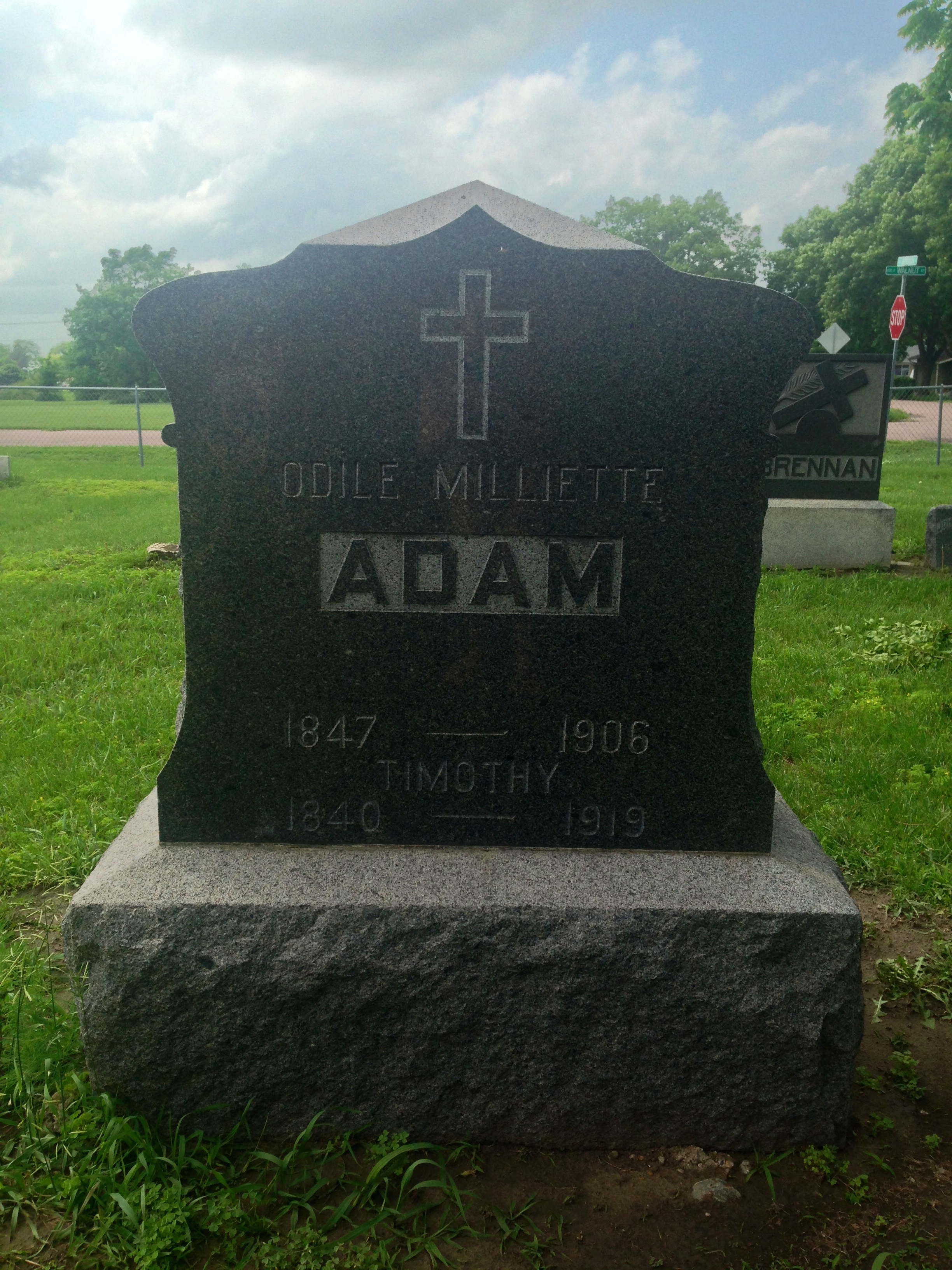
Grave of Odile Milliette Adam (1847-1906) and Timothy Adam (1840-1919), St. Joseph Cemetery, Elk Point, Union County, South Dakota; 2014, privately held by Melanie Frick, 2015. Note: Timothy’s date of birth on his gravestone is incorrect. He was born in 1846.

In 1906, the final year of Odile’s life, she operated a boarding house at 508 Perry in Sioux City.16 Notably, Timothy resided not at home, but at the Washington House Hotel.17 It does seem possible, however, that the couple reconciled whatever differences they may have had by the time of fifty-nine-year-old Odile’s death from hepatitis on 16 December 1906 in Elk Point, Union County, South Dakota.18 When the 1907 Sioux City Directory was printed at some point in late 1906, likely shortly before her death, both Odile and Timothy were named as residents of 508 Perry.19

Timothy, a carpenter again as he had been in his younger years, remained in the house with his children for only a short time before resettling in nearby Jefferson, Union County, South Dakota. He remained here for the next decade; as of 1910, he operated a billiard hall in this small, largely French Canadian community.20

By 1917, Timothy, now seventy, had returned to Sioux City where he lived with his married daughter.21 He died there on 22 February 1919 at the age of seventy-two, his cause of death recorded as senility.22 Timothy Adam was buried beside his wife, Odile Millette, at St. Joseph Cemetery in Elk Point, Union County, South Dakota, his name squeezed as though an afterthought at the base of her gravestone.

Copyright © 2015 Melanie Frick. All Rights Reserved.

Continue reading
Brotherly Love

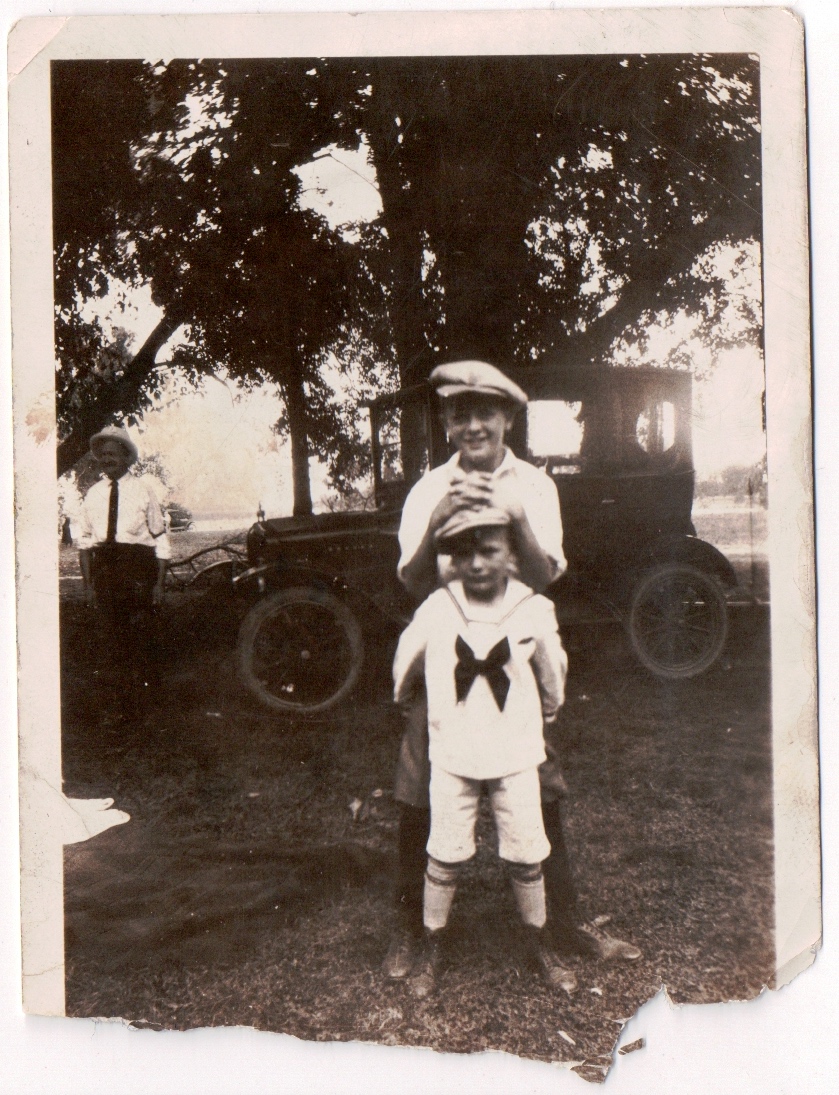
It might have been a late summer’s day when brothers Roy and James Walsted of Sioux City, Woodbury County, Iowa posed for this snapshot circa 1924. Six years apart in age, Roy was perhaps twelve and Jim perhaps six when this photograph was taken some ninety years ago.1 The park-like setting and the blanket at their feet suggest that the occasion may have been a picnic. Classic car aficionados could likely date the vehicle parked behind the boys.

SCAN0323 - Version 2

Roy Louis Christian Walsted (back) and James Herman Walsted (front), Sioux City, Iowa, ca. 1924; digital image 2015, privately held by Valene Petersen, 2015.

Roy suffered from polio as a child, which resulted in a limp as one leg was left shorter than the other. His younger brother was said to have come to his defense when Roy was bullied or was the last to be chosen for a neighborhood baseball team.2 Even in this photograph, it appears that Jim stands guard in front of his brother, his arms protectively curved back around Roy’s legs as Roy clasps his hands atop his brother’s head. Both boys wear short pants and newsboy caps; Jim is in a sailor suit, a style that remained popular for young boys in the post World War I era.3

I have to wonder who the man off to the side of the photograph could be. I have only seen two small snapshots of Roy and Jim’s father, both of which were taken late in his life. (I suppose there is a third if I count a postmortem photograph of him at his own funeral.) From those, I know that he was a man of slight build, but beyond that, I have no way of telling whether this gentleman in a straw boater hat and rolled shirtsleeves is in fact James Jacob Walsted or not. If this picnic was a family affair, perhaps the boys’ mother, Kathrine, was behind the camera.

This charming snapshot is one of a handful of photographs that I have in my digital collection of the Walsted brothers and their parents, both immigrants who came to Iowa from Denmark in the early twentieth century. For more photographs of the family of James Jacob Walsted (1886-1956) and Kathrine Christensen (1886-1971), check out my new Walsted Family Album

Copyright © 2015 Melanie Frick. All Rights Reserved.

Continue reading
The Proud Owners of a New Piano

You never know what might have made the news a century ago. In Iowa, for example, news might have been made when someone acquired a piano. Although mail-order catalogues like Sears, Roebuck & Company made owning a piano more affordable than ever thanks to convenient financing options,1 such a substantial purchase was still of great interest to those in rural communities and small towns across America.

These were the years before Victrolas became widespread.2 Pianos were a ready source of music and entertainment, and people of all ages might have enjoyed gathering at the home of a friend or family member with a piano for an evening of playing and singing.

pianoloc

“A Pleasant Evening at Home,” Prints & Photographs Online Catalog, Prints & Photographs Reading Room, Library of Congress, Washington, D.C. (http://www.loc.gov/pictures/item/90709337 : accessed 5 August 2015).

In the northwestern corner of Iowa, The Sibley Gazette reported on 24 May 1900:

John Hoffman and family are the proud owners of a new piano.3

And in the northeastern corner of the state, The Guttenberg Press reported on 25 June 1909:

Miss Roselyn Thoma is the happy and proud possessor of a new piano.4

John Hoffman was the second husband of Sarah Ellen Hall; married since 1883, they would undergo a tumultuous divorce in 1902. At the turn of the century, however, they were still married with a twenty-year-old daughter and a sixteen-year-old son at home.5 Their acquisition of a piano adds a bit of brightness to what was painted in their divorce proceedings as a rather dim time. Although Sarah led a difficult life, her granddaughter remembered that she had loved fine things; this piano was likely a prized possession.6 As she was said to be a religious woman, perhaps she enjoyed hymns played on the piano either by herself or her children.

Roselyn Thoma was the daughter of Fred and Matilda (Hammond) Thoma and was seventeen years of age in 1909.7 She was the last of four surviving children still at home, her younger sister having been lost to a diphtheria outbreak three years prior.8 Perhaps it was with a newfound appreciation to seize the moment that her parents supported such an extravagance for their daughter, or perhaps the same inheritance that had recently spurred them to purchase a farm made the purchase of a piano possible as well.9 Roselyn would marry two years later, and one can imagine that her piano might have accompanied her to her new home.10

Whether the Hoffman and Thoma families enjoyed idyllic moments crowded around their pianos à la Little Women or not, it is clear that the addition of a piano to a household in their humble Midwestern communities was worthy of note – and pride. However, even in these rural areas, it would be only a matter of time before new forms of entertainment overtook the novelty of owning a piano.

Copyright © 2015 Melanie Frick. All Rights Reserved.

Continue reading

A Letter From the Shipyards

Although Henry Joseph Adam was sixty years old when the United States entered World War II, he made the decision to apply his skills as a carpenter more than fifteen hundred miles from home at the Kaiser Shipyards in Portland, Oregon.1 This was one of several emergency shipyards established during wartime that oversaw the construction of numerous Liberty and Victory ships.2

Henry_Adam_Carpenter

Henry Adam (seated at center) at work, Sioux City, Iowa, ca. 1930-40; digital image 2010, privately held by Melanie Frick, 2015.

Henry ventured to Oregon in 1942, although he was not there continuously; his wife of thirty-seven years, Melanie, remained at their home in Iowa.3 However, we know that Henry was in Portland in June of 1943 when he mailed the following letter:

6-4-43
Dear Mealane
red your letter last night and it seam funey to me to here of so many people dying sent i left. i just got back from supper i was out to cool and here it is quarty to eight so will send you my first check rent i got sick and it leave me purty short you ask me what i am doing well i send you the slip of the copany witch i am with and i is house prog work and i am in side setting up book case and kitchen cabinet and thresh hold and it is a snap so far. and the Boos pick me up right at the door so that make it fine i leave here at half past 7 and we get back about 5.75 and by the time i get to cool it is 6.00. well Mealane i will send you my driver licin so you get me a new one and i wish you would send me the last MWAR so i can go and play cribag with the man that live in the back room that old lady say you aught to be out here now to see the purty flowrs and so many it rain every day a little bit and the night are fine so i guest that about all i think of so good By and good luck
Henry xxxxxxxxxxxxX

This slideshow requires JavaScript.

I don’t have the impression that Henry had occasion to write many letters in his lifetime. His spelling errors are numerous, and at times humorous – for one, his wife actually spelled her name Melanie, not Mealane! However, his apparent lack of practice in spelling and grammar is understandable for a hardworking tradesman of the era. After spending his early years in Massachusetts surrounded by so many relatives of French Canadian descent that he had no reason to speak English until he entered school, Henry moved to Iowa where he spent the remainder of his childhood on his father’s homestead. He did not attend school beyond eighth grade, at which point he likely entered the workforce.3 By the time he was thirty, he had settled on carpentry as a profession.4

A carpenter Henry remained until his death. On 28 March 1944, Henry suffered a fatal heart attack in Long Beach, California, where he had been a resident for less than a week.5 He had likely pursued work at the US Naval Dry Docks, later the Long Beach Naval Shipyard, as the United States was still in the throes of World War II. His letter, written less than a year prior to his death, documents this final chapter of his life.

Copyright © 2015 Melanie Frick. All Rights Reserved.

Continue reading

The Trailblazers

Jensine Kathrine and Lars Marinus Walsted were the first of their siblings to leave Denmark for America. Sine (also spelled Sena) was eighteen and Lars Marinus twenty when they arrived in Boston on 19 April 1886 aboard the Catalonia and made their way to Council Bluffs, Pottawattamie County, Iowa.1 It would be seven years before they would see another member of their family, although eventually, all of their surviving siblings would make their way to America.

Marinus_Walsted_Jensine_Walsted_1887

Lars Marinus “Charles” Walsted, 21, and Jensine Kathrine “Sine” Walsted, 19, half-siblings, Council Bluffs, Iowa, 1887; digital image 2014, privately held by Dianne Anderson, 2015.

This 1887 cabinet card photograph was likely taken outside in the summertime, as real grass appears in front of the outdoorsy backdrop. In addition, Sine poses with a parasol, certainly a warm-weather accessory. Both are smartly dressed, Lars Marinus in a light-colored three-piece suit and Sine in a plaid dress with a straight skirt and snug sleeves that, as was typical of the time, do not quite reach her wrists.2 A flower is pinned at her throat. Their hats – Sine’s quite elaborate – rest at their feet. Lars Marinus parted and combed his hair neatly, while Sine’s hair is pulled back tightly and does not seem to be styled in any special way. Iowa summers can be hot and humid, rather unforgiving to the curled fringe often worn by young women of the era!

At nineteen and twenty-one, these fair-complexioned half-siblings had their lives ahead of them. Having become established among a community of Danes in the Council Bluffs area, Sine and Lars Marinus may have wanted to have their picture made so that their parents could see how well they were doing after a year away from home. As the eldest children and trailblazers for life in America, they may also have hoped to encourage their five siblings to join them when they were able. While this photograph remained in Sine’s possession until she gifted it to her daughter in 1932, it’s easy to imagine that another copy may very well have accompanied a letter home to Denmark.

Copyright © 2015 Melanie Frick. All Rights Reserved.

Continue reading