Tag Archives: immigrants

A July 4th Celebration

On 04 July 1910, a group of twenty people—plus one dog—came together for a photograph somewhere in Yankton County, South Dakota. Presumably, they had gathered to celebrate Independence Day, and several chairs were brought outside for their assemblage before a backdrop of trees. All present appear to be well if not formally dressed for the day. The men wear no jackets and several go without vests or ties, suggesting that the weather was quite warm, and several of the women and girls, most of whom wear light-colored, summer dresses, have their sleeves pushed to their elbows. At least one woman wears an apron. A man’s straw boater hat is cast to the side, and a dog rests, alert, at a girls’ feet. However, despite the fact that this was a warm summer day and that even the men have shed some layers, the children all seem to have been required to wear stockings and shoes as there are no comfortably bare feet in sight.
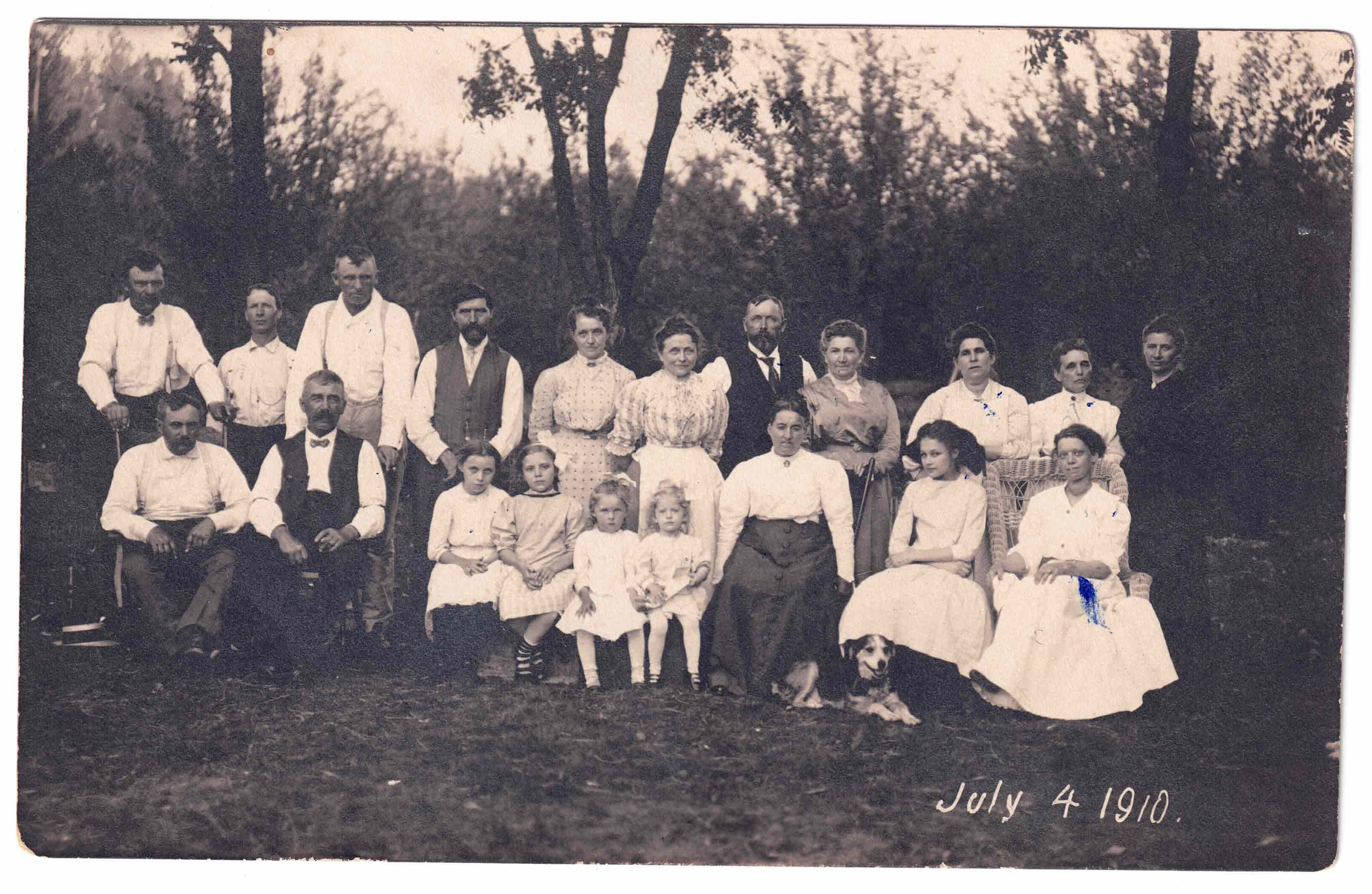
Independence Day celebration featuring descendants of Niels and Juliane (Hennike) Olsen and friends, Yankton County, South Dakota, 1910; digital image 2025, privately held by Greg Smith. Back, left to right: Jens Christian Nielsen?, Marius Larsen, Henry Schaller, John Nielsen, Cecilia (Nielsen) Boysen, Stena (Nielsen) Callesen, Jacob Nissen, Elizabeth Bruhn, Mrs. Schaller, Dorothea (Neilsen) Nissen, and Mary (Jacobsen) Nielsen. Front, left to right: Chris Callesen?, Erick Boysen, Herta Scheel Callesen, Cleora Nielsen, Grace Nielsen?, Violet Larsen, Jennie (Burton) Nielsen?, Henrietta Bruhn, and Helena (Nielsen) Larsen.

Thanks to a loose handwritten note that accompanied this photograph, as well as comparisons made with a 1902 group photograph that included many of the same individuals, most people have been identified with reasonable certainty. Present were at least five if not six of the eight adult children of the late Niels and Juliane (Hennicke) Olsen, Danish immigrants who had settled in Yankton County, Dakota Territory, in the early 1870s: John, Cecilia, Christina (Stena), Dorothea, and Helena Nielsen (also spelled Nielson or Nelson), along with their spouses. Their brother Jens Christian and his wife may have been there as well. Also present were several friends, who, according to the handwritten note, were members of the Henry Schaller and Henry Bruhn families.

The woman in the apron near the center of the photograph, who, given her attire, may have been the hostess of the event, is Christina “Stena” (Nielsen) Callesen (1860-1951). In 1910, Stena and her husband Christian “Chris” Callesen were living in Utica, Yankton County, South Dakota with their nine-year-old foster daughter Herta. Chris, whose name appears twice in the handwritten list of identifications, is likely seated at far left, while the child at left is Herta. Herta Scheel Callesen had been living with the Callesens since she was four years old and lost her father. Her mother, left with seven young children to feed, had made what must have been a difficult decision to allow her youngest daughter to be separated from the family—including from her twin brother—and raised by the Callesens. Stena was known to have had only one child of her own, a daughter who died in infancy. Herta, however, was one of as many as six children that the Callesens fostered or adopted over the years, some for only a short while and some, like Herta, to adulthood.

Seated to the right of Herta Scheel Callesen is her cousin Cleora Nielsen, the youngest daughter of John and Mary (Jacobsen) Nielsen. Cleora, eight years old, had been born in South Dakota but now lived in Santa Clara County, California. She and her parents had most likely returned to South Dakota for a summer visit with relatives; it is possible that her older siblings, the youngest already sixteen, remained in California, as they are not pictured here.

Next to Herta and Cleora are two young girls, between, perhaps, the ages of two and four. Only one was identified in the handwritten note, although it is not immediately clear which one: two-year-old Violet Larsen, the only child of Marius and Helena (Nielsen) Larsen. Tragically, Violet would live only to the age of four, and I have no other photographs of her. Although it was not indicated which girl is Violet, because the child on the right appears to me to be closer to the age of two—she fidgets with her skirt and her feet don’t quite reach the ground from the bench on which she appears to be sitting—that is my guess. There also seems to be a space left between the names of Cleora and Violet in the handwritten note.

Could the bigger of the two littlest girls be, perhaps, Grace Nielsen, four-year-old daughter of Jens Christian and Jennie (Burton) Nielsen? Jens, known familiarly as J. C. or Chris, was not named in the handwritten note accompanying the photograph, nor was his wife, but he bears some resemblance to the man at back left and his wife to the unidentified woman seated in the front row to the right of the children. The Nielsens, like the Callesens, lived in the small farming community of Utica, so it is reasonable to consider that they might have been present to spend the holiday with kin.

Jens Christian Nielsen, known as J.C. or Chris, is pictured at left in 1902. Could he be the man at right in 1910?

JaneJennie” (Burton) Nielsen is pictured at left in 1902. Could she be the woman at right in 1910?

The fact that this photograph was taken during a census year is particularly helpful in confirming the identities of the children, as it is possible to see exactly who resided in which household just a few months prior. It can be determined that the Bruhn and Schaller families, for example, did not have any young daughters who might have been seated beside little Violet Larsen. Unexpectedly, the census provided another important clue about this photograph: the identity of the photographer. It had seemed curious that family friend Henry Bruhn was not pictured alongside his wife, Elizabeth, and fourteen-year-old daughter, Henrietta, but according to the 1910 United States census, Henry Bruhn was, in fact, a photographer, and therefore may very well have been the person behind the camera.

Census records are of course less helpful when attempting to determine the identities of adults who are close in age, particularly considering the similarities in appearance among those with both shared heritages and lifestyles. Perhaps this is why whoever created the handwritten note accompanying the photograph named Chris Callesen twice! Cross-referencing with other more confidently identified photographs is key, and fortunately, in Chris’s case, there are two other known photographs that can be used as points of comparison and provide some degree of confidence.

Christian “Chris” Callesen is pictured at upper left in 1902 and at lower left in 1911. It is believed that he is the man at right in 1910.

Large group photographs like this are particular treasures in a family archive as they provide insight not only into the bonds of family and friendship, but also the occasions that brought people together. As they are less formal than studio portraits, they can also offer greater glimpses into personality and personal style, as well as the surroundings in which people lived. For a number of the Olsen descendants and their friends, 04 July 1910 looked to be a pleasant day spent in the fresh air, perhaps with a bountiful noon meal to share.

Copyright © 2025 Melanie Frick. All Rights Reserved.

Continue reading

A Farewell to Canada

Timothée Adam was only a year old when he lost his father. Born to Charles Pierre Adam and Marie Marguerite Saint Michel on 02 April 1816 in Beloeil, Quebec, he was baptized as Joseph Timothée Adam and was the seventh of eight children born to the couple; his younger sister was born just two weeks after their father’s death in August of 1817. Their mother, who had married at sixteen, was now a widow at the age of thirty, and considering how many small mouths she had to feed, it is not at all surprising that she remarried the following summer.

Although little is known about Marie Marguerite’s second husband, Louis Amable Pineau, after several generations had passed an oral tradition remained that the surname Pineau was somehow linked to the Adam line. Marie Marguerite had no children with Louis, who was ten years her junior, but he was the only father that the youngest of her children would have ever known. Her children would also have known her parents, their grandparents Joseph Michel and Marie Josephe Patenaude, as they spent their later years living in the same parish as Marie Marguerite and her family. Perhaps Joseph, who was born in exile in Massachusetts in 1757 following Le Grand Dérangement, the tragic expulsion of the French-speaking Acadians of Nova Scotia by the British, shared stories of his origins and the family’s eventual return to Canada—or perhaps not.

Timothée married Marguerite Chicoine in Saint-Marc-sur-Richelieu, a village just north of Beloeil on the Richelieu River, on 24 October 1837, when he was twenty-one. The couple then moved approximately thirty miles east to the village of Saint-Pie, where Timothée supported his family as a cultivateur, or farmer. The couple’s first ten children (of an eventual sixteen) were born in Saint-Pie, and the family appeared in the census there in 1851. It was noted that they resided in a one-level home made of wood, although interestingly, not all of their children lived within their household. Two of their daughters, who were eight and two, were found with their grandmother in another household in the same community, although perhaps this was only a temporary arrangement.

A decade later, at the time of the 1861 census, Timothée and Marguerite shared their household with all of their minor children, while their two eldest daughters, both married and with children of their own, were enumerated directly before them in the census. All were recorded as residents of Rang Saint-Charles, a rural road that runs southeast of Saint-Pie and south of the Noire River. This was not far from Saint-Paul-d’Abbotsford, where several of their younger children were baptized.

View of Mont Yamaska from Grand Rang Saint-Charles, Saint-Pie, Quebec

By June of 1865, Timothée had relocated with his family to Massachusetts. One has to wonder whether he recognized the irony in returning to the same place where his grandfather had been born in exile—but what drew him and his family to Massachusetts, a little more than a century after Le Grand Dérangement, was almost certainly the cotton mills. Contemporary news accounts referenced, sometimes scathingly, the “hordes of French Canadians” who traveled by rail from the border crossing at St. Alban’s, Vermont, to Massachusetts, where entire families crowded into tenements and worked at the mills. Indeed, the 1865 Massachusetts State Census places Timothée, Marguerite, and their ten unmarried children, who were between the ages of three and twenty-one, in Ward 8 of Springfield, Hampden County, Massachusetts, where Timothée and the five eldest children were all employed at the Indian Orchard mill.

There may have been another driving factor that caused Timothée to uproot his entire family, however, and that was the potential threat of a military draft in Canada and associated unrest that presumably might have affected his eldest sons. A Massachusetts newspaper printed the following in January 1865: “There is quite a little rebellion in Canada now, and all about a militia draft for frontier service. The French Canadians at Quebec resisted the draft made upon them last week and drove away the officers. Four companies of the volunteer militia were immediately called out and the insurrection will be a short lived one.”

By the time of the 1870 U.S. census, Timothée, by then fifty-four and with nine children still in his immediate household, continued to reside in Indian Orchard but was without an occupation. His six eldest unmarried children, who were between the ages of twelve and twenty, were all millworkers, and their earnings no doubt supported the entire family. Incredibly, the grand total of individuals in Timothée and Marguerite’s multigenerational household, which included their married children and their own large families, numbered twenty-eight.

View of Springfield, Massachusetts on the Connecticut River,” ca. 1840-1845, Thomas Chambers (1808-1869); oil on canvas, private collection, photographed while on loan to the Metropolitan Museum of Art, New York, New York; Wikimedia Commons.

Tragedy struck in 1878, when Timothée first lost two grandsons who drowned while fishing in the Chicopee River, and then lost his wife of forty years when Marguerite succumbed to consumption at the age of sixty-two. Timothée did not appear in the 1880 U.S. census, but city directories indicate that he resided at 83 Main in Indian Orchard. His unmarried children, ranging in age from fourteen to thirty, were enumerated together on Main Street; perhaps Timothée’s absence was an accidental omission, or perhaps he was traveling at the time that the census was recorded. It is known that he ventured to Dakota Territory a short time later, as he was documented as a parishioner at St. Peter’s Parish in what is now Jefferson, Union County, South Dakota in 1885, along with two of his adult sons and their families. The recent deaths of several family members, including two of Timothée’s adult children and multiple young grandchildren, may have spurred this move away from crowded tenement life.

Timothée is absent from the Springfield, Massachusetts city directories of 1885-1895. He makes a reappearance in 1896, boarding at 69 Main, Indian Orchard; this was the home of his daughter, Marie, and her husband, Gabriel Noel. Had Timothée spent the intervening years with his children in the Midwest?

On 19 March 1897, a newspaper in Sioux City, Woodbury County, Iowa, printed the following: “T. Adams, father of P.P. Adams of Davidson Bros., died while visiting relatives at Indian Orchard, Mass., at the age of 84 years.” Timothée would have been, in fact, eighty years old at the time, but this was not the only misprint regarding his death.

The death register for the city of Springfield, Massachusetts, which encompassed Indian Orchard, does not have a record of the death of any individual by the name of Timothée Adam at that time—but it does name one “Mathieu A. Adam,” son of Pierre Adam of Canada, who was reportedly eighty years, ten months, and seventeen days at the time of his death on 09 March 1897.

The dates are close enough that they might be considered a mathematical error—Timothée would have reached the age of eighty years, eleven months, and seven days at the time of his death. His father’s middle name had been Pierre, and it’s quite possible that that is how he was more commonly known. But “Mathieu”? One guess is that entries on the death register were recorded based on other handwritten records or notes, and that a scrawled “Timothée” was mis-transcribed as “Mathieu,” another French name with a “th” in the middle. His cause of death was attributed to “Old age: Indigestion,” and Timothée’s grave, presumably near that of his wife at the Saint Aloysius Cemetery in Indian Orchard, is unmarked.

His will, filed in Springfield in March of 1896, a year prior to his death, is succinct in regards to his wishes and suggests that he may have spent extended time in the care of his second-eldest daughter Marie:

“After the payment of my just debts and funeral charges, I bequeath and devise as follows. First: To my daughter Mary Noel wife of Gabriel Noel of said Springfield, all the estate both real and personal of which I shall die seized and possessed and to which I shall be entitled at the time of my decease. I purposely give no bequest or devise in this will to my only living children, or the issue of any deceased child, having provided for them in my lifetime and I exclude them and their issue from any claim upon my estate of every nature and description. Second: I direct that my executrix hereinafter named expend the sum of Fifteen dollars for a high mass over my remains.”

Hampden County, Massachusetts Probate Records

So little is known of who Timothée Adam was as a person. He was a French Canadian by birth and an immigrant who may have faced contempt and discrimination in the United States due to his language, faith, and culture. He was a farmer and a millworker—but as his eldest surviving son was a carpenter, one can speculate that Timothée may also have possessed these skills. Two of his younger sons played the fiddle, and another sang; was Timothée musical as well? He was a lifelong Catholic, and desired that a portion of his (presumably not large) estate be set aside in order for him to receive a high mass upon his death. He was the father of sixteen known children, fourteen of whom survived to adulthood, and the names of his eldest sons suggest strong familial bonds: Timothée, Louis (like his stepfather), Joseph (like his maternal grandfather), Pierre (like his father and paternal grandfather). Notable too is the name of his youngest son, the only one of his children born outside of Canada: Prosper, named perhaps in recognition of Timothée’s hopes for his family to flourish in a new home.

Copyright © 2024 Melanie Frick. All Rights Reserved.

Continue reading

Wedding Wednesday: Puffed Sleeves, Revisited

It has been nearly a decade since I first featured this photograph on Homestead Genealogy, and at that time, I had never seen the original. The old photocopy in my possession was washed out and grainy, the young couple’s faces barely discernible, and the border with the photographer’s mark was not included. When a nearly pristine original made its way to me last year, I was elated: finally, every detail of the 1896 wedding portrait of my great-grandparents Mathias and Elisabeth (Hoffmann) Noehl of North Washington, Chickasaw County, Iowa, could be fully appreciated, and, in addition, the photographer’s mark offered a new clue about the couple’s lives as newlyweds.

Mathias Noehl and Elisabeth (Hoffman) Noehl, St. Peter, Nicollet County, Minnesota, 1896; digital image 2023, privately held by Melanie Frick, 2024. Courtesy of Richard Buscher (1933-2023).

In this photograph, Elisabeth, with dark hair and eyes and full brows that would be the envy of many young women of today, gazes steadily into the distance, her right hand on her husband’s shoulder and her left holding what is likely a Catholic prayerbook. Her dark dress boasts the elegantly puffed sleeves so popular in the mid-1890s, and a floor-length veil is affixed to the back of her head. A substantial floral arrangement is perched atop her head, cascading over her forehead, while smaller floral sprigs are fastened to her collar and her gathered bodice. These may well have been wax flowers, and appear to be orange blossoms, which were a popular choice for bridal wreaths. Elisabeth, who had immigrated to America from Germany at the age of twenty, had celebrated her twenty-seventh birthday less than a week prior to her marriage.

Mathias, blond and with a fair complexion, gazes in the opposite direction as his bride, his posture upright but casual as he poses seated in a wicker chair, one elbow resting on the arm. He wears a dark suit and vest with a white shirt and necktie, and a floral corsage has been attached to the front of his jacket. What may be a watch chain peeks out underneath. Mathias wears his hair short and has a full mustache; like Elisabeth, his expression is serious. Twenty-eight years old, Mathias had by that point spent a decade in America after emigrating from his native Germany.

Years later, he wrote of his meeting with Elisabeth:

“One day I was standing in front of the house of a venerable old priest, in whose service for five years I found living a good woman. She was reflecting what vocation she should choose. The old pastor had advised her to spend the rest of her life with him, as housekeeper, but on the other side of the house, the nuns beckoned to her, “Come and join us, Lizzie.” Then it happened that I passed by. I was in a neglected condition. My suit of clothes appeared to have seen better days. A hailstorm seemed to have come over my hat. My blond hair lay around my temples unkempt like dried up flowers of the cemetery. When she heard that I had come from her neighborhood village, Holsthum, she said to herself, “That is a disgrace to the whole valley of Prüm. He must be hidden from the streets of North Washington, even if I have to marry him. Perhaps there is hidden in that neglected and careless fellow a good provider, and, if I succeed in making a good Christian out of him, I can earn besides a good crown in heaven.” She thought further, “This is Leap Year and Eve had the job in paradise, a breath-taking job it was, to make the marriage offer. At my first attack, he fell on my breast. Father Probst then tied me to him, on the twenty-second day of September 1896, and he made the knot so tight that I could not think to get away from him anymore.”

Memoirs of Mathias Noehl (Translation)

Although the couple married in Iowa, the mark of the photographer Bancroft on this cabinet card reveals that their wedding portrait was not taken there. St. Peter, Minnesota was well over one hundred miles from North Washington, Iowa, where their marriage had been solemnized on 22 September 1896. What could have brought Mathias and Elisabeth there? I don’t have a good answer. It seems highly unlikely that the couple, certainly not well-to-do, would have set off on a leisurely honeymoon tour of the Midwest; more plausible is that they ventured to Minnesota, where Mathias had spent his first years in America, in order to visit Mathias’s aunts and uncles and/or to scout out a potential place to settle. Mathias and Elisabeth did later reside in Minnesota, but only briefly; after their first two children were born in Iowa, their third child was born in Meeker County, Minnesota in the spring of 1900 following a failed stint in Alberta. However, within months, the family had returned to Chickasaw County, Iowa. A few years later, they made a brief attempt to homestead in Saskatchewan, but, again, ultimately returned to Iowa to raise their nine children. In any case, it is known that Mathias had connections in Minnesota, and undoubtedly some familiarity with the rail lines—one of which did indeed pass through St. Peter.

As North Washington was a small community—its population has hovered between about one hundred to one hundred fifty residents for the past century—a photographer was presumably not available to Mathias and Elisabeth on the day of their marriage. Thus, the couple may have made a point to seek out a photographer during their travels north. Whether Elisabeth traveled with her own veil and flowers or obtained them from the photographer, it seems that this “photo op” must have been carefully planned, and indeed, as Mathias’s parents remained in Germany, it may have meant a great deal to the couple to have a portrait taken in order for Mathias to be able to introduce his parents to his bride.

Copyright © 2024 Melanie Frick. All Rights Reserved.

Continue reading
Tombstone Tuesday: Anna Barbara (Ruckdäschel) Poesch (1811-1887)

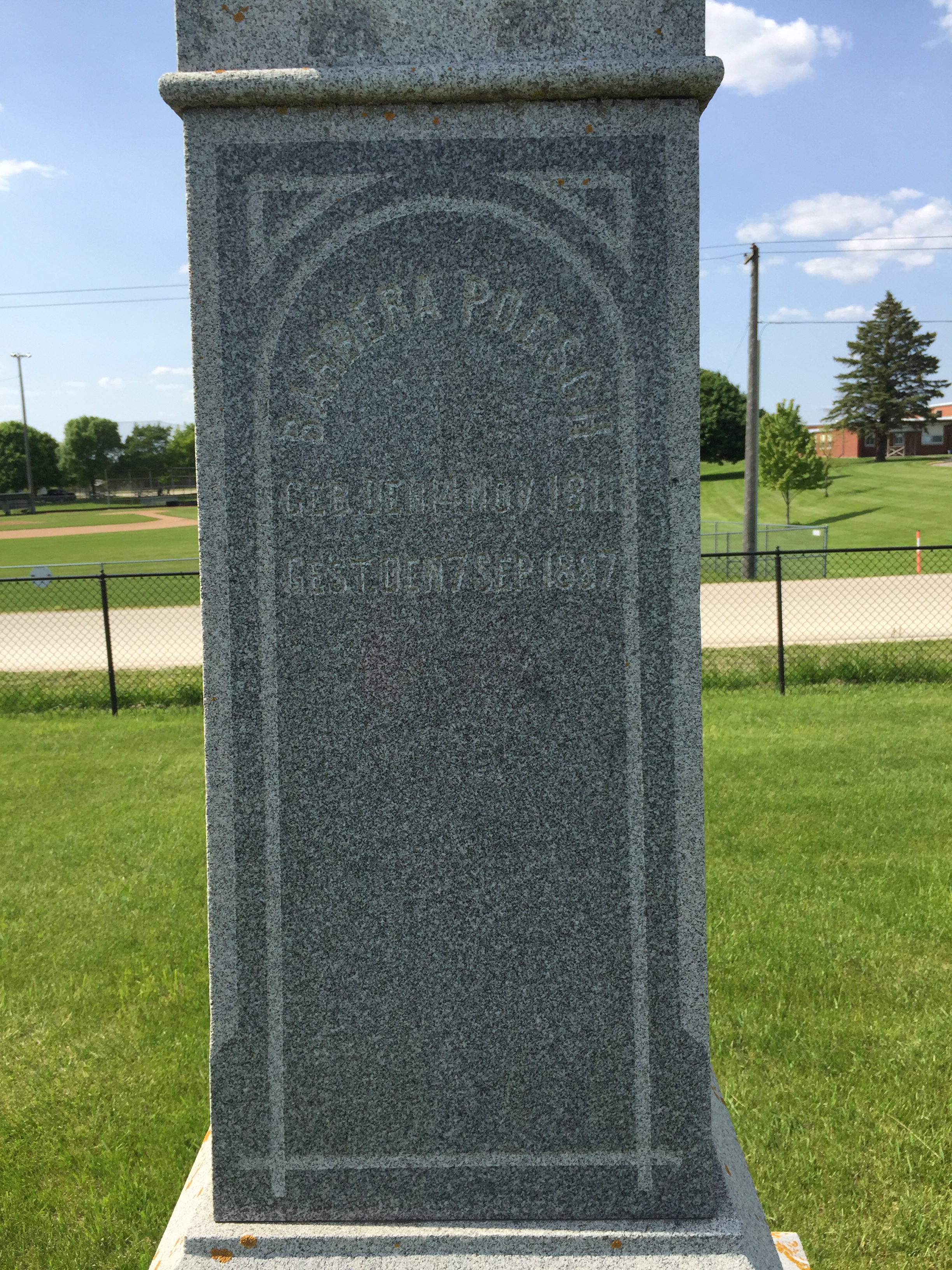
Anna Barbara (Ruckdäschel) Poesch was forty-two years old before she saw something of the world. Born on 14 November 1811 in the village of Schönlind near what is now Weißenstadt, Bavaria, Germany, she was said to have been the daughter of Johann Georg Ruckdäschel and Eva Margaretha Brodmerkel. Nothing is known of her early years, but Barbara, as she was known, married shoemaker Wolfgang Poesch on 22 April 1833 when she was twenty-one years old. Five known children would be born to the couple in the years to come, the first that same year: Johann (1833), Catharina (1835), Anna Margaretha (1838), Lorenz (1847), and Paulus (1850).

In 1852, Barbara bade farewell to her eldest son when he departed in the company of another local family, that of Paulus and Elisabeth (Schmidt) Thoma, to seek a better life in America. Young Johann, nineteen at the time of his passage, must have sent a favorable report to his parents of his new home in northeastern Iowa; in 1854, Barbara, Wolfgang, and their four remaining children packed a trunk and left the village of Weißenstadt behind forever.

After making the trek to Bremen and then stepping aboard the Heinrich Von Gagern, the family was at sea for what may have been as long as two months. Barbara must have struggled to keep her family clean and fed in cramped conditions, but surely took solace in the companionship of others from their home village who traveled with them. Her eldest daughters, Catharina, eighteen, and Anna Margaretha, fifteen, would have been a great help to her in caring for the two little boys, Lorenz, seven, and Paulus, just four.

Barbara and her family disembarked in New Orleans on 27 Apr 1854. They may have been wary of lingering long in this bustling port; a devastating yellow fever epidemic had swept through the city the previous summer, and as April turned to May, the weather would likely have become increasingly hot, humid, and inhospitable. A steamboat would have provided the family relatively quick and reliable passage north, at the very least to St. Louis if not all the way to Iowa.

After an arduous journey across the Atlantic and through the Gulf of Mexico, then up the Mississippi River, Barbara was no doubt thrilled to finally be reunited with her eldest son upon their arrival in Clayton County, Iowa; in fact, numerous familiar faces from their home village would have greeted the Poesch family.

However, tragedy would soon strike—if indeed it hadn’t already. Four-year-old Paulus, listed as the youngest member of the family on the 1854 ship manifest, was not present at the time the family was recorded in the 1856 Iowa State Census, which suggests that he had died at some point in the intervening years, either in Iowa or en route there. Then, most likely within a year of that same census, Wolfgang succumbed to sunstroke. In his early fifties at the time, the physical demands of farming in the heat of an Iowa summer were apparently too much for him.

Although Wolfgang did not live to commemorate his silver wedding anniversary with Barbara, the couple was able to celebrate the marriages of their two eldest children: son Johann to fellow immigrant Catharina Weiss, and, in 1855, daughter Catharina to Friederich Thoma. Then, in 1857, Anna Margaretha married Wilhelm Heinrich Thoma. The Poesch sisters had, in fact, married two brothers, members of the same family with whom their brother Johann had emigrated from Weißenstadt in 1852. This made their children—nineteen between them—double first cousins.

Find A Grave, Inc., Find A Grave, digital image (www.findagrave.com : accessed 25 March 2024), photograph, Barbera Poesch (1811-1887), Memorial No. 148724753, Garnavillo Community Cemetery, Garnavillo, Clayton County, Iowa; photograph by Ken Johnson, 2016.

Barbara survived Wolfgang by approximately twenty years. The year 1860 found her living with the family of her daughter Catharina; a few years later, her son Lorenz would serve with the 12th Iowa Infantry in the Civil War, surely an anxious time for Barbara. Lorenz survived the war and married Wilhelmina Best in 1868. In 1870, Barbara lived with the family of her son Johann, and was perhaps still a member of his household during a bitter cold snap in early March of 1873 when her fourteen-year-old granddaughter, her namesake, sadly perished. Young Barbara, who had been ill, had entered an unheated room one night where she fell and lay undetected until morning, by which time her arms and legs were said to have frozen and she was too weakened to recover.

By 1885, Barbara resided in the town of Garnavillo with her daughter Anna Margaretha, who was by that point also widowed. Barbara’s occupation was recorded as “Old Mother.” Having raised four children of her own to adulthood, and having likely had a hand in raising a total of twenty-five grandchildren as well, Barbara certainly earned her title.

Anna Barbara (Ruckdäschel) Poesch died at the home of her daughter in Garnavillo, Clayton County, Iowa, on 07 September 1887, when she was seventy-five years old. Her obituary, printed in a local newspaper, stated, “Her remains were conveyed to their last resting place on Saturday, followed by a large concourse of sorrowing relatives and friends. Rev. F. Sommerlad conducted the ceremony in his usual impressive manner.”

Copyright © 2024 Melanie Frick. All Rights Reserved.

Continue reading

The Thatcher’s Family

When Matthias Hoffmann died in 1879 at the age of fifty-eight, he left a widow and six children, the youngest of whom was only four years old. Matthias, a thatcher by trade, had lived with his family in the village of Prümzurlay, Eifelkreis Bitburg-Prüm, Rhineland-Palatinate, Germany, near Luxembourg. He and his wife, Anna Marbach, had married in the village of Ernzen on 24 September 1861, and six children were born to them over the next fourteen years: Clara (1861), Nicolaus (1864), Jacob (1867), Elisabeth (1869), Eva (1872), and Matthias (1875).

It is not known how the Hoffmann family supported themselves after Matthias’s death, but as Anna did not remarry, she and her eldest daughters may have been able to earn an income from spinning, weaving, or the like, while her eldest sons may have hired out as shepherds or farm laborers. Perhaps Nicolaus, who was fourteen when his father died, was fortunate enough to have already had an apprenticeship in place; eventually he married and settled in the area, living out his life in Germany.

Prümzurlay, Rheinland-Pfalz, Germany photograph, 2009; privately held by Melanie Frick, 2024.

For the others, however, new horizons were sought. Jacob, the second eldest son, who had been twelve years old at the time of his father’s death, was the first to immigrate to America. He traveled alone from Antwerp to New York in the spring of 1887 when he was twenty years old. One can well imagine the hard work that he—and his mother and siblings—must have undertaken in order to book his passage, quite likely with the expectation that he would pave the way for the rest of the family to eventually join him overseas. Jacob then made his way to northeastern Iowa.

Three years later, in the spring of 1890, his sisters Clara and Elisabeth followed. Within a month of their arrival in North Washington, Chickasaw County, Iowa, Clara, who was twenty-eight, married fellow immigrant John Seelhammer. One wonders whether they had been acquainted in Germany, or whether Jacob may have facilitated the match. Elisabeth, twenty, was not so quick to settle down; she found employment as a housekeeper for the local priest, Father Probst, who was a native of Luxembourg.

In the spring of 1891, matriarch Anna (Marbach) Hoffmann, who was by then fifty-five years old, voyaged from Antwerp to New York with her two youngest children, Eva, eighteen, and Matthias, sixteen. They too were bound for Chickasaw County, Iowa, where they would reunite with Jacob, Clara, and Elisabeth.

The 1895 Iowa state census indicates that Anna and at least four of her children resided in Chickasaw County: Anna headed a household that included her sons Jacob and Matthias, both of whom farmed; Clara lived with her husband, a shoemaker, and their children; Elisabeth resided at her place of employment with Father Probst and the Sisters of Charity. Eva is absent from the 1895 Iowa state census, but whether this is because she had moved elsewhere or was simply missed by the census enumerator is not known.

It was in Chickasaw County that Jacob married Margaret Nosbisch in 1895, and where Elisabeth married fellow immigrant Mathias Noehl in 1896. In 1898, however, tragedy struck the Hoffmann family, when Matthias, the youngest child of Matthias and Anna (Marbach) Hoffmann, died at the age of twenty two or twenty three. Another blow occurred that year when Jacob and his wife lost a child at one day old.

It was also in 1898, however, that Eva married in Chicago to Mathias Weyer, and by 1900, her mother had joined her there. Chicago wasn’t a surprising destination for them; Anna’s mother and two of her sisters had settled there decades earlier. Although her mother had since passed away, Anna would have had the opportunity to reunite with her sisters and to meet her nieces and nephews.

Ultimately, Anna seems to have remained in Chicago until her death in 1907; the cause was attributed to asthma. Clara and Elisabeth both raised large families in Chickasaw County, with Clara having eight children and Elisabeth nine. Eva had one child with her first husband, a farm laborer and beer peddler; after she was widowed, she remarried in 1913 to Milton Jonas, and lived out her life in Chicago.

Jacob, whom a local newspaper described as being “of that hustling, genial disposition which makes him companionable and agreeable whether the weather, or something else is or is not just to his liking,” set his sights on South Dakota shortly after the dawn of the new century, and later settled in Hidalgo County, Texas, with his wife and son—who was ultimately the only one of his six children to survive infancy.

Brother and sister Jacob Hoffmann and Elisabeth (Hoffmann) Noehl, Hidalgo County, Texas, 1940; digital image courtesy of Jacky Sommer, 2018.

Whether the scattered Hoffmann siblings were able to remain in close contact in the decades following their mother’s death is unknown, but it is known that Jacob returned to Iowa to bury his wife in 1929, and there is also evidence—in the form of a photograph—that Elisabeth visited her older brother Jacob at his orange grove in Mission, Texas, in 1940. Eva had died in 1936; Jacob would pass away in 1954, Clara in 1955, and Elisabeth in 1957. Of the fate of their brother Nicolaus who was said to have remained in Germany, however, nothing is yet known.

Copyright © 2024 Melanie Frick. All Rights Reserved.

Continue reading

Evading the Law in 1899

Hedwig Cichos—Hattie to those who knew her—was first widowed at the age of thirty-one. Her husband of twelve years, Joseph Lutz, had succumbed to tuberculosis, leaving her with four young daughters to provide for on her own. The oldest was just ten and the youngest not yet three; with so many mouths to feed, it comes as little surprise that Hattie remarried before the year was out. On 29 December 1887, not quite eight months after Joseph’s death, Hattie married Albert Rindfleisch, a fellow Silesian immigrant who was more than five years her junior.

Albert and Hattie made their home in Minnesota Lake, Faribault County, Minnesota, the same village where Hattie had settled with her parents when she had immigrated to America in 1873. In the years to come, Hattie would have five children with Albert: Edward in 1888, Agnes in 1890, Albert (II) in 1892, Elsie in 1893, and Frank in 1895. The 1895 Minnesota state census, recorded before Frank’s birth, indicates that only the youngest of Hattie’s daughters from her first marriage, Melanie, eleven, still lived under her roof. Her eldest daughter, Julia, had married at the age of sixteen in 1893 and moved out of state; the whereabouts of her middle daughters, Anna and Hattie (II), for the year 1895 are unknown. According to the census, Albert was a laborer and had worked for eight months of the previous year.

In the summer of 1899, everything changed for the Rindfleisch family. First, charged with “whipping his wife,” Albert, then thirty-eight, was jailed at the county seat of Blue Earth. He somehow managed to escape the sheriff, board a train, and travel one hundred miles west—but then his luck ran out. The Slayton Gazette and Murray County Pioneer reported:

Run Over by the Cars. Albert Rindfleisch, of Minnesota Lake, was run over by the west bound freight at this place Tuesday morning and had both legs taken off below the knee. He boarded the train here intending to go to either Hadley or Lake Wilson, and as the train pulled out he was standing alone on the front end of the accommodations car. He claims the cars gave a bump and he was thrown forward. He fell between the cars with both legs across the north rail and his body north of the track. The accommodation car passed over his legs and he was not seen by the train men. His cries attracted passersby and he was taken to the depot and from there to the poor house to be cared for. Dr. Morell, the railway physician, assisted by Dr. Lowe, amputated both his legs, one just above the ankle and the other just below the knee. A bottle containing a small amount of whiskey was found near him when picked up. He had thrown it away so as not to have it on his person. This has given rise to the suspicion that he may have been under the influence of liquor at the time of the accident. He claimed to have been looking for work. He has a wife and five children at Minnesota Lake.

Slayton Gazette and Murray County Pioneer, 03 August 1899

Two months later, the same newspaper provided an update:

Sandy McDonald, sheriff of Faribault county, was here last Saturday and took back with him Albert Rindfleisch who had been an inmate of our poorhouse since he had his legs taken off by the cars here two months ago. Rindfleisch was in jail at Blue Earth for whipping his wife and escaped from the sheriff. While fleeing from the sheriff he had his legs taken off here.

Slayton Gazette and Murray County Pioneer, 12 October 1899

It is not known whether Albert ever returned home to Hattie and their children—or whether Hattie would have let him if he had tried—but when the U.S. census was recorded in the summer of 1900, Hattie was reported to be a widow. It is possible that she may have been known in her heavily German-speaking community as a Strohwitwer, a term with the English equivalent “grass widow” that indicated that a couple was separated or that the wife had been effectively abandoned. Albert and Hattie—both Catholic—never divorced, and Hattie was not in fact widowed for the second time for another thirty years.

While Hattie remained in Minnesota Lake, Albert made his way to Wisconsin. Milwaukee city directories indicate that he may have eked out a living as a peddler for a period of time, but ultimately, he spent many years at the Milwaukee County Infirmary, an almshouse and poor farm in neighboring Wauwatosa. The 1920 and 1930 U.S. censuses both indicated that he was an inmate there, although whether alcoholism or the loss of his legs was the primary factor that brought him to this last resort for food and shelter is unknown. His final days were apparently spent in a rooming house in Milwaukee, as that is where he died on 08 May 1930:

08 May 1930, Thu The Sheboygan Press (Sheboygan, Wisconsin) Newspapers.com

Alcoholism, domestic violence, disability—all played a part in Albert’s sad demise, his death ultimately garnering a headline only as an oddity. Hattie, for all the hardships she may have suffered in an unhappy marriage and as a single mother, was resilient. She supported herself and her children as a seamstress and through her own self-sufficiency, keeping a milk cow, chickens, and pigs on three acres of land. Her grandchildren’s memories of her industrious nature and of her home cooking and preserving—ham, bacon, sausage, braunschweiger, pickled pigs feet, sauerkraut—long outlived her. Of Albert, however, little was ever said.

Copyright © 2023 Melanie Frick. All Rights Reserved.

Continue reading

A Full House in a Mill Town

By the time of the 1870 U.S. census, French Canadians Timothée and Marguerite (Chicoine) Adam, both fifty-four years old, had lived in America for approximately five years. Along with their children, who ranged in age from toddlerhood to young adulthood, they had settled among fellow French-speaking immigrants in Springfield, Hampden County, Massachusetts. Their neighborhood, Indian Orchard, boasted a booming cotton mill on the banks of the Chicopee River. This would certainly have been a different environment than they had been accustomed to in the quiet village of Saint-Pie, Quebec where, for the first twenty-five years of their marriage, Timothée had been a farmer and Marguerite had raised more than a dozen children in their humble home. Their move from rural to comparatively urban was certain to have been full of adjustments, but what may be the most striking about their lives in the year 1870 is the impressive number of people with whom they shared one roof: twenty-eight, to be exact.

Their household had grown substantially from their first appearance in the Massachusetts state census in 1865; then, Timothée, who was employed at the mill, headed a household that numbered thirteen, including ten children and one boarder. In 1870, the twenty eight residents, all related, were in fact divided among four households within a single dwelling unit, presumably a tenement block. First recorded was the household headed by Timothée and Marguerite Adam themselves, which included nine of their children—those nine ranging in age from twenty-two down to three. Then came the households of three of their married daughters. The household of Leon and Julienne (Adam) Gay was first; they were the parents of one child. The household of Joseph and Marie (Adam) Noel and their five children was next, and last was that of Jean Baptiste and Marguerite (Adam) Gendreau and their five children.

Although Timothée himself was without an occupation at this time, and Marguerite kept house, nine other members of the combined households worked at the mill. Four of those nine millworkers were under the age of sixteen: Jean Adam was fourteen, Elisa Adam was twelve, Jean Gendreau was twelve, and Euclide Gendreau was eleven. Six children between the ages of six and eleven were at school, and six children between the ages of one and four were at home in the care of their mothers.

Many of Timothée and Marguerite’s children, grandchildren, and even great grandchildren would spend the decades to come employed in the Indian Orchard mill. It was not an easy life; in the years following the 1870 census, several members of the family would succumb to tuberculosis and other respiratory illnesses common among millworkers of the day, who often worked in dismal conditions with poor ventilation and were plagued by both communicable diseases and cotton lint.

“Clarence Noel, 138 Main St., Indian Orchard. Doffer in Hodges Fibre Carpet Co. of Indian Orchard Mfg. Co.,” September 1911, Prints & Photographs Online Catalog, Prints & Photographs Reading Room, Library of Congress, Washington, D.C. (https://www.loc.gov/pictures/item/2018676653/ : accessed 08 January 2023).
“Alfred Gengreau [Gendreau], 20 Beaudry St., Joseph Miner, 15 Water St. Both work in Mr. Baker’s room, Indian Orchard Mill,” September 1911, Prints & Photographs Online Catalog, Prints & Photographs Reading Room, Library of Congress, Washington, D.C. (https://www.loc.gov/pictures/item/2018676654/ : accessed 08 January 2023).

Notably, at least two of the couple’s great-grandchildren appear to have been photographed by famed muckraker Lewis Hine, who documented the plight of child laborers in the early twentieth century and whose work was instrumental in child labor reform. Clarence Noel, fifteen, grandson of Timothée and Marguerite’s daughter Marie (Adam) Noel, and Alfred Gendreau, thirteen, grandson of their daughter Marguerite (Adam) Gendreau, were both photographed outside their workplace in September of 1911. Clarence, Hine noted, worked as a doffer and said that he had “made seven dollars last week.” Alfred, who posed with another boy, was said to “work in Mr. Baker’s room, Indian Orchard Mill.”

These boys were not by any means among the youngest of the child laborers that Hine photographed, nor did they work in the most arduous conditions, but still their images are striking. In their knickers and caps, both slight of build, Clarence and Alfred look every bit like schoolboys, although the mill—to which four generations of their family had now been tied—loomed large in the background. Their school days behind them, it was time for the boys to work to support their families.

Copyright © 2023 Melanie Frick. All Rights Reserved.

Continue reading

One of Dakota’s Pioneer Mothers

There can be no question that Christina Marie (Schmidt) Nelson was a strong and capable woman.

Born in Skrydstrup, Gram, Haderslev, Denmark on 11 October 1868, to Jens Madsen Schmidt and Anne Bramsen, Christina immigrated to America with her parents and older sister when she was just twenty months of age. A dugout on a homestead in Dakota Territory was her first home in America; it was from this homestead in Bon Homme County that she spent long hours tending her family’s cattle, experienced devastating prairie fires and blizzards, witnessed interactions with displaced Native Americans, and even once encountered General George Armstrong Custer when he stopped for a drink of water. She was fortunate enough to attend a one-room log schoolhouse through eighth grade, and, in 1889, when she was twenty-one, she married her neighbor and fellow Danish immigrant Frederick Nelson.

Over the course of the next twenty years, Christina gave birth to nine healthy children: Anna Sophie (1891), Julia Marie (1892), Ole James (1894), Andrea Mathilda (1896), Louise Christine (1899), Helena Margaret (1900), Mary Magdalene (1904), Frederick Andrew (1908), and Myron Alvin (1910). Education was of apparent importance to Christina and Fred, as he was known; although their oldest son attended school only through eighth grade, destined to become a farmer like his parents before him, their younger sons and daughters all attended school at least until the age of sixteen. They even saw to it that their four youngest daughters had the opportunity to attend a “normal school” in nearby Springfield, South Dakota, where they received the necessary training to become schoolteachers.

The Fred and Christina Nelson Family, Yankton County, South Dakota, 1912; digital image 2011, privately held by Lori Dickman. Back row, from left: Julia, Anna, Ole, and Andrea Nelson. Front row, from left: Mary, Louise, Christina with Myron, Fred with Fred Jr., and Helena Nelson.

A formal portrait of the Nelson family was taken in July of 1912, likely in Yankton, which was not far from the family’s home in Lakeport; the girls sport bare forearms for the season, their fabric colors light and featuring gingham, stripes, and lace. Christina, while dressed in a dark gown, wears a white collar and whimsical crocheted flowers at her throat. As to the occasion for the photograph, it was not a milestone anniversary year—Christina and Fred would have celebrated their twentieth anniversary the previous spring. However, Christina perhaps realized that, at forty-three, her childbearing years were behind her and now was the time to have a portrait taken of the entire family all together. Furthermore, as her eldest daughter had married in March of 1912, having her first child leave the nest might also have sparked sentimentality and a wish to document the fact that, at least for a short while, all nine Nelson children had been under one roof.

Christina and Fred would go on to celebrate their twenty-fifth anniversary in 1916, but two years later, a matter of weeks after her fiftieth birthday, Christina would be dealt several harsh blows in short succession. First, Spanish Influenza hit the household, and then, in a turn of events that shocked both the family and their wider community, she lost Fred to suicide, and, one month later, daughter Andrea to undetermined medical circumstances.

Christina persevered. She faced another trial when her father died the following spring, but it was a blessing that her eldest son was home from his service in the Great War and able to help manage the family farm while she continued to raise her two youngest sons. She continued to live on the farm with support from her sons well into her old age; even in 1950, when she was eighty-two, the census reported that she was still “keeping house” for her three bachelor sons. It was at this farmhouse that her children and grandchildren frequently gathered to celebrate birthdays and holidays.

Christina died on 23 January 1961 at the age of ninety-two and is buried alongside her husband and three of their nine children at the Elm Grove Cemetery in Yankton County, South Dakota. A brief biography included in a local history book several years prior had noted, “Mrs. Nelson is well-known by her many friends and relatives as a person who always has a warm welcome hand extended to all those who call at her home. Even today, at the age of eighty-five, she is active with her household duties and retains an active interest in what is going on about her. She is cordial and sympathetic with the many young people who come her way. She is truly one of Dakota’s pioneer mothers who still looks ahead and enjoys her home and family.”

Copyright © 2022 Melanie Frick. All Rights Reserved.

Continue reading

Michael and Magdalena

Little is known about Michael Noehl and Magdalena Hoffman, a couple who spent their married life in the village of Holsthum, Eifelkreis Bitburg-Prüm, Rhineland-Palatinate, Germany. Holsthum was described by one of their sons as “situated in a lovely valley of rich agricultural land, crowned with fruit trees, and further off, with magnificent forests, between nurseries and rose plantations.” Even now it remains a quaint, pastoral village.

Michael Noehl, one of at least eight children of Johannes Noehl and Elisabeth Gierens, was born in Niederstedem, Eifelkreis Bitburg-Prüm, Rhineland-Palatinate, Germany on 22 June 1828. Nothing is known of his childhood, but as a young man, he entered the military. According to the memoirs of his son, Michael served as a Prussian soldier in Koblenz between the years 1847-1851; during the Baden Revolution in 1848, he stood sentry at the Ehrenbreitstein Fortress.

After his service, Michael married Magdalena Hoffman, who was born on 21 Jul 1833 in Holsthum, one of at least four children of Mathias Hoffman and Magdalena Ehr. Michael and Magdalena were married on 12 February 1857; Michael was twenty-eight and Magdalena twenty-three at the time of their marriage, which was recorded at Schankweiler. The Schankweiler Klaus is an eighteenth-century chapel and hermitage tucked into the forest approximately two miles from the village of Holsthum, and still stands today.

Schankweiler, Rheinland-Pfalz, Germany photograph, 2009; privately held by Melanie Frick, 2022.

Together, the couple had seven sons: Mathias (1858), Michael (1860), Nikolaus (1864), Nikolaus (1866), Mathias (1868), Johann (1870), and Jakob (1873). Notably, despite name repetition among their sons, it is believed that all survived to adulthood. (This is not the first case of name repetition among children of this region that I have observed.)

Mathias Noehl (1868-1950), second from right, with brothers, perhaps Nikolaus, Johan, and Jakob Noehl, Holsthum, Germany, 1938; digital image 2009, privately held by Roland Noehl, Holsthum, Germany, 2009.

A great-grandson of Michael and Magdalena remembered being told that Michael was a forester, and Magdalena certainly had her hands full raising seven sons, but few details are known of their adult lives. One of their sons recalled completing school at the age of fourteen and going to work herding sheep to help his parents pay off a debt on their property; later this same son was apprenticed to a rose grower, so it may be assumed that their other sons were similarly established with apprenticeships.

Michael saw several of his siblings immigrate to America in the nineteenth century; his sister Susanna and his brothers Matthias and Johann all settled in Minnesota. Likewise, Magdalena saw a paternal aunt and a paternal uncle immigrate to Minnesota and Iowa. Later, Michael and Magdalena bade farewell to two of their own children who left their homeland to try their luck on American soil: Michael in 1881 and Mathias (1868) in 1886. From these two sons then came fifteen American grandchildren whom Michael and Magdalena never had the opportunity to meet.

Michael and Magdalena lived out their lives in Holsthum, surviving at least to their sixties, as it is known that their son Mathias came from America to visit in 1894 and found them in good health at that time. To the best of my knowledge, however, their graves, according to German custom, have long since been recycled and are no longer marked.

Copyright © 2022 Melanie Frick. All Rights Reserved.

Continue reading

Two Brothers from Sondersdorf

When immigrant Joseph Lutz died in 1887 the age of forty-two, only one line in a Minnesota newspaper made note of his death. His brother Paul, however, survived him by more than fifty years, and when he died in 1939 he was ninety-three years old. A lengthy obituary in a Minnesota newspaper documented his death, but what is more, his birthday several years prior had warranted an informative and colorful tribute to his life both in his native Sondersdorf, a village in eastern France, and in southern Minnesota. As Joseph and Paul, only two years apart in age, both served in the Franco-Prussian War and then immigrated to America, many of Paul’s recollections relate what must have been shared experiences.

The brothers were born to François Joseph Lutz (1801-1881) and Marguerite Meister (1801-1876), Joseph on 31 May 1844 and Paul on 07 August 1846, both in what is now Sondersdorf, Haut-Rhin, Alsace, France. Their father was a farmer, and this was his second marriage; their mother was a native of the nearby border village of Roggenburg, Switzerland. Joseph and Paul were raised to work hard, although they also had the opportunity to attend school, as related in the Blue Earth County Enterprise in 1935:

“Alsace Lorraine at that time belonged to France, as it does now, although for many years between it was Germany’s. And so young Paul was born a French citizen. His father was a farmer and when Paul was still very young he was put to work. How young? Well, he says, laughing, that he thinks he began to work before he was born. He worked in the field, in the town, anywhere where there was work to be had.

“French was taught in the schools, but his family, like many others in Alsace, spoke German at home. So he grew up with a knowledge of both tongues. However, today and for many years since, it is German that he speaks fluently. There are, he says, no Frenchmen around to give him practice in that language.”

In 1866, Joseph and Paul, by then twenty-two and twenty years of age, appeared in a census in a household in Sondersdorf with their parents and younger sister, Philomene. Just a few years later, the brothers served in the Franco-Prussian War, which broke out in the summer of 1870:

“Like every other French citizen, [Paul] entered military training when old enough. His memories of that period are clear and vivid, for while he was still in the army, the Franco-Prussian war broke out. That was in 1870 and one of the causes of the bitter enmity between France and Prussia was that same Alsace Lorraine where he was born, a strip of territory at the eastern edge of France coveted by both nations and snatched first by one, then the other. When Prussia whipped France in that war of 1870, she took Alsace Lorraine as one of the indemnities and from then on France never rested until the World War brought it back again to the French.

“There wasn’t so much to the war so far as he was concerned, says Mr. Lutz, except horse meat to eat and being taken prisoner at the battle of Metz. Asked how that happened, he drolly repied [sic] that the Germans took the whole army prisoner so of course he went along. Speaking of horse meat, Mr. Lutz remarked that it wouldn’t have been so bad had they been given some beer, or at least enough water to wash it down with. But there was none of the first and little enough of the second. To make it worse he says it was tough meat with no pepper or salt. You stuck two sticks up on each side of a fire and hung the meat on a third stick laid across. After it had toasted a bit, you ate it – if possible.

“Because Germany considered Alsace her own, and to gain the good will of its people, she released the French prisoners from Alsace earlier than others. That was in 1871. Between horse meat, fighting and being a prisoner, Mr. Lutz says he’d had enough […] and straightaway came to America.”

Although comparatively little is known about Joseph Lutz’s experiences, his grandson once related that after serving in the Franco-Prussian War and coming out on the losing side, Joseph immigrated to America because he wouldn’t live under Prussian rule. It seems the brothers were allied in their feelings after having fought and been imprisoned by the Prussians—and having been forced to survive on horse meat during the Siege of Metz, which has been documented. A passenger list has been located that may indicate that the brothers immigrated together, arriving in New York aboard the Nevada in May 1871, mere months after the war’s end.

Lutz_Joseph

Joseph Lutz (1844-1887), circa 1875-1885; digital image 2010, privately held by Melanie Frick, 2021.

Although the Blue Earth County Enterprise recorded in 1935 that Paul and his wife Josephine Lutz married in Sondersdorf and immigrated together, settling first near Burlington, Des Moines County, Iowa before making the move to Minnesota, records indicate that the couple actually married in Des Moines County, Iowa, in 1872. “Asked if they came by train to Burlington, Mr. Lutz chuckled and said, ‘Well, you needn’t think I walked.'” Perhaps the plan all along had been that Paul and Josephine would reunite and marry once in America and free of the strife of their homeland. Joseph, it seems, had not made any such promises to any young women from their home village; he instead married a Silesian immigrant, Hedwig Cichos, in Faribault County, Minnesota, in 1875. 

The brothers’ paths diverged to a degree in Minnesota; Paul farmed, as their father had before him, whereas Joseph lived in town, making a living first as a butcher and then as a saloon keeper. Of farm life, the Blue Earth County Enterprise shared that Paul owned one hundred and twenty acres “two miles west of Bass Lake,” and noted, “Memories of early days in southern Minnesota come to [Paul] as he talks. He tells of hauling grain to Delavan and Easton in the winter, using oxen-drawn sleds. Many a time, he says, blizzards would spring up and there was nothing for it but to give the oxen their heads and trust them to find the way home. They never failed.” Of Joseph, the newspaper shared, “Joe Lutz, early Mapleton butcher, was [Paul’s] brother. His shop was on Second Street just back of where the Wiedman drug store stands today. The frame building that housed it is the same one that stands there still, says Mr. Lutz.”

Joseph was indeed known to have been a butcher in Mapleton in the early 1880s; in the 1870s, however, he had operated a one-story frame butcher shop in Minnesota Lake, behind which were rooms where his family lived. After his stint as a butcher in Mapleton, he returned to Minnesota Lake but this time kept a saloon. Family lore notes that Joseph was a generous-hearted man who was known to give away cuts of meat to new immigrants in his community—to the occasional dismay of his wife, who chided him that these newcomers would not even have a pot with which to cook the meat!

Joseph would succumb to tuberculosis not quite sixteen years after his arrival in America; it seems especially tragic that he was stricken with this disease as he might otherwise have enjoyed as many years as his brother. At the time of Paul’s eighty-ninth birthday, the Blue Earth County Enterprise wrote, “Paul Lutz feels much younger than his years. His mind is far keener toward what is going on in this world than that of many a younger man. Age has as yet brought little failing to his senses. His speech is filled with humor that indicates his cheery optimism and enjoyment of life. His hearing is good. He walks up town every day. He administrates for himself the affairs of the farm he owns near Bass Lake. Paul Lutz has enjoyed and is still enjoying a full life with a clear memory that is truly remarkable.”

Copyright © 2021 Melanie Frick. All Rights Reserved.

Continue reading