The Iowa Asylum

“Timothy Adams, living near Moville, was sent to the insane asylum the past week.”1

When a casual online search turned up this statement printed long ago in a small-town Iowa newspaper, I was intrigued. There are three generations of Timothys in my family, and all three might have lived near Moville, Woodbury County, Iowa at the time of publication of this issue of the Sioux Valley News on 9 January 1890.2 Which Timothy, then, was sent to the insane asylum? For that matter, which asylum? And why?

As it turns out, this Timothy Adam was the youngest of the three, the son of Timothy and Odile (Millette) Adam, and the grandson of Timothée and Marguerite (Chicoine) Adam. He was born on 26 September 1869 in Chicopee, Hampden County, Massachusetts,3 where his parents, French Canadian immigrants, were employed in the area’s cotton mills.4 The family remained in Massachusetts until 1883 when they traveled west, first to southeastern South Dakota and then to homestead near the community of Moville in northwestern Iowa.5

When Timothy, Jr. was seven years old, he suffered a fever that led him to experience what was described as a fit.6 These fits continued, “sometimes three or four in succession,” although a week could pass before another occurrence.7 Apparently, however, Timothy “was never [a] very bright boy,” and furthermore, as he grew older, his condition became more unmanageable.8 He suffered memory loss and “wanted to run away constantly without occasion.”9 It was for these reasons, including his first unmanageable fit, that his father had Timothy evaluated and committed to the Clarinda State Hospital in Clarinda, Page County, Iowa, on 7 January 1890.10

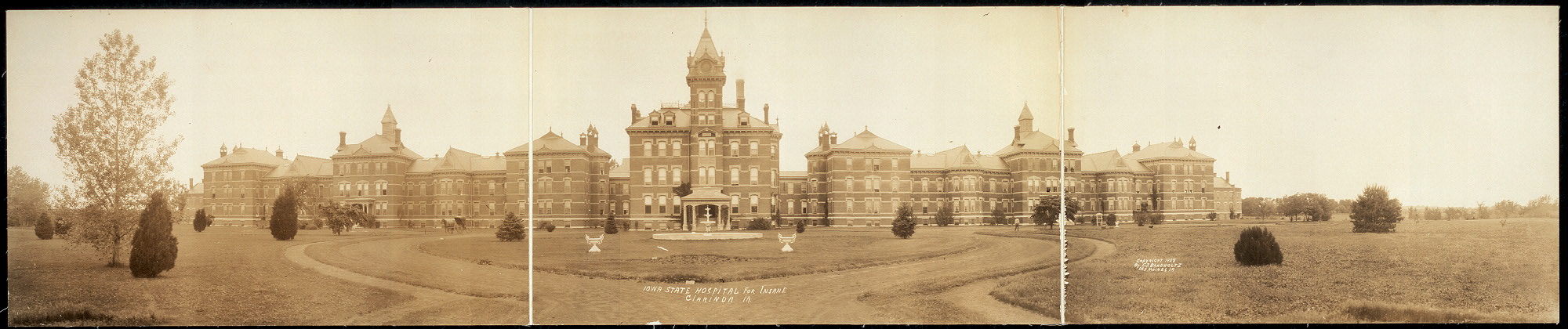
“Iowa State Hospital for Insane, Clarinda, Iowa (1908),” Prints & Photographs Online Catalog, Prints & Photographs Reading Room, Library of Congress, Washington, D.C. (http://hdl.loc.gov/loc.pnp/pan.6a04897 : accessed 28 March 2017).

One can only speculate as to what condition or conditions might have ailed Timothy. While the fits he suffered were perhaps epileptic seizures, low intelligence and a desire to run away from home were noted as secondary issues. Timothy was not the only child to cause his parents similar distress, as his younger brother, Edward, had run away several years earlier. In addition, upon Timothy’s entry into the asylum, it was noted that a member of his extended family had also been institutionalized: his mother’s younger brother, Joseph Millette, had entered the poorhouse in Beekmantown, Clinton County, New York, in 1869 at the age of nineteen.11 Records state that Joseph was an “imbecile,” intemperate, and, though he was of “respectable parentage,” his parents, too, were unable to care for him.12

At the time of Timothy’s admission to the asylum in the winter of 1890, the Clarinda State Hospital was brand new. Its first patients were received less than thirteen months before, and in fact, construction would not be complete until 1897.13 The Second Biennial Report of the Board of Trustees of the Iowa Hospital for the Insane at Clarinda reported a commitment to humane treatment, with avoidance of extreme measures such as restraint and isolation, and it can be hoped that Timothy and his fellow patients were treated with respect and kindness.14 Indeed, whether embellished or not, the Second Biennial Report stated of the years 1890-91, “Perfect harmony seems to exist between our superintendent and his subordinates.”15

The hospital housed a daily average of two hundred and sixty-one patients in January of 1890, a number that climbed over to over three hundred within a month.16 Although Superintendent Lewellen applauded the facilities as a whole, he also admitted that the hospital was overcrowded due to an influx of patients, many of whom had transferred from Iowa’s other mental institutions.17 However, the Second Biennial Report offered an encouraging perspective as to the overall conditions of the hospital, and plans were outlined for future improvements, including additions to the building and grounds as well as opportunities for patients to engage in both amusements and meaningful work.18

Timothy was discharged “without improvement” on 31 October 1891 after nearly two years at the hospital, perhaps once it was determined that no available treatment would be of help to him.19 It is not known whether he ever returned to his family. Sadly, Timothy died at the Clarinda State Hospital on 1 December 1894 at the age of twenty-five. Epilepsy was reported as his cause of death, which suggests he may have returned to the hospital due to a fatal seizure.20 He is buried in the hospital’s cemetery, many miles from his family and his former home.21

Copyright © 2017 Melanie Frick. All Rights Reserved.
Continue reading
A Baby Carriage in Dakota Territory

A new arrival in the family has meant that blogging my research findings has taken a backseat in recent months, but with babies on the mind, here is a peek at a sweet little one posed with his mother in the nineteenth century:

nielson_harry_andresen_hannah_1888

Hannah Marie (Andersen) Nielsen with Harry Niels Nielsen, Yankton, Dakota Territory, 1888-89; digital image 2014, privately held by [personal information withheld].

Pictured is Hannah Marie (Andersen) Nielsen, wife of Ole Nielsen of Yankton, Yankton County, South Dakota, with her infant son Harry Niels Nielsen.1 Harry was to be the couple’s only surviving child; a daughter died in infancy.2 He was born 25 May 1888 in the town of Yankton,3 only a few months after the infamous Children’s Blizzard; his parents, both Danish immigrants, had married in 1880.4 At the time of Harry’s birth, Ole managed a dray line in Yankton, transporting heavy loads in a specially built wagon.5 Later, he would take up farming east of the nearby community of Mission Hill.6

In this photograph, Hannah, forty years of age, wears a dress with a full skirt, fitted sleeves, and a bodice fastened with no less than a dozen buttons.7 A brooch is pinned at her high collar and a flat-brimmed hat atop her head is adorned with feathers, adding an elegant statement to her otherwise relatively simple attire. What appears to be a strip of fabric is wrapped around the palm of her visible hand.

Harry, who looks to be less than a year old, dating this picture to South Dakota’s pre-statehood days of 1888-89, is dressed in a light-colored gown and a snug bonnet. He looks directly at the camera and a belt around his middle secures him to the seat of a baby carriage. The slatted basket is long enough that a smaller baby could lay flat until, like Harry, sitting upright against the fringed backboard would be possible.

I love that a baby carriage is featured here, unlike in any of the other nineteenth century baby photographs in my collection. However, I do have to wonder how practical it would have been at this time and place. While a bustling prairie town in its own right, Yankton was not, by any stretch of the imagination, a particularly urban environment, where a baby carriage might have proven more useful. Was it a prop at the Janousek studio, then, or did it belong to the Nielson familyperhaps a special luxury for a woman who had waited out eight years of marriage for a healthy child?

Whatever the case, this is a charming look at a proud mother and her well-behaved infant striking an elegant pose on the frontier. And, I have to say, the picturesque baby carriages of the nineteenth century were certainly more worthy of studio portraits than those of today!

Copyright © 2017 Melanie Frick. All Rights Reserved.
Continue reading

A Genealogical Year in Review

Since I began blogging in August 2013, I made an effort to never miss a single month as an opportunity to share a snippet of family history on this blog. Over the course of three years, I shared over one hundred research findings, favorite old photographs, and updates on my experiences at genealogy conferences and beyond. However, this past August, a special new addition to our family meant all self-imposed deadlines were off.

_dsc0813-hdr

Despite the blogging hiatus and the transition to full-time motherhood, which I absolutely love, 2016 was still a banner year for my personal genealogical endeavors:

  • I attended the Salt Lake Institute of Genealogy and shared what I learned on Adventures in Genealogy Education, a blog by Angela McGhie. While in Salt Lake City, I also logged a number of hours with old German records on microfilm at the Family History Library.
  • The NextGen Genealogy Network continued to occupy my time, and I contributed a resource for societies interested in engaging young genealogists. My proposal to lead a panel discussion on the same topic at the 2017 Southern California Genealogical Society Jamboree was recently accepted, and I look forward to the discussion with a fun team of panelists.
  • Speaking of the Southern California Genealogical Society Jamboree, I attended in 2016 for the fourth time, hosted a meetup of the NextGen Genealogy Network, and was honored to receive the Suzanne Winsor Freeman Genealogy Grant, with many thanks to Denise Levenick, blogger behind The Family Curator.
  • Through the month of August, I also continued in the position of editor of the APG eNews for the Association of Professional Genealogists, as well as in a volunteer position as a proofreader of the NGS Magazine for the National Genealogical Society. I thoroughly enjoyed being involved with these incredible organizations.
  • In addition, I was featured on Geneabloggers, wrote about my passion for antique photographs for MyCanvas, completed several memorable client projects (including copyediting Deborah Sweeney’s Lots of Love, Daddy: The World War II Letters of Roscoe and Gladys Yegerlehner), delved more deeply into DNA research, conducted interviews, photographed family historical sites in South Dakota, and made some exciting research discoveries of my ownalong with, of course, adding a new generation to the family tree…

2017 is likely to be a less-involved year, genealogically-speaking, but I look forward to researching, writing, and sharing many more family history stories in the months to come!

An Ancestor with an Alias Revisited

In the past, I’ve touched upon the mystery surrounding George Hiram Thoma, who used an alias for a number of years before reverting back to the use of his original name. Born on 29 September 1880 in Clayton County, Iowa to Fred and Matilda (Hammond) Thoma, census records indicate that George remained in his home county at least until 1895.1 Family lore states that he left home as a teenager due to a poor relationship with his father;2 he was said to have bicycled from northeast to northwest Iowa where the next definitive record of his existence shows him marrying Anna Leota Fenton in the spring of 1902.3 However, he married under the assumed name of George A. Neilson, and later affidavits attest that this was one and the same person.4 George continued to use this assumed name for a number of years before finally reverting to the Thoma surname.

Now, a century has passed, and none of his living descendants, including his youngest daughter, seem to have even heard of the Neilson alias! In an effort to learn more about the potential cause of George’s name-change, a closer look was taken at his movements during his late teens and early twenties:

Did George leave home as a teenager? It was said that George had a poor relationship with his father, and recently uncovered evidence shows that he did, in fact, leave home as a teenager. However, at least at first, he didn’t go far. At the time of the 1895 Iowa State Census, George was fourteen and lived at home in the community of Garnavillo.5 Two years later, sixteen-year-old George attended high school in Postville, a town about twenty-five miles away.6 As George’s maternal grandmother also resided there, it’s certainly possible that he may have lived with her while completing his education.

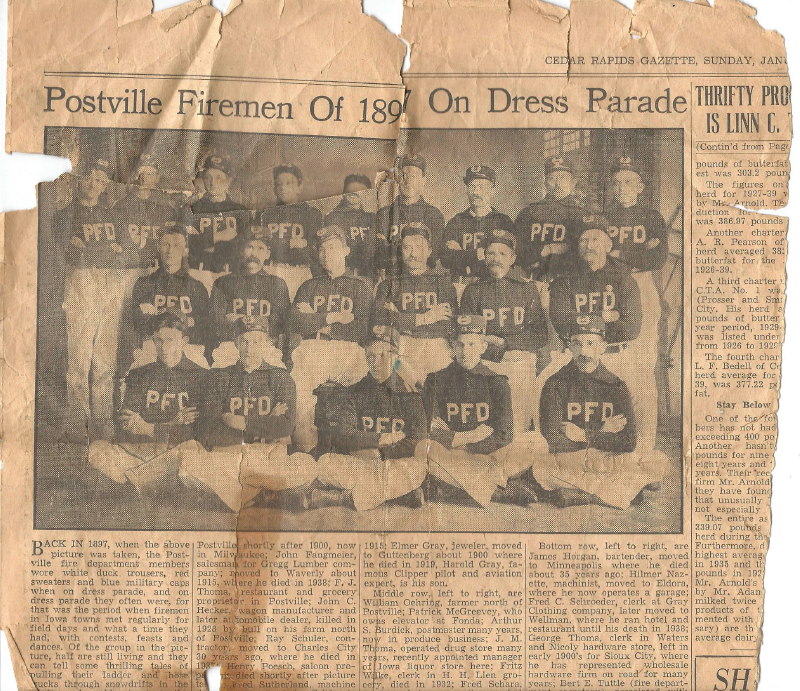
“Postville Firemen Of 1897 On Dress Parade,” 28 January 1940, Cedar Rapids (Iowa) Gazette; clipping privately held by David Adam, 2016. George Thoma is seated second from right; text reads, “George Thoma, clerk in Waters and Nicol[a]y hardware store, left in early 1900’s for Sioux City where he has represented wholesale hardware firm on road for many years.”

Also in 1897, George served with the Postville Fire Department.As reported in a local newspaper decades later, “Back in 1897 […] the Postville fire department members wore white duck trousers, red sweaters and blue military caps when on dress parade, and on dress parade they often were, for that was the period when firemen in Iowa towns met regularly for field days and what a time they had, with contests, feasts, and dances.”8 George, slim and clean-shaven, sits cross-legged in the front row of the group of twenty men, among whom he may have counted both former classmates and kin. At this time, after having dabbled previously with the idea of becoming a tinner,9 he was a clerk at a local hardware store.10

Did George really ride a bicycle across Iowa? Although family lore states that George left home as a teenager and bicycled across Iowa, I’ve always questioned whether this particular tale was entirely true or, indeed, even possible. As it turns out, George did, in fact, have access to a bicycle, and according to a blurb in the Postville Review in the summer of 1898, he “took an overland trip by bicycle to Farmersburg last Saturday, returning on Sunday.”11 From Postville to Farmersburg was a distance of more than fifteen miles—more than thirty miles roundtrip—which, with an eye to both the quality of bicycles of the era as well as the condition of the roads, frankly impressed me. Maybe he did bicycle across Iowa, or at least part of it, but from this clipping we are able to learn that he did not make the journey before he was eighteen; he remained close to home and was known as George Hiram Thoma at least until 1899. In January of that year, the Postville Review shared that he had spent several days visiting his parents in Garnavillo.12

How long did George use an alias? Thanks to the record of his daughter’s birth as well as the discovery of the record of his relinquished homestead, a fairly concrete date can be determined for the conclusion of George’s alias. His eldest daughter was born Fern Neilson in September of 1907;13 George A. Neilson appeared in a city directory printed in late 1908;14 and in February 1909, George H. Thoma made application for a homestead in western Nebraska.15 Perhaps the need to sign a record at the federal level inspired George to embrace his true identity once again! As for when George first used his alias, however, I have as of yet discovered no definitive records of his life between February of 1899, when he was known locally as George Thoma, and March of 1902, when he was married as George A. Neilson.16

What could have happened in those three years to give George reason to change his name? His experiences between the ages of eighteen and twenty-one remain a mystery to me. While I don’t yet know why George Hiram Thoma used an alias throughout a seven to ten year period of his early adulthood, however, I do have a more complete picture of his life during his late teens: he was a high school student, clerk, and fireman who lived apart from his immediate family but maintained a relationship with them, and he was apparently known well enough in his community to be mentioned routinely in the local newspapers.

Further complicating matters, however, is the fact that, in December 1905, during the midst of his documented use of an alias, a newspaper in his home county noted that “George Thoma, from Nebraska, is visiting with home folks since Friday.” This suggests both a continued relationship with his parents as well as the fact that his alias was either unknown or unacknowledged by those in northeastern Iowa. In any case, further information gleaned from historic newspapers could ultimately narrow the search for answers as to why, exactly, George Hiram Thoma was known as George A. Neilson.

Copyright © 2016 Melanie Frick. All Rights Reserved.
Continue reading

2016 SCGS Jamboree and a Special Award

This was my fourth year at the Southern California Genealogical Society Jamboree in nearby Burbank, California, and a memorable one at that. I was honored to be awarded the Suzanne Winsor Freeman Memorial Genealogy Grant, with many, many thanks to Denise Levenick (The Family Curator), a staunch supporter of young genealogists. In previous years, the grant has been awarded to a student, a profile I no longer match. However, this year, it was decided to award it to any active young genealogist, and I couldn’t have been more surprised and delighted when I received the call informing me that I would be the recipient. The Southern California Genealogical Society also provided a complimentary conference registration.

FullSizeRender (10)

Sunday Scholarship Breakfast, 2016 SCGS Jamboree: Paul Woodbury (Legacy Tree), Denise Levenick, Melanie Frick, and Jessica Taylor (Legacy Tree)

The award was presented at the Sunday Scholarship Breakfast, sponsored by Legacy Tree Genealogists and featuring speaker Paul Woodbury on the topic, “Preparing Good Ground: Fostering Genealogical Interest for Coming Generations.” I think everyone came away with chills after hearing about Paul’s experience visiting the abandoned home of a French ancestor that featured his family history carved into its stone walls. (This also happened to be my husband’s first genealogical event, and it made a good impression!) The Family Curator’s press release is available here.

The Suzanne Winsor Freeman Memorial Genealogy Grant includes a cash award which I look forward to putting towards, in part, the proper archival preservation of my own family archive, hopefully bringing greater organization (and peace of mind!) to my ever-growing collection of old photographs and documents. Stay tuned!

I was glad to attend a number of excellent sessions at this year’s Jamboree, including speakers Tom Jones and Elissa Scalise Powell on methodology and Michael Lacopo on German genealogy. I can hardly wait to dive into Archion.de, a new online database of German records. Other standout sessions included topics ranging from adoption to migration to pre-1850 census records, and I especially enjoyed Jane Neff Rollins’ “Sensitive Subjects in Genealogy: What to Conceal, What to Reveal.” Selected sessions from Jamboree can be viewed for free until July 5.

As always, Jamboree is a social as well as educational event, and it was nice to catch up with geneafriends, fellow geneabloggers, and former classmates from the Salt Lake Institute of Genealogy. I also hosted a meetup for the NextGen Genealogy Network and had a great time sharing what’s new with our organization—including a community directory that will allow young genealogists to connect with their peers. I’ve loved being a part of NGGN as it’s grown and evolved over the past several years and always enjoy getting a good group together to chat at Jamboree. Until next year!

Y-DNA and the Hall Family of the Colonial Carolinas

When confronted with a common surname and the patchy records of the post-colonial south, it’s all too easy to despair that a family line might never be conclusively traced. This is the scenario I’ve grappled with for years when faced with the vague details of the lives of my presumed fifth-great-grandfather, Isaac Hall, and his son, Elithan Hall. Both spent the later years of their lives in Washington County, Illinois, where Isaac died in 1852 and Elithan died in 1860.1 Their earlier years, however, were spent further south; Isaac was allegedly born in 1776 in Anson County, North Carolina,2 while Elithan was said to have been born in 1813 in Tennessee.3

As in the case of another elusive male ancestor, I knew that Y-DNA would be key in determining the origins of the Hall family. Family Tree DNA explains that as the Y chromosome “is passed almost unchanged from father to son,” it can be useful in determining the origins of a surname and can establish connections with cousins who share the same chromosome.4 I am descended from a daughter of Elithan Hall, so I turned to a direct male-line descendant of one of his sons, who, fortunately, was willing to submit his DNA sample per my request.

The Y-DNA results were more extensive than the results I’d received when pursuing the Hammond surname; clearly, a number of Halls are curious about their origins! In the Hall Families DNA Project, my cousin now has a number of matches who share the Y-DNA haplogroup E-M96 and trace their origins to the border region of colonial North Carolina and South Carolina. An e-mail exchange with several matches reinforced the idea that both DNA and the faint paper trail pointed to a connection.

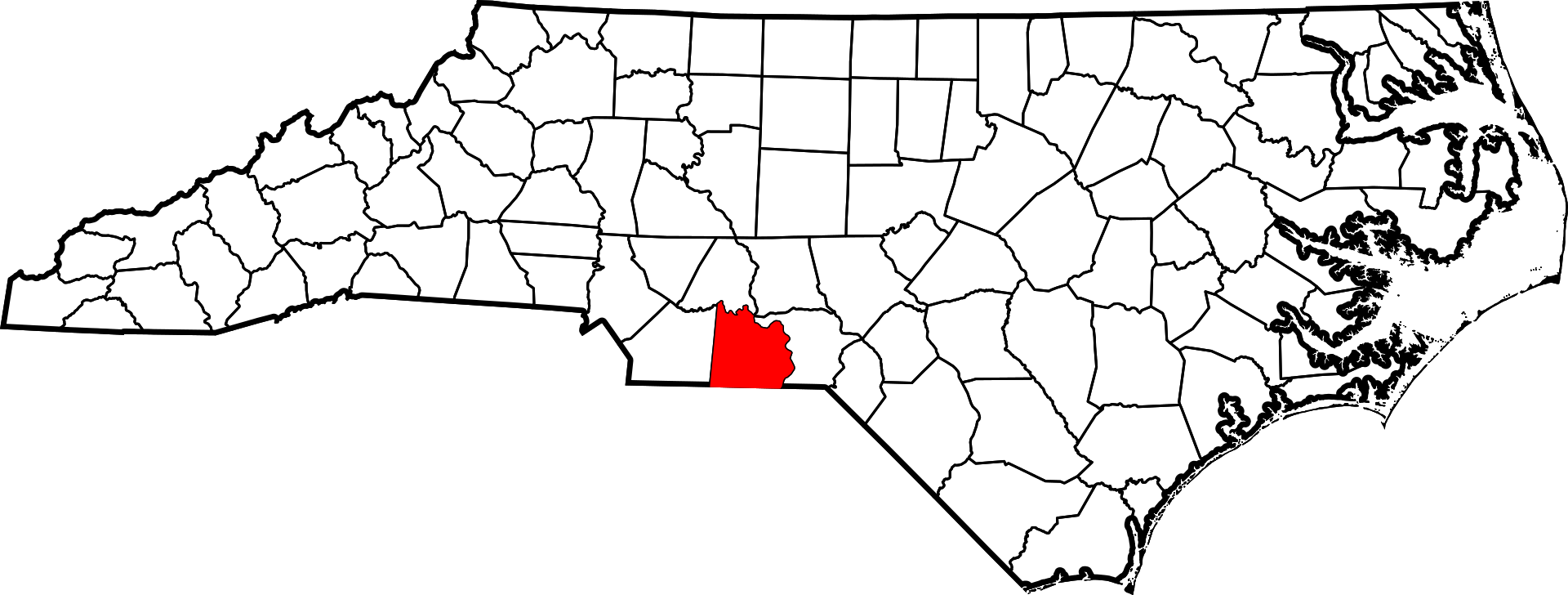
Anson_County_North_Carolina

Anson County, North Carolina; Wikipedia, Public Domain. At the time of the birth of Isaac Hall in 1776, Anson County encompassed portions of several surrounding counties.

Although little is known about Isaac Hall’s early years in Anson County, North Carolina, I managed to uncover his affidavit for the Revolutionary War pension of one John Hall, who, like Isaac, also migrated from North Carolina to Illinois with a stopover in Tennessee. When called upon to provide an affidavit in 1847, Isaac, then seventy-one, recalled John’s return from the army “with his camp clothing on to wit a black ragged and greedy garment.”5 He also stated that he was present at John’s marriage, which took place around 1784.6 Both of these events occurred when Isaac was still a child, leading me to believe that the shared Hall surname between the men was no coincidence—surely they were related in some way, whether John was Isaac’s older brother, uncle, or perhaps a cousin. I was intrigued to see that a descendant of the same John Hall appeared as a match on Family Tree DNA, but at that point still wasn’t quite sure what to do with so much new information.

It was timely, then, when in February I learned that I was to be the recipient of a DNA analysis by Legacy Tree Genealogists, a prize generously provided for the Salt Lake Institute of Genealogy’s 2016 Tagline Contest. (I had shared that SLIG was “the perfect way to kick off the year on a genealogical high note,” and in more ways than one, it certainly was!) It took me no time at all to decide that the Hall family DNA would be ideal for the analysis, and the project was undertaken by genetic genealogist Paul Woodbury.

From the completed report, which I could hardly wait to receive, I was introduced to the concept of STRs, or “short tandem repeats,” a type of genetic mutation. According to the report, “Occasional mutations that are introduced in the Y-DNA help to distinguish different lineages, some of which are ethnically and geographically specific.”7 It was noted that my cousin’s DNA sample might share a mutation in particular with several other Hall DNA samples, suggesting a potential recent common ancestor who might be uncovered through recommended further, higher-level testing.8 In addition, by reviewing the lines of descent of other matches, Hall family roots in the Carolinas were confirmed along with suggested distant origins in the British Isles.9

The report also included a review of key matches and further suggestions to pursue the identity of the father of Isaac Hall.10 With so many new ideas and leads to follow, I look forward to learning more about how best to interpret and apply this wealth of information to the Hall family while attending the Southern California Genealogical Society Jamboree this week!

Copyright © 2016 Melanie Frick. All Rights Reserved.

Continue reading
A Visit to an Alsatian Village

I can never forget the moment when I knocked at the door of a home in a small French village, a copy of my family tree chart in my hands as I stammered the phrase, “Bonjour. L’histoire de ma famille! to the startled teenage girl who answered. Thankfully, before long, with our fathers by our side—her father just so happened to be the mayor of Sondersdorf, Haut-Rhin, Alsace, France—we managed to reach a mutual understanding of the fact that my father and I had ancestral roots in this village and would love to take a peek at the old records.

Sondersdorf_2006_02

Sondersdorf, Haut-Rhin, Alsace, France photograph, 2006; privately held by Melanie Frick, 2016.

This was ten years ago, when I first traveled to Europe. Along with a few days spent in Paris and the ancestral village of my mother’s German grandfather, we also paid a visit to the charming Alsace region of northeastern France where my father’s great-great-grandfather had lived and served in the Franco-Prussian War.

Joseph Lutz, the son of Francois Joseph Lutz and Switzerland-native Marguerite Meister, was born 31 May 1844 in Sondersdorf, Haut Rhin, Alsace, France.1 In his mid-twenties when the Franco-Prussian War of 1870-71 broke out, family lore states that Joseph served and was injured.2 Following the war and its German victory, the residents of the newly annexed region of Alsace were informed that they could remain French citizens by removing to France by the fall of 1872, or they could stay in their homes and default to German citizenship.3 Joseph’s parents, who were over seventy by this time, apparently opted to stay in Sondersdorf; a move to French territory may well have proven to have been a great hardship, no matter if they would have preferred to remain French.4 In any case, it was said that Joseph did not wish to live under German rule.5 Thus, at the age of twenty-eight, he left Sondersdorf for America, where he settled in Faribault County, Minnesota, near other relatives.6

Sondersdorf_Cemetery_2006

Sondersdorf, Haut-Rhin, Alsace, France photograph, 2006; privately held by Melanie Frick, 2016.

It was a treat to see Sondersdorf, although it was not quite the rugged and rocky village that my father had long envisioned. Although in a mountainous area with the snow-capped Alps within view, Sondersdorf boasted a tidy village situated among rolling green fields. We enjoyed exploring a beautiful old cemetery, where the Lutz surname was prominent, and paid a visit to the village church. If I recall correctly, it was a local who called down an inquisitive greeting from a shutter-framed window who directed us to the mayor’s home for our genealogical questions. After becoming acquainted with the mayor and his daughter in a mix of broken English, French, and German, we made plans to meet the next day to see the old vital records held in the local school building.

Ferrette_2006

Ferrette, Haut-Rhin, Alsace, France photograph, 2006; privately held by Melanie Frick, 2016.

We were treated equally well by the people of Ferrette, a larger village nearby, where we stayed the night. Hearty Alsatian meals and investigating the crumbling castle ruins on its picturesque hillside kept us well entertained until it was time to return to Sondersdorf. There, we met again with the mayor, who allowed us to page through the centuries-old record books, brown ink faded on the pages. Although we didn’t conduct in-depth research, not wanting to take advantage of the mayor’s time, it was incredible to see so many family names recorded in their original form. Upon our departure, the mayor kindly presented me with a book about the history of the churches of the region, in which he inscribed the date and the place—much as Joseph Lutz had inscribed his prayerbook upon his departure from Sondersdorf, long ago.

Copyright © 2016 Melanie Frick. All Rights Reserved.
Continue reading

Fun on the Farm

Farm kids have long learned to make their own fun, and Frances Marie Noehl of Deerfield, Chickasaw County, Iowa was no exception. Pictured here circa 1920, Frances is grinning as she sits on a wooden cart pulled by her dog, Shep. If his expression can be interpreted, he appears to have been game to take part in the shenanigans of Frances and her siblings: Leo, Helen, Kathryn, Elinor, John, Al, Frank, and Joe. Frances, born in the spring of 1911, fell between Frank and Joe in age as the second-to-youngest of the nine children of German immigrants Mathias and Elizabeth (Hoffman) Noehl.

Noehl_Frances_Shep_c1920_Iowa

Frances Marie Noehl with Shep, Chickasaw County, Iowa, circa 1920; digital image 2015, privately held by Valene Petersen, 2016.

Although the Noehls were not prosperous and bounced around from farm to farm while their children were young, the available recollections of their children indicate that plenty of fun was to be found in the country—after chores, of course. Following brief, unsuccessful stints in Canada and Minnesota around the turn of the century, the Noehls returned to Chickasaw County where they rented a farm near New Hampton.1 As a small child, Frances’s brother John, who was seven years her senior, could apparently often be found in the maple grove, contentedly sipping sweet sap from a tin cup under the watchful eye of another beloved dog, Sultan.2

Next, the family moved to an acreage in the town of North Washington, where the older children attended Catholic school and learned English for the first time.3 After three years there, the man who owned their property offered them a chance to rent out his farm in Deerfield, near the community of Alta Vista.4 John recalled his mother’s happiness as they prepared to resume farm life, teaching him to sing, “For to plow / For to mow / For to reap / For to sow / For to be a farmer’s boy.”5 It was now around 1910, and the family would remain on this farm for years to come. Aside from playtime with the family dog, rumor has it that Frances and her siblings also liked to have spitting contests while perched in the hayloft.6

With her bobbed haircut and loose-fitting, short-sleeved cotton dress, complete with a tie about the neck à la a sailor suit, Frances looks every bit an energetic 1920s tween.7 Her worn leather shoes appear to be barely staying on her feet and she sits relaxed with one bare (or stockinged) leg folded underneath. A massive barn with a stone foundation is visible behind her. This informal snapshot was likely taken by a family member, although since I have seen very few photographs of the Noehl family in general, I wonder if photography may have been only a passing hobby. In any case, it’s a pleasure to have a rare glimpse into a long-ago childhood.

Copyright © 2016 Melanie Frick. All Rights Reserved.
Continue reading
The Relinquished Homestead

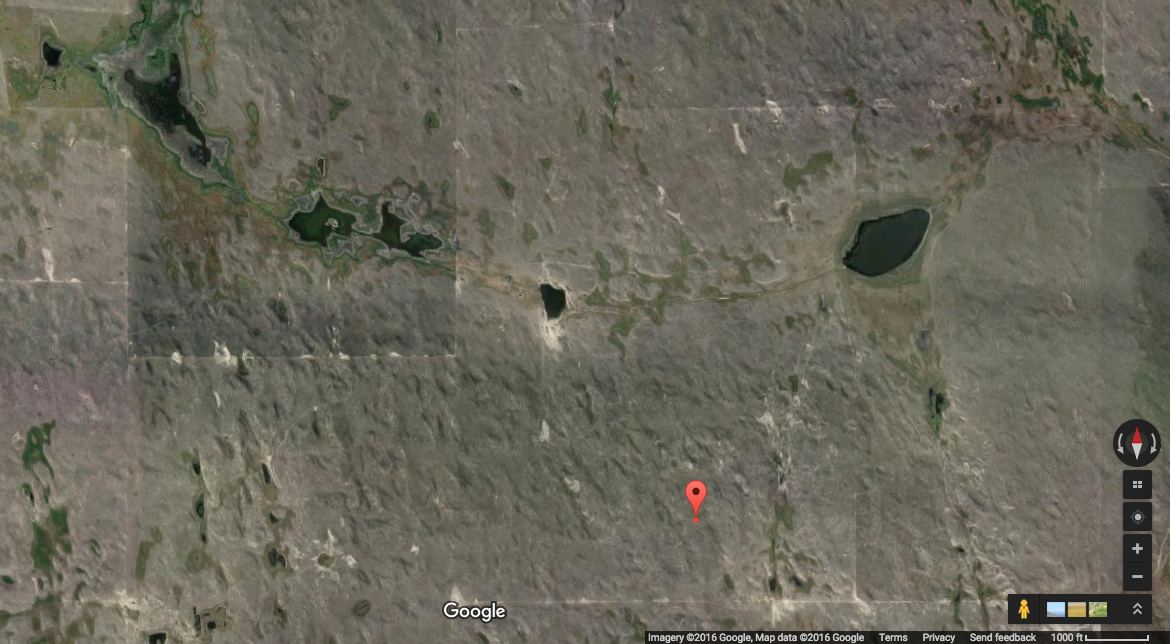
Not all homesteaders made it. As far as I know, George Hiram Thoma was the last of my direct ancestors to stake a claim, which he did in western Nebraska on a February day in 1909. George and his brother-in-law Clare Eugene Gibson arrived together at the land office in Valentine in order to pay their respective filing fees; each was granted about six hundred acres of land on adjoining claims in the desolate Sandhills of nearby Rock County, Nebraska.1 While earlier claims under the Homestead Act of 1862 allowed each individual only one hundred and sixty acres, later amendments granted settlers more land in certain areas where, for example, the soil and climate might be less conducive to raising crops. The Kincaid Act of 1904 applied specifically to thirty-seven counties in northwestern Nebraska that contained non-irrigable land.2

Screen Shot 2016-02-29 at 1.12.48 PM

Google Earth certainly doesn’t make this part of the country look particularly inviting, and life there may have been even more difficult than expected. The homesteads were located more than twenty miles from the nearest town of Bassett, and the families had likely never experienced such isolation. However, Clare Gibson, along with his wife, Alpha, and their four children, Bernice, Pauline, James, and Florence, stuck it out; his homestead was patented in February 1913,3 and the Gibson family remained there for years to come.4

George Thoma and his wife Leota, on the other hand, lasted only a little more than a year. On 4 May 1910, George relinquished his homestead,5 acknowledging defeat and, apparently, accommodating his wife’s wishes to leave an area that his daughter later described as “all sand, horrible, no trees.”6 To make matters worse, there were rattlesnakes, and with a rambunctious six-year-old son, Fenton, and a two-year-old daughter, Fern, to keep safe, this was perhaps more than the couple had bargained for. They cut their losses, bade farewell to Clare and Alpha—sisters Alpha and Leota would never again have the opportunity to live as neighbors—and moved to town.7

Thoma_George_Homestead_01

George H. Thoma (Rock County) homestead file, case no. 1383, Valentine, Nebraska, Land Office; Serialized Land Entry Case Files That Were Canceled, Relinquished, or Rejected, ca. 1909-ca. 1918; Records of the Bureau of Land Management, Record Group 49; National Archives at Kansas City.

I may never have come across this record had I not attended the course “Advanced Research Tools: Land Records” at the Salt Lake Institute of Genealogy. [Read about my experience HERE.] It was there that I learned about tract books, bound volumes maintained by the Bureau of Land Management that faithfully recorded the filing of all land transactions—including claims that were later canceled, relinquished, or rejected. These claims cannot be found indexed at the Bureau of Land Management, typically my go-to resource for locating land records. Fortunately, however, the United States Bureau of Land Management Tract Books are available online at FamilySearch, and a handy Tract Books Coverage Table makes it possible to navigate the unindexed record images.

While I knew my great-grandmother had said that her father had homesteaded near Bassett, Nebraska, when no final patent could be found on the Bureau of Land Management’s database, I initially came to the conclusion that he must not have actually homesteaded there. Perhaps the family had lived with relatives or rented a farm during their brief time in Bassett, I thought. After all, my grandmother was only a toddler at the time, so her recollections might well have been dim. Well, as it turns out, George Hiram Thoma did indeed have his very own homestead, albeit briefly, and as a bit of a research bonus, the federal records that this homestead created mark the conclusion of his mysterious use of an alias.

Copyright © 2016 Melanie Frick. All Rights Reserved.
Continue reading

A Sioux City Streetcar

One might not expect that a community in Iowa was the first in the world to have an electric-powered elevated streetcar system, but in the early 1890s, Sioux City blazed that trail.1 It was already the third city in the United States—after New York and Kansas City—to host a non-electric elevated streetcar system, and for years to come, streetcars served to connect its far-flung neighborhoods, offering a convenient and affordable transportation option to its citizens.2

Henry_Adam_Streetcar

Henry Joseph Adam, center, Sioux City, Iowa, circa 1903-07; digital image 2010, privately held by Melanie Frick, 2016.

As a newlywed in his mid-twenties, Henry Joseph Adam of Sioux City, Woodbury County, Iowa worked as a conductor for the Sioux City Rapid Transit Company, also known as the Sioux City Service Company.3 This photograph, dated circa 1903-07, shows him in uniform, his suit rather baggy on his slight frame and a cap atop his head. Half a dozen men and women pictured behind him are in the process of boarding the streetcar, while three men at the front seem to be investigating an issue with either the tracks or the car itself. As this seems an unlikely place for passengers to board the car, suspended as they were over the Floyd River, I suspect there was a problem with the streetcar and the passengers had temporarily disembarked, an inconvenience on such a chilly day. That might also explain the occasion for the photograph; the original, mounted on a large piece of cardboard, looks as though it could be a copy of a local press photograph.

Just a few years before, Henry’s parents had had an unfortunate encounter with Sioux City’s elevated streetcars. In the summer of 1896, the Sioux City Journal reported:

Yesterday afternoon Timothy Adams and wife, of Moville, were about to cross the track of the elevated railway at Hedges station, Morning Side, when they met with a severe accident. They were driving a team to a light wagon, and as the electric car approached the horses became frightened. The tongue of the wagon broke and stuck into the ground, throwing Mrs. Adams violently over the dash board. The wheels passed over her, but when Dr. Brown was called it was found she was not much hurt and that no bones were broken.4

Seriously injured or not, Henry’s mother filed a suit against the Sioux City Rapid Transit Company and received one hundred and twenty-five dollars.5 Little could she have known that her son would soon become their employee, and, fortunately for Henry, if this incident was recalled, it must not have been held against him! He was employed there for only a few years, between approximately 1903-07, and spent the rest of his life as a carpenter. In the above photograph, he is working the route from East 4th and College to Greenville, which necessitated crossing the Floyd River on an elevated track.6

As for the streetcars of Sioux City, they peaked in 1933 with around forty-five miles of track that traversed multiple neighborhoods and even crossed the state line into South Sioux City, Nebraska.7 By the 1940s, however, with the introduction of a more-flexible bus system, streetcars quickly became obsolete, and after sixty years of service to the community, operations ceased in 1948.8

Copyright © 2016 Melanie Frick. All Rights Reserved.

Continue reading